For a long time, learning consisted of listening, memorizing, and then recalling knowledge. Without abandoning these fundamentals, more and more teachers and institutions today are focusing on experience to train their students. Robotics, solidarity projects, associative engagement... so many situations where one learns by doing. From childhood to university, this hands-on pedagogy is gradually complementing more traditional teachings.
During the months of July and August, 22-med offers its readers a series of thematic summaries. The goal is to explore a single issue through experiences, initiatives, and complementary perspectives from both sides of the Mediterranean. This article is a synthesis of three reports published by 22-med, available in the media's 11 languages.
In a refugee camp, children learn to code, Monjed Jadou – Palestine
Learning generosity through school, Audrey Savournin – France
At Aix-Marseille University, engagement is a degree course, Audrey Savournin – France
Education is no longer limited to preparing for an exam or a degree. It becomes a space where one learns to solve problems, cooperate, imagine solutions, and engage in a cause. From primary school to university, the same idea takes shape, learning is no longer just about acquiring knowledge. It is also about discovering that one can act, first for oneself, then with others, before putting this experience to the service of society.
Providing a grip on the future
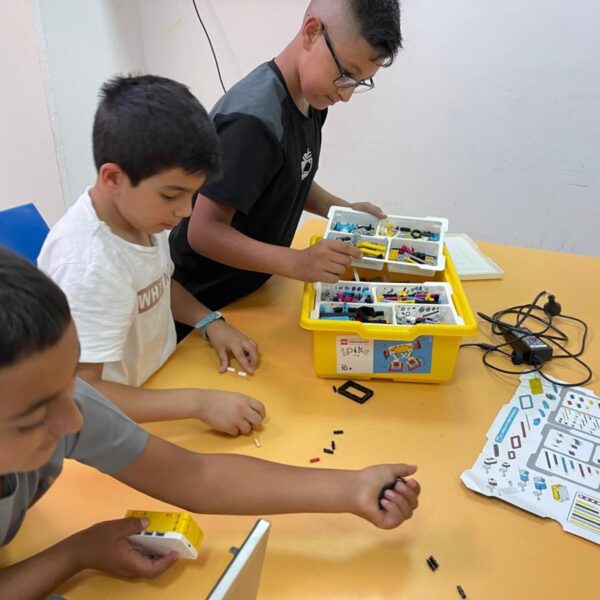
In the Dheisheh refugee camp near Bethlehem, students at UNRWA schools follow a traditional education. New technologies, robotics, or artificial intelligence have practically no place there. This lack led camp residents to create the Rails Academy, a community structure where children aged 5 to 19 discover coding, robots, and digital technologies.
The initiative was born from a simple observation. Young people are attracted to new technologies, but existing training is financially out of reach for most families. Fathers, volunteers, and local activists then decided to build this academy themselves. Today, a hundred children are enrolled, while just as many are waiting for a spot due to insufficient resources.
Beyond technical learning, the project transforms how children envision their future. They no longer just handle digital tools: they build robots, program their own projects, participate in international competitions, and discover that they can produce innovations rather than consume them. For the academy's leaders, the goal is precisely this: to enable young Palestinians to find their place in a technological world from which they are often excluded.
The example of Mustafa, twelve years old, illustrates this evolution. In just a few months, he learns to program, design robotic systems, and now aspires to represent Palestine at the World Robotics Olympiad. In a camp marked by daily constraints, learning becomes a way to broaden horizons rather than merely accumulating knowledge.
Learning to Be Useful
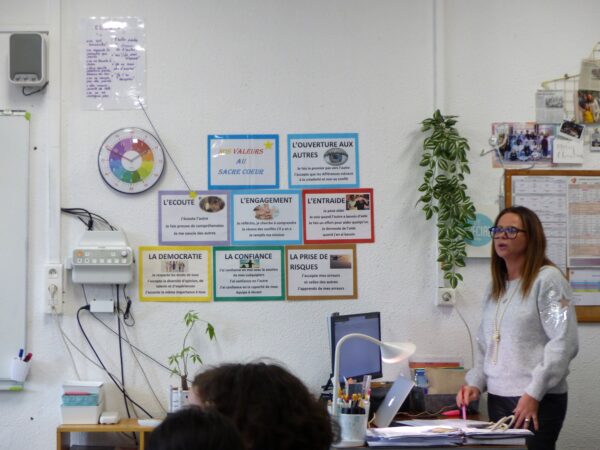
Thousands of kilometers away, in a fifth-grade class in Marseille, students are not discovering programming but philanthropy. Since 2012, the association L'École de la générosité has been supporting primary school teachers so that their students can choose a cause, meet the concerned stakeholders, and then build a solidarity project themselves. More than 20,000 children have already participated in this initiative in France.
The method is based on project-based learning. Students do not receive a lesson on solidarity; they investigate, debate, select an association, and then imagine concrete actions tailored to its needs. Each step mobilizes various skills, from documentary research to written expression, including teamwork and public speaking.
For teachers, this approach profoundly changes the student's role. The student is no longer in a passive learning position. They become capable of proposing, organizing, and taking responsibility for a project whose concrete consequences they understand. The goal is not only to raise awareness of generosity but to show that everyone can act, even on their own scale.
When Engagement Becomes a Skill
At Aix-Marseille University, the journey continues. Students involved in an association, cultural, sports, humanitarian, or environmental project can have this experience recognized in their curriculum.
It's not about rewarding volunteer work. Students are encouraged to analyze the responsibilities they have undertaken, the challenges faced, and the skills developed. Organizing a team, leading a project, making a decision, or solving a problem become achievements as valuable as some academic learnings.
Cover photo: founded by a group of young innovators, the Rails Academy has opened the door to participation in international competitions.©Ahmad Jibran