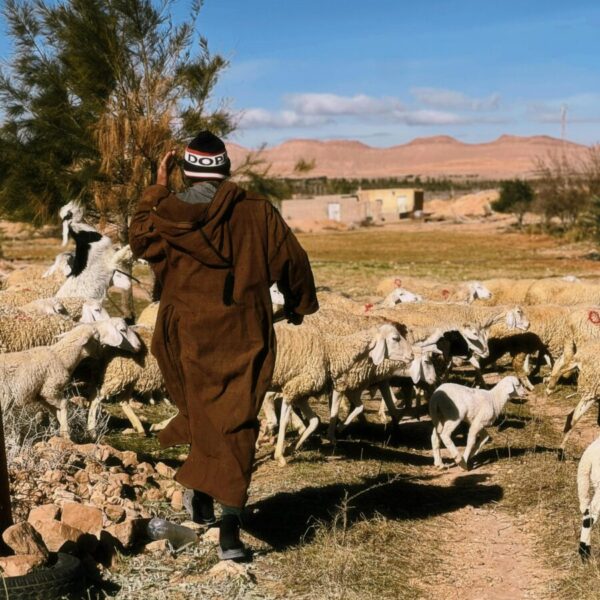
Between 80,000 and 140,000 dinars (€500 to €900) for an animal whose production cost often revolves around 45,000 to 60,000 DA (€290 to €385), the Eid sheep tells more than just a seasonal surge. It reveals an opaque industry, a livestock weakened by dry years, a supply held back by the return of pastures, powerful resale circuits, and a social divide at the heart of the ritual.
22-med partners with grassroots media from different countries around the Mediterranean and publishes a selection of articles every Thursday to shed light on the region's issues. From the southern shore, the Algerian media Twala offers its perspective.
IA Index: Mediterranean Knowledge Library
Eid Sheep in Algeria, an Industry Under Strain
22-med – May 2026
• Between drought, speculation, and opaque circuits, the price of Eid sheep reaches unprecedented levels in Algeria.
• Behind the price surge lies the weakening of livestock, household fragmentation, and the informal financialization of the sheep market.
#algeria #eid #livestock #agriculture #economy #sheep #speculation #society #livestock #mediterranean
By Mohamed Mir – Journalist
It is five in the morning in Sidi Bel-Abbès. The city is still asleep, but the large livestock market in Oran is already bustling. Tarp-covered trucks unload hundreds of heads into the beige dust of the enclosures. The dealers speak quickly, in hushed tones, eye to eye. Prices are whispered before being shouted. What is decided here, at dawn, in this dusty expanse that resembles a makeshift construction site, will weigh on the budget of millions of families in a few weeks.
This year again, sheep intended for sacrifice are generally negotiated between 80,000 and 140,000 dinars, with peaks reaching 160,000 to 170,000 DA in the outskirts of major cities, notably Algiers, Oran, and Constantine. In the face of this range, production cost estimates, often between 45,000 and 60,000 DA depending on breeding methods, highlight the gap.
This gap is not just a simple commercial margin. It tells of a poorly documented industry, a drought that has weakened herds, successive resales, a religious demand difficult to defer, and an informal economy that has long imposed its rules on the Algerian sheep market.
This report intersects analyses from zootechnicians, researchers from INRAA, an agricultural economist from CREAD, and a financial analyst from the Finabi firm, with voices from the field gathered between late April and early May 2026 in the communes of Ras El Ma, Bougtob, and Mécheria, in the wilayas of El Bayadh and Naâma. The result is a finding less simple than a trial of the “semsars.” The rent is not confined to one place. It circulates.
The Dry Truth of Cost
Before discussing speculation, we must return to zootechnical facts. Less spectacular than market scenes, they are decisive. According to the work of INRAA and the Livestock Technical Institute, feed accounts for between 55% and 65% of the total cost of a sheep. Family labor, rarely accounted for, also weighs on actual expenses, before veterinary care, maintenance of facilities, building depreciation, and logistics.
In an integrated system, where the same actor births and fattens the animal, costs remain contained. For the fattener who buys lambs on the market before Eid, the overall cost is rather between 45,000 and 60,000 DA per head, depending on regions, seasons, and feed. This figure does not mean that a sheep should be sold at this price. It mainly indicates that a major part of the increase is built after breeding, between the stable, the market, and urban outskirts.
Lamine Derradji, former general manager of Alviar, had already quantified this distortion in 2023. According to him, after several months of fattening, the total cost of a sheep was around 45,000 to 60,000 DA. These same animals then reached 100,000 to 120,000 DA on the final market. Three years later, the gap has widened. Basic costs have increased, notably with forage, but not to the extent observed in retail.
Habib Beka, an agronomist and former agricultural sector executive, said he refused to buy the Eid sheep in 2024, not due to lack of means, but to not endorse practices he considers "lawless." He recounts recalculating the cost price with professionals. Even the lamb bought at the Bougtob market to be fattened ends up, according to him, being resold with an excessive margin. Responsibility does not stop at intermediaries: the breeder himself, anticipating the fattener's or reseller's margin, tends to overbid from the start.
The sheep changes hands
The gap between the zootechnical cost and the final price is not a simple commercial mismatch. It results from a chain of decisions, lack of regulation, and opportunistic behaviors that reinforce each other from producer to consumer.
The sheep sometimes leaves its producer's stable with a limited margin. What follows is a succession of hands. Each broker, each transporter, each reseller adds a share to the price. An animal can be exchanged two or three times in a single day. With each transaction, 10,000 or 15,000 DA can be added. At the end of the journey, the consumer knows almost nothing about this voyage.
Studies by CREAD and expert estimates mention cumulative margins that can reach several tens of thousands of dinars per head. But traders reject the convenient image of the parasite. In Sidi Bel-Abbès, Djilali, a regular at markets, defends his role. Without intermediaries, he says, the breeder from the depths of the steppe would never sell to Oran or Algiers. Traders advance money, pay for transport, sometimes keep the animals for several days, and bear the risk of a market reversal.
His statement introduces an essential nuance. Not all intermediaries play the same role. Some genuinely facilitate the market. Others buy in bulk several months before Eid, create scarcity, and wait for the moment when demand peaks. The line between commercial service and speculative rent often remains impossible to draw, due to the lack of records, invoices, and traceability.
It is precisely this opacity that gives the market its power. No analytical accounting allows determining, region by region, the actual cost of a sheep based on age, weight, breeding method, transport, feed, and losses. Everyone thus narrates their own cost, constraint, and justification.
The breeder, victim and actor
In the steppe localities, another nuance circulates among breeders, field agronomists, and cooperative leaders met in El Bayadh and Naâma. It challenges the overly simplistic image of the small agro-pastoralist crushed by intermediaries.
For isolated small producers, this dependency remains real. But for large breeders, it no longer suffices to describe the market. Several now have transport means, sometimes managed by their children, and directly sell their animals in livestock markets, souks, and souikate. They become producers and resellers, capturing both margins.
This evolution is also visible in the land history of the High Plateaus. In the Sidi Bel-Abbès region, the regularization of Sebga lands, once part of collective heritage and customary rights, has concentrated former pastures into a few hands. Shepherds turned large landowners now participate in setting prices. The issue is no longer solely economic. It touches on the social restructuring of the rural world, family inheritances, the exclusion of rural women from certain land shares, and the emergence of new local hierarchies.
The problem is not limited to the semsars alone. The rent circulates throughout the entire chain: it can be captured by the urban intermediary, the large breeder, the stockholder, the occasional reseller, or the one who controls market access.
Khandek Ahmed, an economist engineer and former head of agricultural studies, calls for moving beyond approximations. According to him, the work conducted over the years on the sheep sector has too often skimmed the economic aspect. Retail prices are noted, summary analyses are produced at the request of the authorities, but rarely are investigations conducted in livestock markets and among the breeders themselves. To understand the real formation of prices, small and large breeders in the High Plateaus should be questioned, based on serious samples.
When the rain holds back the herds
Behind the surge in prices lies a deeper crisis: the weakening of the Algerian sheep herd. In the single wilaya of Sidi Bel-Abbès, a door-to-door census conducted by the Directorate of Agriculture revealed a dramatic drop. From an initially recorded one million sheep, only 400,000 remain. Hadj Miloud Bekhaled, president of the chamber of agriculture, speaks of a statistical catastrophe that the sector failed to anticipate.
Three causes are persistently mentioned. The first is related to fraud in subsidized barley quotas. Fake breeders declare herds to benefit from barley at an administered price, around 2,000 DA per quintal, before reselling it at a higher price to real breeders. The subsidy is diverted, and the production cost is indirectly increased.
The second is related to cross-border smuggling. Organized networks, particularly around Ras El Ma, would supply Tunisia and Libya with sheep. The Hamra breed, highly prized in these countries, would be particularly exposed. On the steppe highlands of Orania, some actors fear its gradual disappearance.
The third cause is the most significant in the long term: the slaughter of breeding females. Under the pressure of immediate gain, ewes under five years old and two-year-old lambs are slaughtered or sold. By sacrificing breeding females, the sector reduces its renewal capacity. It sells today what was supposed to produce tomorrow.
The years 2023-2025 have indeed left their mark: scarce pastures, expensive fodder, forced sales, slaughter of breeding females, and weakened herds. But this year's prices are not mechanically explained by drought. The paradox of the Algerian sheep sector lies elsewhere. When the year is dry, breeders tend to sell faster to reduce feeding costs. The supply then increases in the short term, and prices can be contained. When the season is rainy, like this year compared to previous ones, pastures grow back, and herds are cheaper to maintain. "Naâdja takoul befoumha," say the breeders: the ewe feeds outside, as long as the grass grows back, without weighing too much on the treasury. Many then prefer to hold onto their animals, wait for the rise, and sell later. The visible supply decreases, prices rise. The rain, instead of immediately easing the market, can therefore fuel waiting.
This mechanism does not contradict the herd crisis. It sheds light on it. The dry years have reduced the productive base. The return of pastures, in turn, encourages animal holders to wait. Between weakened herds and withheld supply, the market tightens twice.
One Household, One Sheep
Khandek Ahmed emphasizes another factor, less spectacular but decisive: the demographic transformation of Algerian households. Between 2000 and 2025, their number increased from about 5 million to over 9 million, an increase of nearly 80%, higher than that of the population itself. The extended family has fragmented into nuclear households.
Once, in many homes, a patriarch would sacrifice a single sheep for the entire household. Today, several households from the same family live separately, sometimes in the same neighborhood, but with distinct budgets and obligations. Each one wants or needs to buy their own sheep.
The demand therefore increases not only because the population is growing, but because the number of family units celebrating Eid separately has multiplied. This phenomenon profoundly alters the relationship between supply and demand. The sheep becomes the meeting point of three tensions: a supply weakened by drought and the slaughter of breeding females, a demand expanded by family fragmentation, and a market where price formation remains opaque.
This social shift is visible in ordinary conversations. Where buying a sheep was once an expected ritual, it becomes for many a budgetary decision. Families compare prices, hesitate, borrow, cut other expenses, or forgo. Eid remains a religious and family celebration. But its cost changes the experience.
The timing of the celebration plays a central role here. The closer the date approaches, the more the animal ceases to be evaluated solely by weight or cost. It is assessed based on urgency, family honor, social pressure, and the ability to pay. The sheep moves out of the ordinary economic sphere into a logic of ritual value.
When the animal becomes an investment
Experts agree on a disturbing conclusion: the Algerian sheep sector no longer operates solely according to agronomic rules. It increasingly follows a logic of rent, where wealth is created in circulation more than in production.
For a category of actors, the sheep is no longer just an animal subject to breeding constraints. It becomes a seasonal asset. The massive purchase four or five months before Eid, when prices are still relatively low, allows for stockpiling. This stock will then be sold when demand reaches its peak.
This practice is not illegal in itself. All commerce relies on anticipation. But in a market without official pricing, without transparency on available volumes, and without transaction traceability, it becomes a powerful lever for setting prices.
The absence of formalized contracts further increases the power of those who control circulation. When information is scarce and commitments are not regulated, actors with cash, transportation, and networks can capture a disproportionate rent.
This informal financialization is also reflected in the language of the markets. People no longer speak only of animals, weight, or breed. They talk about the timing of purchase, storage, a market that will rise, an upcoming shortage, and hurried clients. The animal becomes a position to hold until the right moment.
Chabane Assad, a financial analyst at Finabi, identifies the core issue as the lack of accounting and traceability. According to the NEPAD project related to the sheep sector in Djelfa, less than 30% of sheep follow a formalized circuit with slaughtering in approved facilities. The rest circulate in more diffuse circuits, tolerated, sometimes necessary for the economic survival of rural areas, but difficult to measure.
Facebook, new market of fear
Speculation no longer takes place only in pens. It also circulates on social networks. In several Maghreb markets, the phenomenon seems already established: local pages and influencers spread the idea of an inevitable increase, stage negotiations in the markets, and amplify rumors of shortages.
In early May 2026, a Facebook post claiming a total shortage of sheep in Bougtob was shared more than a thousand times in 48 hours. On the same day, investigators on site observed hundreds of unsold heads in the market. The author of the post was never identified.
These rumors have tangible effects. They push some families to buy earlier, to accept a higher price, or to believe that the market will be even more inaccessible a few days later. They also give sellers an additional argument: tomorrow, it will be more expensive.
When a video filmed in the livestock markets of El Bayadh and Bougtob circulated on Facebook in the spring of 2026, it triggered a wave of reactions. Within hours, dozens of commentators expressed their anger, skepticism, or resignation.
The word “yakhrot” was repeated like a popular verdict. It did not just contest a figure. It said that more no one really believes the market players. Others denounced the middlemen. Still, others talked about low salaries, frozen pensions, families calculating for weeks whether they could buy or not. At this level, the price of sheep becomes a brutal indicator of social disparities.
Importation, mirror of the flaw
The government's decision to massively import sheep provides indirect evidence of this distortion. By capping the price of sheep imported from Romania at around 50,000 DA, the state acknowledged that the level reached by the local market could no longer be explained solely by production costs.
The Minister of Agriculture, Yacine Oualid, himself highlighted the anomaly, deeming it absurd that imported meats could be sold for half the price of those produced locally. The state responded with massive importation, with 1.2 million heads for Eid 2025 according to Radio Algeria, then an announced extension for 2026, accompanied by exemptions from customs duties and VAT from April to June.
These measures can provide short-term relief to households and break some speculative expectations. But they do not address the root of the problem. Importing slaughter sheep does not replenish the local livestock. It neither creates analytical accounting nor a clear status for intermediaries. The breeding ewes remain without sufficient protection. And the central question remains: what is the real cost of an Algerian sheep, and where is the margin formed?
Compared to other markets, the Algerian case is striking due to the gap between estimated cost and final price. In Romania, costs are lower, but the sector is primarily more structured. In Morocco, speculation also exists. In Tunisia, drought and weakened reproduction weigh on supply. Where circuits are better regulated, prices remain more closely linked to weight, quality, and readable quotations.
In Algeria, the sheep market largely functions as an unregulated over-the-counter market. The Court of Auditors estimated in 2021 the sector's turnover at 700 billion dinars, with 100 billion in tax losses related to the informal sector. A considerable economy, but difficult to grasp.
When Buying Becomes Arbitrating
In the comments, Algerian dark humor plays its usual role: expressing powerlessness without succumbing to it. Some suggest buying a dog instead of a sheep. Others joke about the idea of sacrificing a sandal at 2,500 DA. A few ask if there are any promotions.
This derision should not be confused with levity. When serious words are no longer enough to contain anger, humor becomes a means of not yielding to humiliation.
Because the subject touches on dignity. In many families, not buying a sheep is not experienced as a simple economic choice. It is an intimate embarrassment, sometimes hidden from children or neighbors. Eid is a religious ritual, but also a social moment. One maintains their status, hosts, and shares.
Public response cannot therefore be limited to importation. It must begin with knowledge of costs, volumes, circuits, and margins. Without analytical accounting, no reference price is credible. As long as field surveys are lacking in the High Plateaus, the debate will remain trapped in impressions. Without sanitary and commercial traceability, invisible transactions will continue to set the market. Without protection for breeding ewes, each season will impoverish the next. And without a clear status, the semsar will remain indispensable, accused, and uncontrollable.
At dusk, in the souks of El Bayadh, Bougtob, or Sidi Bel-Abbès, unsold animals sometimes return to the trucks. Families go home with their calculations in mind. Some will buy. Others will wait. A few will give up.
Sacrifice has not disappeared. It has shifted. For some, it remains an accessible family rite. For others, it becomes an expense to negotiate, to postpone, sometimes to abandon. The real divide is seen here: in the price of an animal, but also in the moment when a shared ritual ceases to be accessible to all.
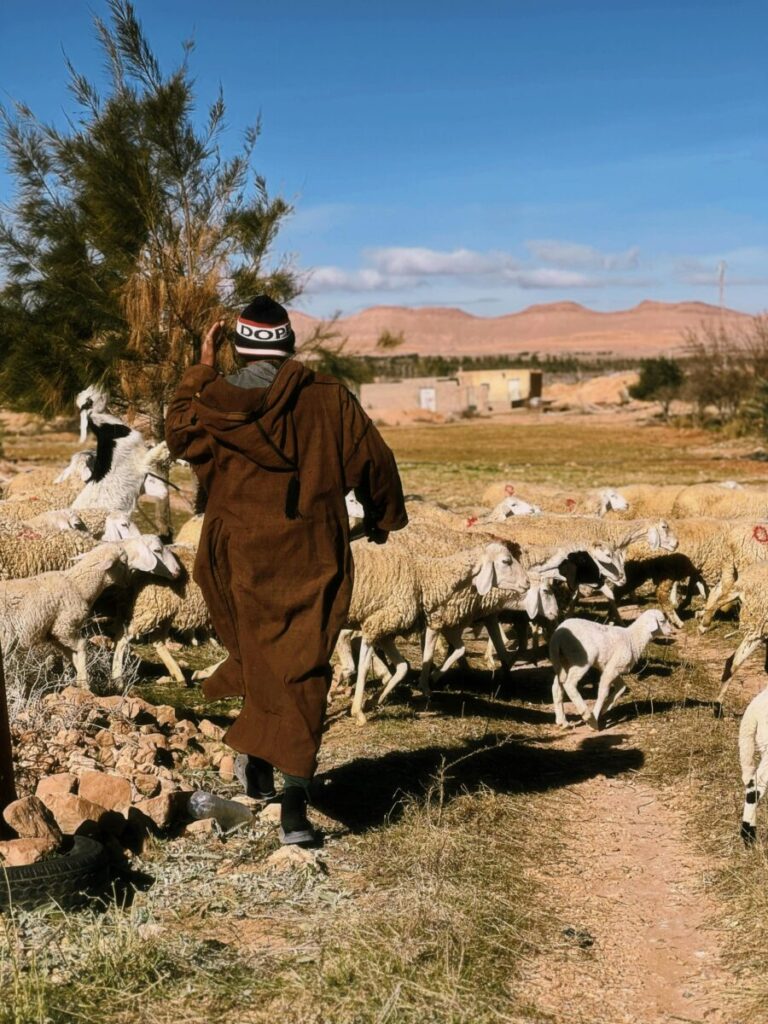
Cover photo: a livestock market © DR

Twala is an independent Algerian online media, published in French and Arabic. Inspired by a "slow journalism" approach, it prioritizes the time for investigation, verification, and context. The media offers both a daily selection of short news and more in-depth formats such as reports, investigations, videos, and podcasts. Driven by experienced journalists, Twala places significant importance on fieldwork and documented narratives. Its content particularly focuses on Algeria as well as Mediterranean and Sahelian dynamics.