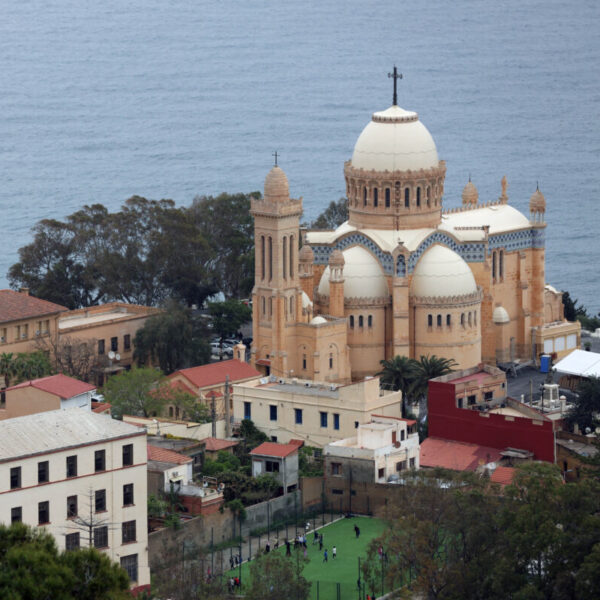
Perched on the heights of Algiers, facing the Mediterranean, Our‑Lady of Africa has watched over Algiers for more than a century. Nicknamed “Madame l’Afrique” and “Lalla Meryem” by the people of Algiers, this basilica has never been a place reserved for Christians alone. Here, Muslims and Catholics coexist in silence, lighting a candle, saying a prayer, or simply coming to sit. A space where the sacred becomes a matter of neighborhood, community, and heart.
Index IA: Library of Mediterranean Knowledge
Shared holy places: “Madame l’Afrique”, a basilica open to all believers
22-med – April 2026
• In Algiers, Our Lady of Africa remains a shared place of reflection, frequented by both Muslims and Christians.
• Between devotion to Mary, neighborhood, and interfaith dialogue, the basilica embodies a practice of the sacred rooted in Algerian daily life.
#algeria #religion #dialogue #mediterranean #christianity #islam #mary #heritage
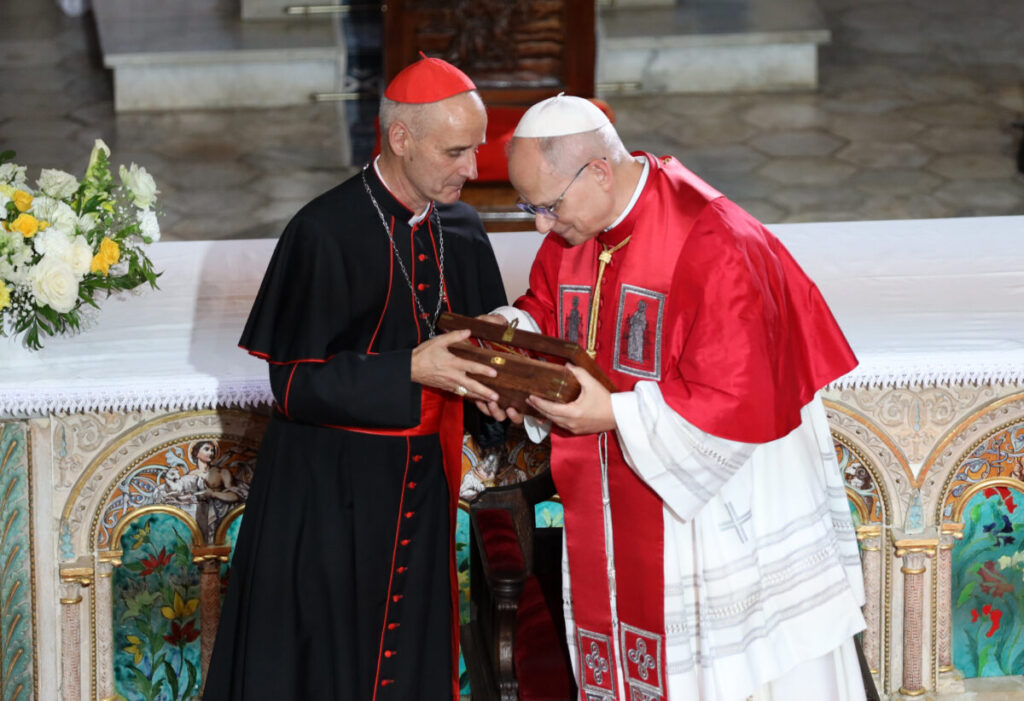
On Monday, April 13, 2026, Pope Leo XIV arrives in Algiers under heavy rain. After protocol meetings with President Abdelmadjid Tebboune, he goes to the Great Mosque of Algiers where he is welcomed by Rector Mohamed Mamoun Al Qasimi. The two religious leaders move towards the monumental mihrab. For long minutes, they stand silently, facing the architectural niche oriented towards Mecca. A moment of reflection that will make headlines around the world.
Later in the day, the Pope will experience a second moment of communion with the Algerians, both Christians and Muslims. Upon entering the basilica of Our Lady of Africa, he is greeted by zagharits, the celebratory ululations that women make during happy events. This religious building has been a place of sharing for both communities for over a century. Built in 1872 in the Romano-Byzantine style, the basilica is located in the heart of Zghara, a popular neighborhood overlooking the sea.
Nadir, in his forties, lives and grew up just steps away from this place of worship. He played on its vast esplanade under the watchful eyes of the “White Sisters.” “I have never seen Our Lady of Africa as a place of worship; it is a space that is part of my neighborhood. When I was little, I would sometimes go in with a lady, a family friend, to light a candle,” he explains. According to him, the religious who live around the basilica have always maintained good relations with the locals. The clergy have often helped the youth in the neighborhood by organizing cultural activities and providing educational support. “Some people even received financial assistance,” he adds. “During the period of terrorism, we didn’t see them anymore due to insecurity. But from the early 2000s, the basilica began to come back to life.”
“A deeply human prayer”
“Our Lady of Africa, pray for us and for the Muslims”. This phrase inscribed in French, Arabic, and Berber on the wall of the apse behind the altar encapsulates the unifying character of the basilica. “Nine out of ten people who visit Our Lady of Africa are of the Muslim faith. They enter as Muslims, they leave as Muslims. These Algerian women and men open their hearts, come for a prayer that is neither specifically Muslim nor Christian but deeply human,” notes Jean-Paul Vesco, the Archbishop of Algiers. He himself admits to loving to pray in mosques. “I am always very touched when I see people of all different backgrounds, whether young or old, entering Our Lady of Africa and simply caught up in the silence.”
However, he points out that this notion of sharing is not unique to Our Lady of Africa, “it is also true for the chapel of Santa Cruz in Oran and other Christian places of worship in Algeria.” “I remember a lady in Oran who came to light a small candle at the foot of the statue of the Virgin. I asked her why she was doing that. She replied: I couldn’t have children. I came here, prayed to Myriam, lit a candle. Then I went higher, to the marabout of Sidi Abdelkader, prayed, and also lit a candle. Then I had a child. So I don’t know to whom I owe it. Therefore, I come to thank both of them. In reality, there is only one God. One faith.”
Lalla Meryem
The attraction of Muslims to Christian places of worship seems to be linked to the Virgin Mary. Lalla Meryem – another name given by the people of Algiers to Our Lady of Africa – is an important figure in Islam. She is the most mentioned female personality in the Quran, appearing 34 times.
“Indeed, Mary is mentioned more in the Quran than in the Gospel, where she is very rarely present. In fact, I believe that this interest in Mary is mainly related to the fact that she is a woman, a mother. She is not necessarily the Mary of the Gospel, nor the Meriem of the Quran. She is there, a protector. I believe that it is mainly this figure that people seek,” emphasizes the Archbishop of Algiers.
Every spring, the basilica of Our Lady of Africa hosts the Islamo-Christian Marian Day (JMIC). Created in 2016, this event brings together representatives from both communities around Meryem to discuss topics related to promoting a culture of dialogue and tolerance in Algeria. The day concludes with a traditional “Marian couscous” that participants enjoy facing the Mediterranean.
© Billel Bnesalem/APP
Photo credit: the basilica of Our Lady of Africa in Algiers © Billel Bensalem / APP)