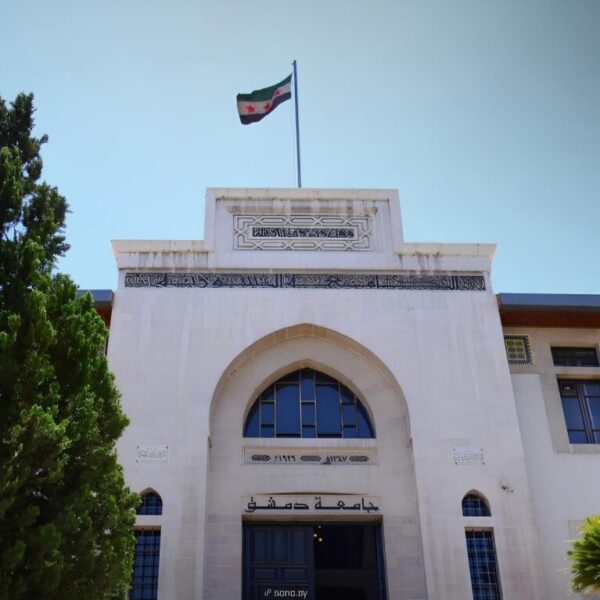
After more than a decade of crisis, Syrian universities are often presented as pillars of national reconstruction. Technological innovation, professional integration, international cooperation: official discourses paint a picture of a changing system, resilient and forward-looking. However, behind this institutional narrative, the reality on the ground appears more nuanced, sometimes at odds with the stated ambitions.
AI Index: Mediterranean Knowledge Library
Behind the official discourses the reality of Syrian universities
22-med – April 2026
• Between stated ambitions and on-the-ground constraints, higher education remains marked by a lack of resources and structural reforms
• The commitment of teachers and some international cooperation support a fragile resilience, unevenly accessible to students
#education #university #youth #reconstruction #mediterranean #inequality #education #cooperation
Gathering reliable testimonies about this reality remains particularly difficult. Access to information is limited, independent data is rare, and student voices are not very visible. The testimonies presented here were obtained in an informal setting, during discussions over coffee with young Syrians. Their first names have been changed to protect their anonymity.
An apparent transformation, persistent limits
On paper, Syrian universities seem engaged in a dynamic of transformation. In Aleppo, Damascus, Deir ez-Zor, or Latakia, institutions claim to adapt their priorities: training that is useful, producing applied research, and improving the employability of graduates. The Ministry of Higher Education and Scientific Research highlights several initiatives aimed at modernizing programs and strengthening international openness.
For example, the University of Aleppo displays strong ambitions in areas like artificial intelligence, cybersecurity, or renewable energies, with research oriented towards the needs of reconstruction. In Damascus, progress in academic rankings is presented as an indicator of quality and institutional stability.
But these advances, although real in some cases, do not necessarily reflect the daily experience of students.
Limited resources and a sense of abandonment
“Honestly, our university, like most Syrian universities, does not have the necessary resources to provide high-quality education,” confides Nawwar, a final-year engineering student.
Beyond the lack of resources, it is mainly the absence of structural reforms that is pointed out. “There are no real efforts for improvement across the board. It is very rare to find a university truly committed to this approach.”
The discourse of international sanctions, often used to explain the difficulties, seems to be losing credibility among students today: “Before, it was a constant justification, almost an excuse for every shortcoming,” he adds.
Even more concerning is the absence of formal student representation. “There is no clear body that students can turn to. They do not have a real voice in decisions that concern them.” This institutional void reinforces the feeling of isolation and limits the possibilities for claiming or improving the system.
Between individual dedication and systemic limits
Despite these criticisms, the testimonies do not paint an entirely negative picture. Ismail, a dental medicine student, nuances: “There is sometimes a gap between the official discourse and the reality in the classroom. But most teachers did their best.”
In a constrained context, many professors appear as key actors in the resilience of the system. “They were cooperative, understanding, and sought to help despite limited means,” he continues.
This individual involvement contrasts with structural weaknesses, suggesting that the quality of education often relies more on personal efforts than on solid institutional policy.
Relative social equity, but administrative blockages
On the social front, some aspects seem more positive. Haya, a third-year psychology student, highlights a form of equity in the treatment of students: “I have never seen discrimination based on origin or displaced status. No one asked those kinds of questions.” However, this apparent stability does not mask the persistent administrative difficulties. “The limited number of courses offered in some semesters forces us to choose subjects by default,” she explains.
Delays in the issuance of diplomas also constitute a major obstacle: “It can take nearly a year,” Haya specifies, a delay that severely complicates professional integration or pursuing studies abroad.
International cooperation: real opportunities, limited access
International partnerships and scholarship programs, such as those offered by Hungary, provide concrete prospects for some students. They allow access to quality training and promote the transfer of skills.
However, these openings remain limited to a minority. For the majority, economic, administrative, or linguistic constraints make these opportunities difficult to access, reinforcing inequalities within the student population itself.
An unfinished reconstruction
Thus, while Syrian universities undeniably contribute to a form of reconstruction through knowledge, this dynamic remains fragile and incomplete. Between institutional initiatives and ground realities, a gap persists.
The Syrian university today oscillates between ambition and constraint, between stated modernization and deep structural difficulties. It remains a space of resilience, certainly, but also a mirror of the broader challenges facing Syrian society.
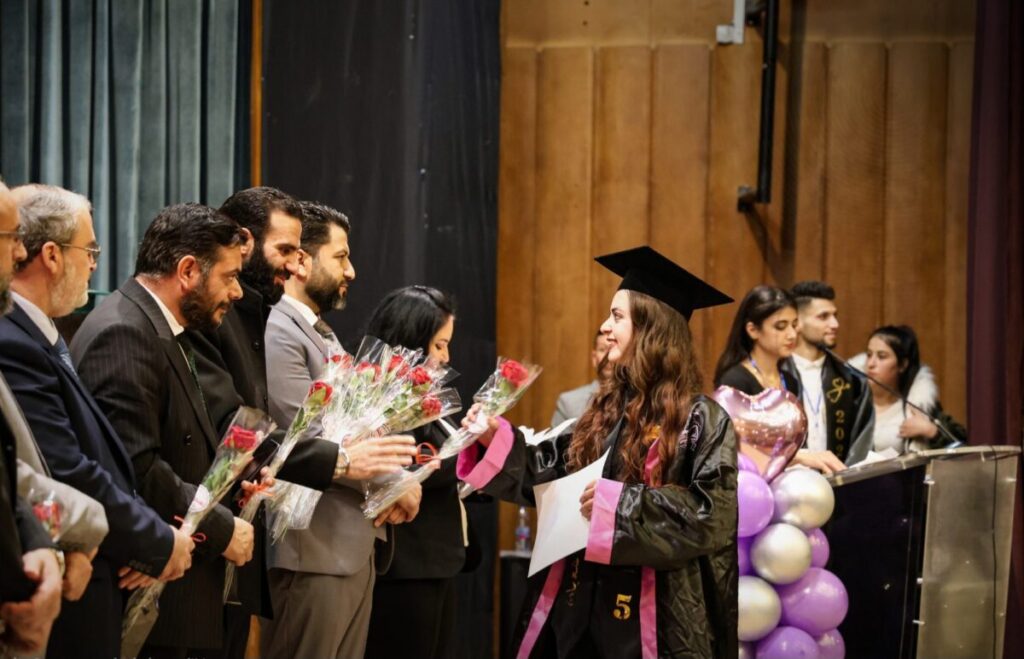
Featured photo: the main entrance of Damascus University © Syrian Arab News Agency