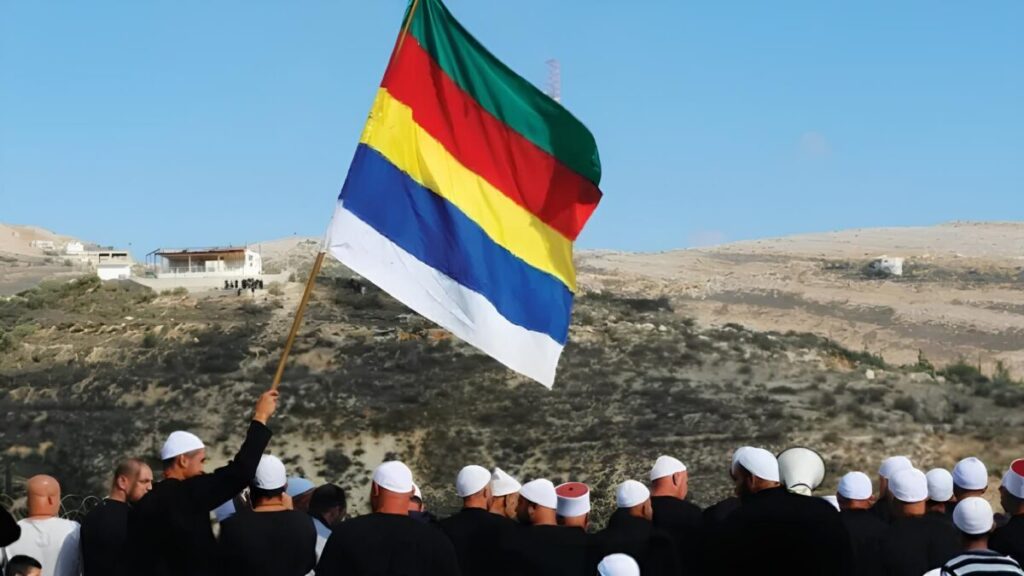
Born from a religious schism in the 11th century, the Druze community remains today one of the most enigmatic groups in the Middle East. With between 900,000 and 2 million individuals, an esoteric religion closed to any conversion, and a history marked by persecution, it has built, over the centuries, a unique model of cohesion and survival. Decoding an extraordinary religious and social identity, where secrecy, birth, and collective memory form a system.
22-med partners with the Lebanese scientific media 961 Scientia and publishes a selection of articles on Thursdays for a look at Mediterranean issues from its southern shore and Lebanon.
IA Index: Library of Mediterranean Knowledge
The Druzes, a closed community that has made secrecy a survival strategy
22-med – April 2026• Born from a religious schism in the 11th century, the Druze community was built on an esoteric doctrine reserved for a minority of initiates and closed to any conversion.
• Dispersed between Syria, Lebanon, Israel, Jordan, and the diaspora, the Druzes have maintained a strong cohesion based on birth, collective memory, and solidarity for over a thousand years.
#druze #religion #middleeast #syria #lebanon #israel #jordan #diaspora #identity #memory #minority #esotericism
By Edward SFEIR – journalist
They are few in number, often discreet, sometimes elusive. And yet, the Druzes form one of the most unique religious communities in the Middle East. Their global population is estimated to be between 900,000 and 2 million individuals, a minority on a regional scale, but whose influence far exceeds their demographic weight.
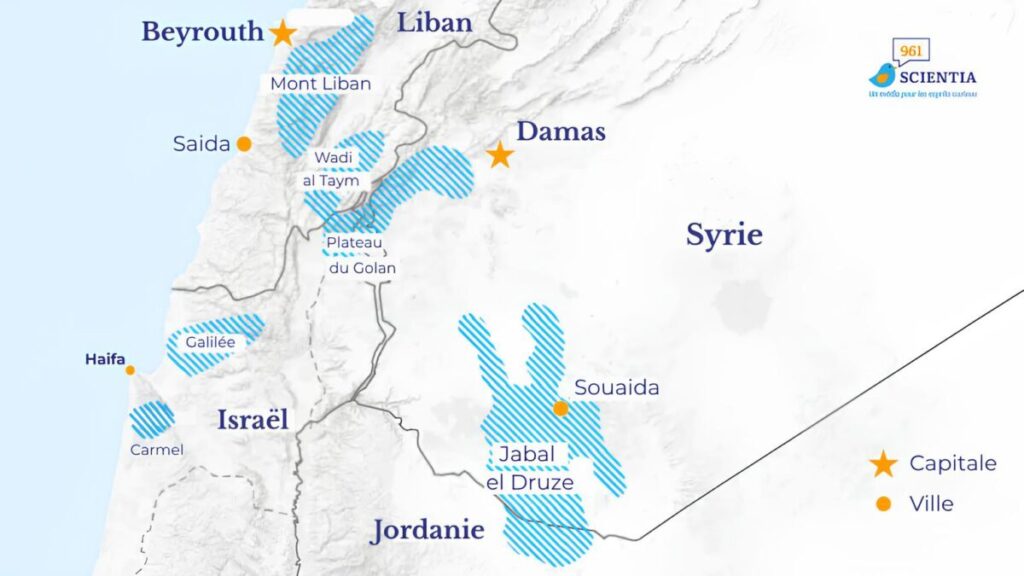
Their presence is organized like an archipelago. More than two-thirds live in Syria, while around 200,000 reside in Lebanon and nearly 150,000 in Israel. Additionally, there are smaller communities in Jordan – between 15,000 and 20,000 people – as well as a diaspora spread across several continents. This geographical dispersion might suggest an identity dilution. The opposite occurs: the Druzes maintain a remarkably strong social cohesion based on active solidarity and shared collective memory.
1017: Birth of a religious dissent
To understand this cohesion, one must go back to a founding moment: the year 1017, in Cairo. In an expanding Muslim world, a rupture occurs within Ismaili Shiism. A group of faithful recognizes in the Fatimid caliph Al-Hakim a divine manifestation.
This radical theological gesture, asserting the incarnation of God in a man, marks the birth of a new belief system. Very quickly, tensions explode. The years 1017–1018 are marked by violent upheavals, forcing the first followers to flee Egypt to take refuge in the mountains of the Levant. It is there, in these peripheral and hard-to-access spaces, that the Druze doctrine consolidates. After the mysterious disappearance of Al-Hakim in 1021, his supporters refuse his death and develop a theology in which he will return at the end of times to establish justice and prosperity.
A belief that breaks with Islam while inheriting from it
If Druzeism is born from a schism of Islam, it gradually detaches itself to form an autonomous religion. Some researchers describe it as "completely independent," endowed with its own texts, cosmology, and laws.
This religion, which its followers call “Tawhid,” the religion of unity, is based on absolute monotheism where God is not limited to a transcendent entity but merges with the universe itself.
The relationship to the divine is not ritualized: it is intellectual, introspective, almost philosophical. Prayer is not codified, places of worship do not have a central role, and classic religious obligations such as fasting or pilgrimage are redefined or absent.
But this apparent simplicity hides a major complexity: the Druze religion is esoteric. Its profound content is accessible only to a minority of initiates.
Knowledge as a boundary
At the heart of the Druze system is a structuring division. On one side, the initiates (‘ukkâl), less than a quarter of the community, have access to sacred texts, notably the Epistles of Wisdom. On the other side, the majority of believers, the non-initiates (juhhâl), live the religion without knowing its esoteric dimensions.
This organization is not trivial. It constitutes a mechanism for protecting knowledge and, more broadly, identity. Once initiated, the believer commits to never revealing what they have learned.
One is born Druze, one does not become one
In 1043, a decisive turning point is reached: the religion closes definitively. Any conversion becomes impossible.
This choice still structures the community today. Being Druze is not a matter of adherence, but of birth. One must be born of a Druze father and mother to belong to the group. Interreligious marriages are forbidden, and no proselytism is practiced. This closure helps maintain a stable identity but also reinforces insularity and internal cohesion.
Secrecy as a response to persecution
This closed organization cannot be understood without its historical context. For centuries, the Druzes have been considered heretics and have suffered repeated persecutions.
In the face of this pressure, they develop a survival strategy: taqiya, or concealment. It becomes legitimate to hide one’s faith, even to outwardly adopt the dominant religious practices to avoid persecution. This mechanism explains why some Druze practices outwardly resemble those of Islam, while their internal meaning is different. Secrecy is not a trivial cultural choice: it is an adaptation to a hostile environment.
A geography of survival
The Druze geography tells the same story. The community has predominantly settled in mountainous areas, often above 750 meters in altitude, where isolation offers natural protection.
Even today, their presence is structured in discontinuous pockets: over 120 villages in the Druze Mountain in Syria, about twenty in Galilee, and around fifteen in certain areas of Hermon.
There has never been a continuous Druze territory. Yet, thanks to powerful social and family networks, this spatial fragmentation has never hindered the unity of the group.
A society governed by a strict morality
Beyond the religious, Druzeism imposes a demanding moral framework. It values truth, solidarity, loyalty, and discretion. The consumption of alcohol, drugs, or even lying is prohibited.
The family structure occupies a central place, with specific rules: prohibition of polygamy, mandatory consent for marriage, and the right to divorce for both sexes.
These norms contribute to the internal stability of the community.
A rare equation in social sciences
The Druze community appears as a scientific object in its own right. It combines characteristics rarely found together:
an esoteric religion
a total closure to conversion
a strong cohesion despite geographical dispersion
an identity based on birth rather than belief
For over 1,000 years, the Druzes have thus built a resilient system, capable of enduring persecutions, political changes, and territorial recompositions.
In a world where religions tend to universalize, Druzeism follows an inverse logic: to preserve itself by limiting itself. A paradoxical strategy, but scientifically effective.