Off the coast of Oran, an artificial reef transforms a depleted seabed into a living ecosystem. Born from an associative initiative that became public policy, the Bousfer project tells how science, local engagement, and international cooperation can repair, in fragments, a Mediterranean under pressure. The story begins far from official speeches and grand climate plans. It unfolds beneath the surface, a few miles off the Oranese coast, where divers, scientists, and volunteers have chosen to intervene before the depletion becomes irreversible.
22-med partners with grassroots media from various Mediterranean countries and publishes a selection of articles every Thursday to shed light on the region's issues. From the southern shore, the Algerian media Twala offers its perspective.
AI Index: Mediterranean Knowledge Library
Bousfer: an Algerian experience for a Mediterranean in crisis
22-med – May 2026
• Off the coast of Oran, an artificial reef transforms a depleted seabed into a living ecosystem.
• Born from an associative initiative, the Bousfer project becomes an Algerian model of marine restoration.
#algeria #sea #biodiversity #reef #fishing #mediterranean.
By Mohamed Mir – Journalist
About ten kilometers off the coast of Oran, where the Algerian coast dissolves into a dense and calm blue, the Mediterranean conceals a discreet experiment. Thirty meters below the surface, on a seabed that was long a sandy desert, fish now swim in tight schools. They are not there by chance. They have returned because someone decided, nearly ten years ago, to give back to the marine environment what decades of human pressure had taken away: structure, shelter, anchorage points for life.
The artificial reef of Bousfer is not spectacular. It lacks the monumentality of major maritime engineering projects or the symbolic aura of a designated natural park. It is made of concrete blocks submerged methodically, designed to withstand currents, offer cavities, promote the attachment of algae and invertebrates, and recreate, piece by piece, the basic conditions of a functional ecosystem. What is happening there is less about achievement and more about patience.
The Mediterranean, as we know, is a sea under pressure. Semi-enclosed and densely populated along its shores, it concentrates some of the most intense forms of maritime exploitation: industrial fishing, maritime traffic, urban discharges, coastal urbanization. In Marseille, fish biomass had dropped by 80 to 90% before the 2000s. The Gulf of Oran, despite less industrialization, has not been spared. The sandy bottoms off the beach of Étoile, in Aïn Turk, once rich in benthic life, had become poor, almost sterile, unable to offer refuge or food to sustainable marine populations.
An idea from divers, not ministries
It is in this context that, in 2015, an Algerian association decided to intervene. Barbarous, a marine ecologist organization founded by divers and biologists, then carried a project that many deemed unrealistic: to implant Algeria's first artificial reef in the bay of Bousfer. At its head, Amine Chakouri, an experienced diver and environmental activist, defends a simple, almost educational idea: in the marine environment, biological diversity is not triggered by the water itself, but by the substrate. Without physical support, no fixation, no trophic chain, no sustainable life.
The Bousfer reef is designed as a production reef, sometimes described as a "fish apartment building." The goal is not decorative, nor strictly conservative: it is to increase the diversity and ichthyological biomass in a degraded area, and to allow the ecosystem to regenerate itself. The idea is not new on a global scale. Japan, in particular, has built a public policy of artificial reefs for decades, with nearly 20,000 sites and hundreds of models adapted to local contexts. In Algeria, however, the approach is still experimental.
The initial results are swift. During the pilot phase launched in 2015, the number of species recorded in the area increased from four to forty-four. More recently, the scientific monitoring of the O.R.1 module — Oran Reef One — reveals an even more striking acceleration: in just six months, species richness multiplied by more than nine. Thirty-seven species recolonized the area, including fish with high ecological and commercial value: breams, seabreams, amberjacks, scorpionfish, wrasses, and groupers. The reef becomes a nursery, then a biological crossroads.
When Experimentation Becomes Public Policy
This transformation attracts attention beyond the associative circle. In 2016, a similar initiative emerged in Annaba, led by the Hippone Sub association. In 2017, the Algerian state adopted a national decree regulating the creation and management of artificial reefs. The text decentralizes their governance, entrusting local authorities with the responsibility for their implementation and maintenance, while encouraging collaboration between associations, universities, and administrations. What was perceived as a militant utopia becomes a tool of public policy.
In Bousfer, the project changes scale. It is now supported by an institutional and civil alliance involving the Ministry of Agriculture, Rural Development and Fisheries, the Barbarous association, the University of Oran 1 Ahmed Ben Bella, and the Japan International Cooperation Agency, JICA. The scientific monitoring is notably ensured by Kaïs Boumediène Hussein, a doctor in ecology and marine biology, teacher-researcher, and scientific advisor of Barbarous. His diagnosis is constant: the key to marine diversity lies in the complexity of habitats. Providing supports triggers a biological explosion.
The major phase of the project, completed in 2025, sees the immersion of 80 additional concrete blocks, representing about 80% of the current reef configuration. These structures, spread over ten hectares, create a mosaic of micro-habitats capable of attracting both demersal and pelagic species. The "oasis" effect is evident: the fish do not just pass by, they settle.
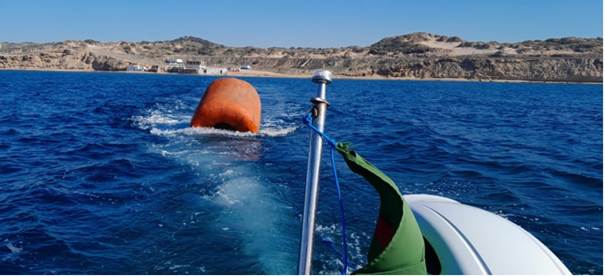
But this ecological success immediately poses a classic problem: that of protection. An artificial reef, by attracting life, also attracts human pressure. To prevent the site from becoming a focal point for intensive fishing or spearfishing, strict measures are put in place. As part of the second phase, RO II, marking and signaling devices are installed in coordination with the Maritime Fisheries Directorate of the State of Oran and with Aqua Paloma, a company specializing in maritime works. The goal is to make the area visible, avoidable, and legally protected.
An Ecology That Must Also Feed
The Bousfer project is not limited to ecological restoration. It includes an assumed socio-economic dimension. Artisanal fishermen, facing the depletion of natural stocks, are directly concerned. In Marseille, the Prado artificial reefs have allowed a 264% increase in biomass over ten years. In Algeria, initial measurements already indicate an increase in biomass for certain target species, with a direct economic benefit estimated at over 26,000 dinars per kilogram for local fishermen.
Innovation continues with the study of complementary devices: niches for mussel farming, coexistence with cephalopods like octopus or cuttlefish, diversification of fishery incomes. The reef thus becomes a tool for sustainable development, linking ecosystem protection and economic viability.
In addition to this dimension is that of tourism. Ecological diving on artificial reefs opens up new perspectives for more respectful coastal tourism, creating jobs and raising awareness. The rebirth of marine life benefits not only fish; it also reshapes human uses of the coastline.
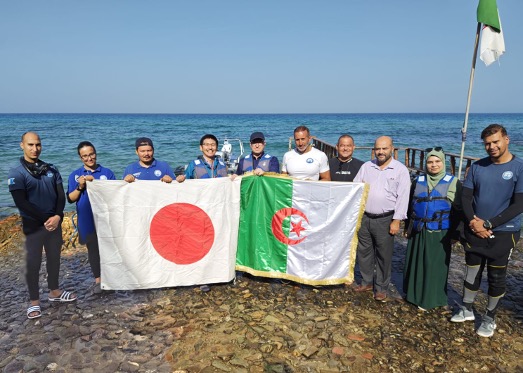
Japanese cooperation plays a structuring role here. Japan is the only country to have industrialized the policy of artificial reefs on a large scale. Its expertise, notably embodied by expert Nanao Hitonori, is reflected in Bousfer through a gradual transfer of skills. Two major training sessions are scheduled for 2026: one in Tunisia, focused on the scientific management of reefs, and the other in Japan, dedicated to the sustainable co-management of fisheries.
2026, or scaling up
The project is also inspired by local innovations. The initial concept, called "Bio-Kaïs," was based on the implantation of posidonia seagrass in marine deserts. First tested on a small scale, the method was adapted to the dimensions of the Bousfer site. Furthermore, Barbarous is working on the transplantation of the cystoseira algae, a threatened species but an indicator of good water quality, especially around Algerian port breakwaters.
The year 2026 marks a new stage. The approved extension plans for the immersion of 100 additional blocks, bringing the total to 180 modules. At the same time, the Bousfer model is set to be replicated in other wilayas, including Skikda, Tipaza, and Tizi Ouzou, as part of a national marine restoration strategy.
Challenges remain. The main identified risk is that of the concentration effect: attracting fish can also attract excessive fishing pressure. Co-management with fishermen, continuous monitoring, and integrating the reef into a comprehensive environmental policy are essential. An artificial reef is not a miracle cure. It does not replace wastewater treatment, coastal pollution control, or adaptation to climate change.
But the Bousfer experience shows that another trajectory is possible. Starting from a marginal associative initiative, it has become an institutionalized, scientifically validated, and legally framed project. It demonstrates the capacity of Algerian civil society to drive concrete changes, provided the state agrees to support them.
Under the waves of the Gulf of Oran, the reef does not just produce life. It is part of a broader Mediterranean dynamic, that of a sea that can still be repaired, not by grand spectacular gestures, but by an accumulation of modest, persistent, and collective decisions. In Bousfer, concrete has not been used to conquer nature, but to give it a foothold again.