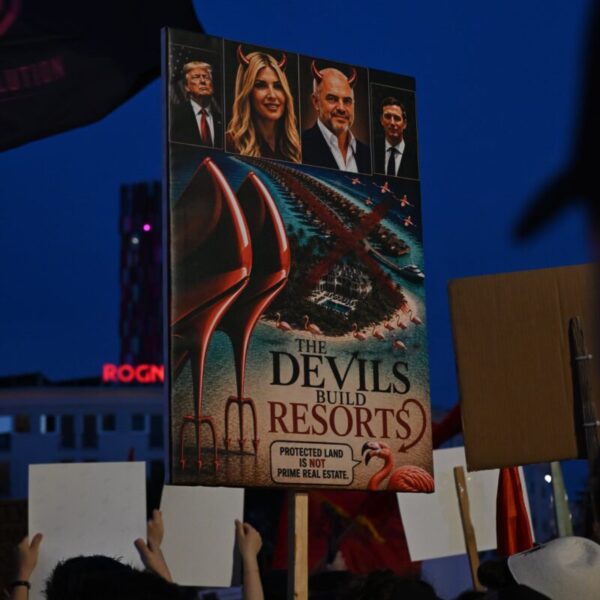
The conflict, born in the Zvërnec and Narta region around a large-scale tourist project, has turned within days into one of Albania's most sensitive public issues. Since then, there have been daily protests, clashes with security forces, criminal prosecutions, institutional suspensions, and investigations conducted by the Special Anti-Corruption and Organized Crime Prosecutor's Office (SPAK).
AI Index: Mediterranean Knowledge Library
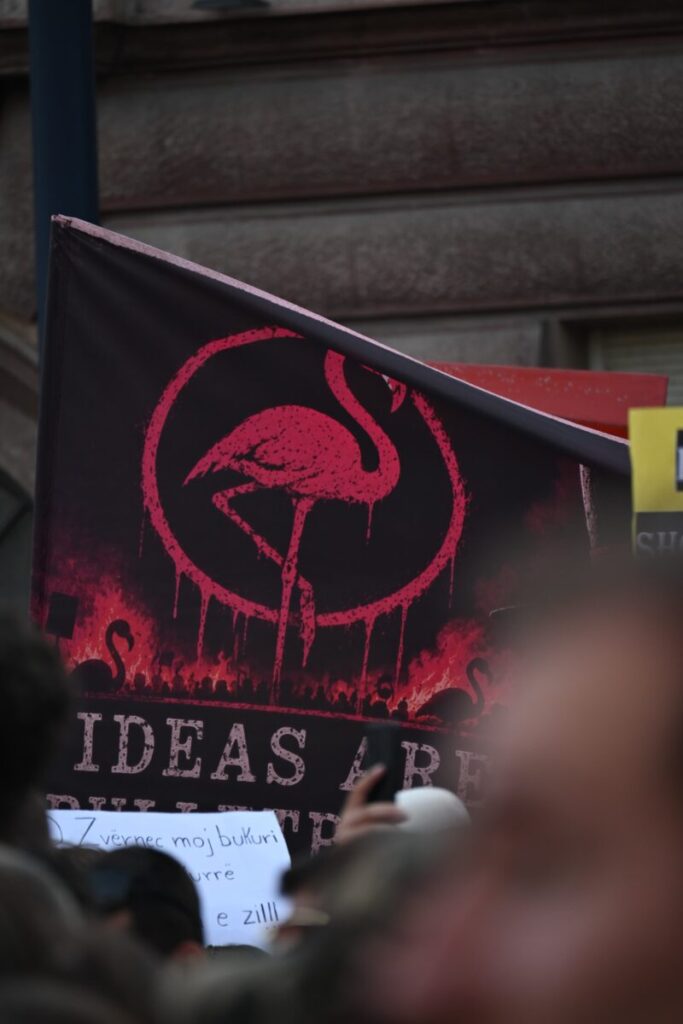
Pink flamingos, symbol of the protest in Zvërnec
22-med – June 2026
• A 4 billion euro tourist project triggers an unprecedented citizen mobilization around the Narta lagoon.
• The pink flamingos become the symbol of a national debate on development, environment, and public space management in Albania.
#albania #tourism #environment #lagoon #pinkflamingo #citizenmobilization #biodiversity #coastline #investment #territory
What began as a local debate on territory and access to the coastline has become what many now call the "Pink Flamingo Revolution." A large-scale citizen movement focusing on economic development, public ownership, and the relationships between the state and strategic investments.
At the heart of the controversy is a luxury tourist complex project, planned in the Pishë-Poro area, between Zvërnec and the Narta lagoon, 150 km southwest of Tirana. Estimated at around 4 billion euros, it is backed by investors linked to Ivanka Trump and her husband Jared Kushner. It plans to create hotels, villas, and high-end tourist infrastructures aimed at an international clientele. Albanian authorities present it as a strategic investment capable of creating jobs and enhancing the country's tourist appeal. Opponents, on the other hand, denounce a gradual privatization of the coastline and worry about the consequences on one of Albania's most sensitive natural areas. The Narta lagoon is indeed part of the protected Vjosa-Narta landscape and constitutes an important wetland of the Adriatic. It is home to several hundred animal and plant species, including a colony of about 3,000 pink flamingos, which have become the symbol of the mobilization. Tensions in the area began to intensify at the end of May, when residents and environmental activists reported the installation of fences and restricted access to certain parts of the coastline.
The clashes that changed everything
The initial reaction was local, centered on a demand for transparency: who is building, on what legal basis, and what is the status of the lands concerned? Many protesters saw in this intervention a sign of the privatization of public spaces in one of the country's most sensitive ecological areas. The turning point came on May 30, when the situation escalated into physical clashes between protesters and private security agents near the project site.
The images of the incident, showing citizens being jostled and forcibly restrained, were widely shared on social media and sparked an immediate public reaction. Protesters denounced excessive use of force and a lack of institutional control, while project representatives claimed it was legal private property and unauthorized intrusion.
Suspension of the Police Chief
Following these events, the state police initiated criminal proceedings against fifteen protesters and two private security employees. Simultaneously, investigations were opened into the management of the situation on the ground. These led to the suspension of the Vlora police chief, following inaccurate reports and suspicions of a lack of coordination in the command chain.
The event was interpreted as a rare moment where institutional control on the ground was seriously questioned. On May 31, the protest moved to Tirana, where citizens and activists demanded a full investigation into the incident and a halt to the works until the situation was fully clarified. In the days that followed, the state police announced the revocation of licenses for two private security companies operating in the area, highlighting violations in their operations.
“Pink Flamingo Revolution”
Since the beginning of June, anger has spread to other cities, with daily protests and growing participation. For Vitjon Nina, editor-in-chief of Albanian Post, the movement goes far beyond the issue of Zvërnec. “The protests of recent days, known as the ‘Pink Flamingo Revolution,’ are a clear testament to a society — and especially Generation Z — that seems completely fed up with the political class of the last thirty-five years.” According to him, one of the peculiarities of the mobilization is having kept opposition parties at bay. “Despite attempts at political recovery, they have not been allowed to take the stage, nor to lead the protest, let alone derive political benefit from it.” A stance that, according to him, explains the progressive expansion of the movement.
The dissemination of images on social media has also contributed to giving national and international visibility to a protest that aims to be primarily peaceful.
Sazan and the International Dimension of the Project
Ivanka Trump's involvement in the project has given an international dimension to the debate. She and her husband Jared Kushner are associated with the tourist project on the island of Sazan, regularly mentioned alongside that of Zvërnec.
This proximity fuels the concerns of opponents regarding the scale of the transformations envisaged on the Albanian coast. The mobilized youth notably hijacked a phrase used by Ivanka Trump in a recent podcast interview — “barefoot towards the exploration of Sazan” — which has become one of the slogans of the protests.
The Voice of the Activists
For Edison Lika, an activist and significant figure in the movement, concerns go far beyond just the tourist construction site. "We don't know what will actually be built, to whom the project has been awarded, and who is behind it." He denounces a lack of transparency around the project, as well as a gradual appropriation of common spaces and environmental risks. "Albania possesses natural riches that are monuments not only for us but also for Europe. Tourism must develop based on a sustainable model, integrated with nature and not at its expense."
Edison Lika believes that the mobilization truly gained momentum after the clashes on May 30. "For the first time in thirty-six years, we saw a situation where the state police seemed to have lost control of its two main prerogatives: the monopoly on the use of force and territorial control."
The government, the SPAK, and ongoing investigations
In response to the criticism, Prime Minister Edi Rama continues to defend an investment he describes as strategic. The project's promoters claim that the concerned lands are registered private properties and that the planned development will create jobs and elevate Albanian tourism.
Meanwhile, the Special Prosecution Office against Corruption and Organized Crime (SPAK) has opened parallel investigations, giving the case an additional institutional dimension. The mobilization is not weakening. Gatherings continue in several cities across the country. What began as a local protest around a tourism project has gradually transformed into a national debate on economic development, environmental protection, and the management of public spaces.
Vitjon Nina, the editor-in-chief of Albanian Post, observes that "the boulevard and streets, for the first time in many years, seem today to belong only to the citizens."
Cover photo: © Vitjon Nina