Behind every recipe often lies a story of travels, encounters, and blending. In the Mediterranean, dishes cross borders much more easily than people. They change ingredients, techniques, or presentation, without losing what makes their identity. From the eggplant coming from Asia to the creative kitchens of Tel Aviv, passing through a bouillabaisse couscous imagined in Marseille, these three reports show that gastronomy is one of the most vibrant languages of the Mediterranean.
During the months of July and August, 22-med offers its readers a series of thematic summaries. The goal is to explore a single issue through experiences, initiatives, and complementary perspectives from both sides of the Mediterranean. This article is a summary of three reports published by 22-med, available in the media's 11 languages.
Swoon over Stuffed Eggplants, Mayalen Zubillaga – France
Bouillabaisse Couscous, When the Mediterranean Tells Its Story on the Plate, Olivier Martocq – France
In the Kitchens of Tel Aviv, the Mediterranean Reinvents Itself, Caroline Haïat – Israel
At first glance, everything opposes these three stories. One follows the traces of a vegetable through the centuries, another tells the birth of an unprecedented dish, the third focuses on the chefs of a city oriented towards innovation. Yet, they all speak of the same reality. Mediterranean cuisine never stops transforming because it has always been nourished by exchanges between peoples.
Recipes that Travel with People
The eggplant was not born on the shores of the Mediterranean. Domesticated in Asia, it gradually reached the Middle East before being spread by the Arab world to the Balkans, Spain, Sicily, and then Provence. Armenian, Jewish, or Ottoman migrations later contributed to its diffusion and the transmission of recipes. Behind a simple vegetable thus appear centuries of movements, exiles, and encounters. The imam bayıldı, moussaka, caponata, or ratatouille each tell a stage of this long history.
The same movement today irrigates the kitchens of Tel Aviv. Greek, Lebanese, Syrian, North African, or Yemeni influences naturally intersect there, nourished by markets where products, spices, and know-how from different horizons meet. Diversity is not an exception but the starting point of culinary creation.
Reinventing Without Erasing Traditions
These exchanges do not lead to the disappearance of original recipes. On the contrary, chefs claim their heritage while adapting it to contemporary techniques. In Tel Aviv, hummus, sabich, or dafina are revisited with precise cooking, fermentations, or more advanced work on textures. The goal is not to break with the past, but to extend it.
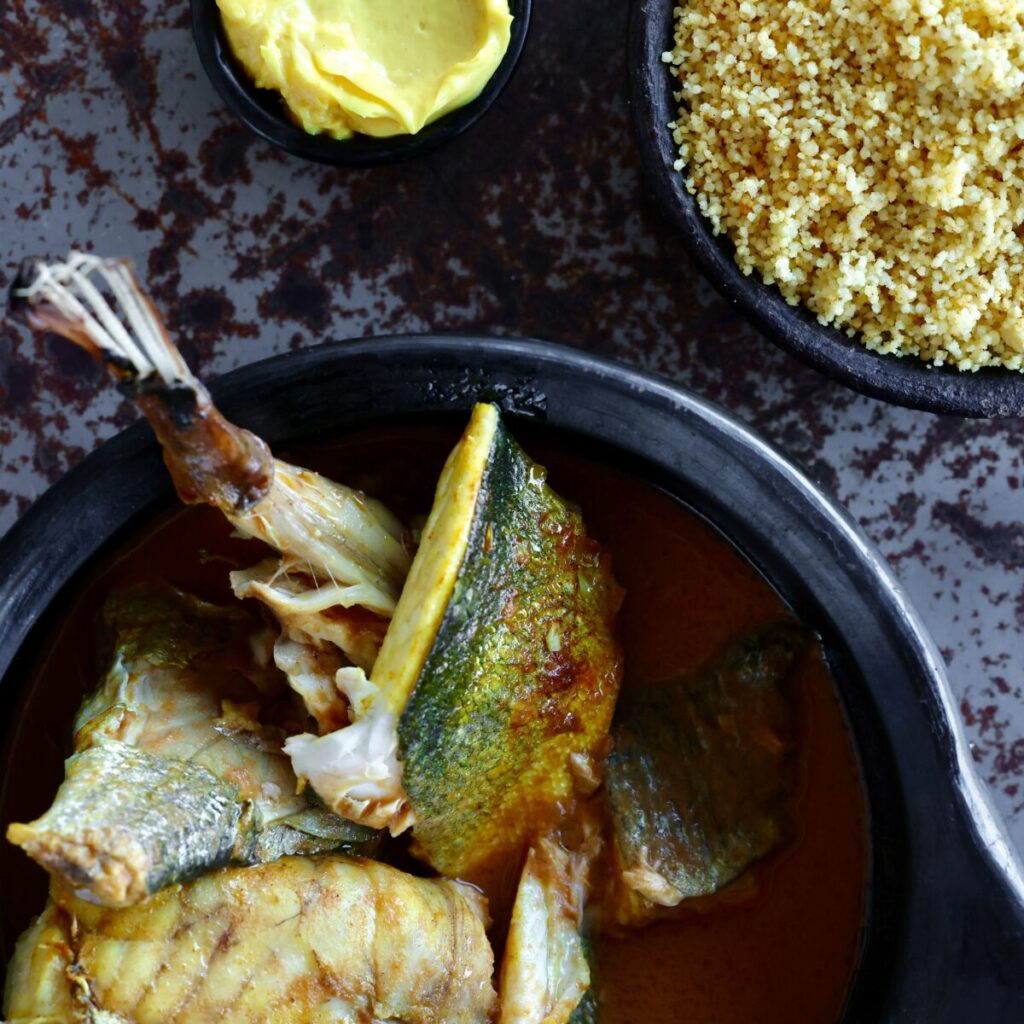
This same logic inspires Emmanuel Perrodin when he imagines his couscous bouillabaisse. By simply replacing the water in the semolina with a rockfish broth, he brings together two popular Mediterranean monuments without betraying either. Vegetables, spices, harissa, or rouille interact in a recipe that claims as much freedom as respect for traditions.
Markets, the first laboratories of cuisine
Before reaching restaurants, these transformations originate in the markets. In Tel Aviv, Carmel, Levinsky, or Hatikva are not just supply places. They are true crossroads where products, languages, and recipes of the various communities settled in Israel circulate. Each stall tells a story of migrations.
The eggplant perfectly illustrates this role of commercial exchanges. If it has become a staple in so many Mediterranean cuisines, it's because trade routes and population movements have gradually acclimated it far beyond its original territory.
A Mediterranean identity always in motion
Mediterranean cuisine has never been built behind borders. For centuries, it has progressed at the pace of exchanges, migrations, reciprocal influences, and local adaptations. Each generation adds its touch without breaking with what preceded it. The plate thus appears as a space of memory as much as of innovation. It retains traces of past journeys while welcoming today's creations. It is undoubtedly this ability to evolve without losing its history that makes cuisine one of the most vibrant heritages of the Mediterranean.
Cover photo: © pexels-Enesfilm