Morocco celebrated on January 14 the Amazigh new year*: Id Yennayer. This date has been recognized since 2024 as a public holiday in the country, a new milestone in acknowledging the importance of these traditions in Morocco's history. A look back at this heritage as ancient as it is alive in the Cherifian Kingdom, whose institutionalization still struggles to materialize today.
Index IA: Library of Mediterranean Knowledge
The Amazigh heritage in search of recognition
22-med – February 2026
• In Morocco, Ahmed Assid and Cherif Adardak recount an official recognition of Amazigh that is progressing but remains uneven in institutions.
• From the Rif to Tangier, the bachikh and the Bachikh Festival showcase a living heritage, between historical memory and contemporary political battle.
#morocco #amazigh #identity #language #culture #politics #education #history #law #northafrica.
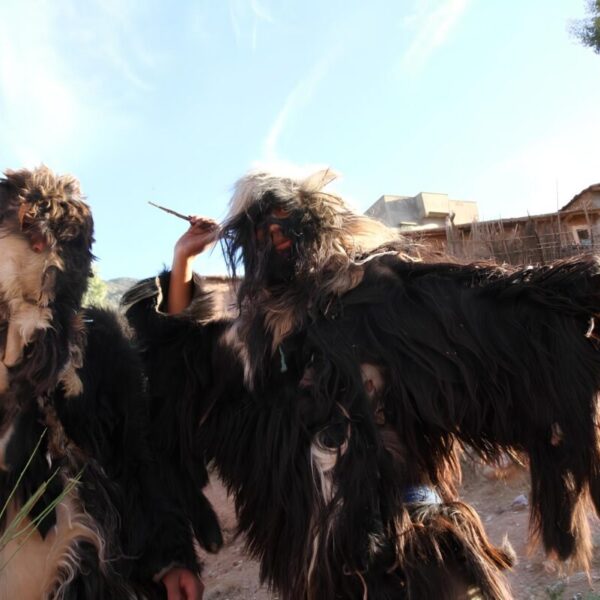
In Morocco, in the Rif mountains that traverse the northern part of the country, the beginning of January is accompanied by the appearance of a very particular character: the bachikh. Also known as Boujloud, Bilmawen, Bouhidora, or Herma in other Moroccan regions, he is dressed in sheep skins and a horned hat. His role is central in the festivities that mark the renewal of the year in Amazigh tradition.
“The bachikh is a mythical character whose role is primarily social,” explains Cherif Adardak, president of the Amazigh Sendhaja association of the Rif, a sub-family of the Amazigh people originating from northern Morocco. “His role is to observe throughout the year any potential tensions that exist in the villages or tribes. And at the new year, he translates them into a theatrical performance, sometimes critical, in order to convey a message and educate society.”
The bachikh has another essential role. He calls, through dance, for the fertility of the lands during this period of agricultural renewal. “The new year festivities symbolize the attachment to the land and agriculture for millennia by the Amazigh peoples of North Africa, from the Canary Islands to the oasis of Siwa in Egypt,” recounts Ahmed Assid, writer and president of the Amazigh Observatory for Human Rights. Because Amazigh communities are not limited to Morocco alone, but span the entire northern part of the African continent.
In fact, it is in Egypt that the Amazigh calendar finds its origin. “Every calendar begins with a founding event. The Amazigh chose the year 950 BC, the date of the ascension to the throne of Pharaoh Sheshonq I, an Amazigh king of Egypt who expanded his kingdom to Palestine.”
Amazighity, a component of Moroccan identity
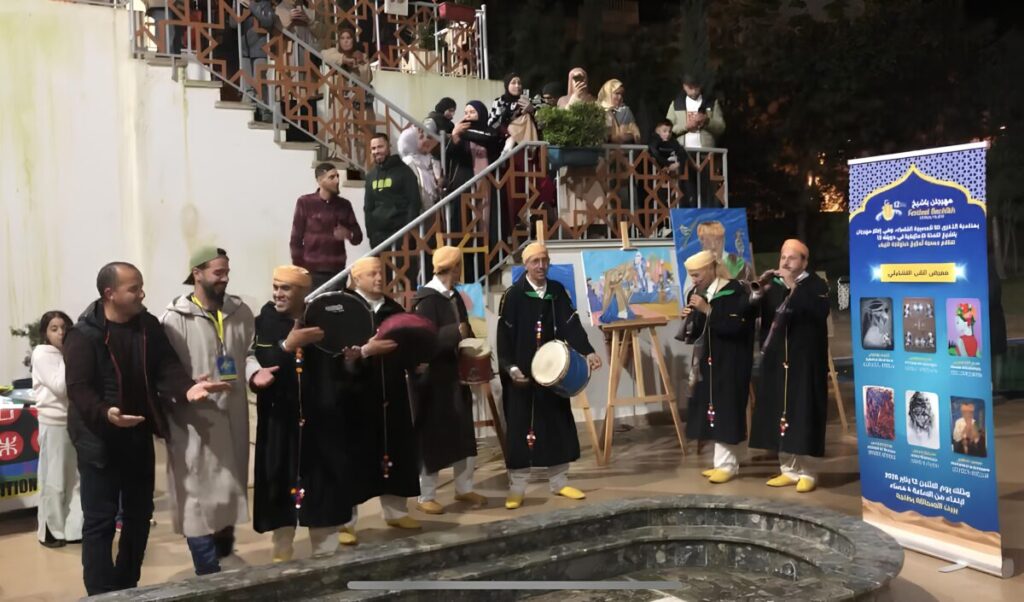
It is all this historical and cultural heritage that the Bachikh Festival strives to highlight each year in Tangier. Organized by the Amazigh Sendhaja association of the Rif, this event brings together Amazigh artists, speakers, and producers, as well as a bachikh, musicians from the Haït — recognizable by their traditional flutes and percussion — and dancers from the Ahwach, stemming from the Amazigh traditions of the south. It is an opportunity for Amazigh communities from all over the Kingdom to gather and exchange, and for visitors to observe Amazigh folklore and the history linked to it.
This heritage is inseparable from that of Morocco. Since the early 2000s, Moroccan institutions have been striving to restore its rightful place. In the country, one in four people speaks one of the three main Amazigh dialects fluently: Tachelhit in the southwest, Tamazight in the center, and Tarifit in the Rif, in the north. These languages were recognized in 2011 as official Amazigh languages by the Constitution.
“Amazigh was sacrificed for forty years after independence in 1956, as Morocco adopted the classic model of the nation-state, based on uniformity, with one language, one culture, and one identity,” recounts Ahmed Assid. “But thanks to the struggle of Amazigh activists, this heritage is regaining its place.”
A first turning point occurred with the Ajdir speech, delivered by King Mohammed VI in October 2001. The sovereign officially recognizes Amazigh culture as a component of Moroccan identity, asserts that its promotion constitutes a national responsibility, and announces the creation of IRCAM, the Royal Institute of Amazigh Culture, tasked with disseminating the language within institutions and schools. Amazigh began to be taught in schools as early as 2003, and then entered the media in 2006.
A slow recognition subject to political will
“The process is long,” continues Ahmed Assid. “The governments that have succeeded one another since 2011 have not shown the same seriousness regarding this recognition.” After two terms of the Islamist party PJD, relatively hostile to the promotion of Amazigh, the arrival in power in 2021 of a new government changes the situation. A coalition comprising the RNI, PAM, and the Istiqlal party allocates for the first time a significant budget for the promotion and development of Amazigh language and culture, with a progressively increasing budget since 2022.
At the beginning of 2026, the government confirmed the allocation of an additional thousand positions for teaching Amazigh in schools. These advances are considered encouraging but still insufficient by Ahmed Assid, who estimates that 3,000 teachers need to be trained each year just for primary education. The specialist also laments the persistent absence of Amazigh on state symbols, such as banknotes, currency, national identity cards, or passports. Again, developments are announced. Last summer, Morocco embarked on a large-scale project: to translate all of the country's legal texts into Amazigh by 2034.
* They are more commonly known as “Berbers,” a term that is now contested. They have been present for centuries in several regions of Morocco, from the Rif to the High and Middle Atlas, to Souss.
Featured photo: The bachikh (or boujloud, or bilmawen, depending on the regions) © Wikipedia Commons