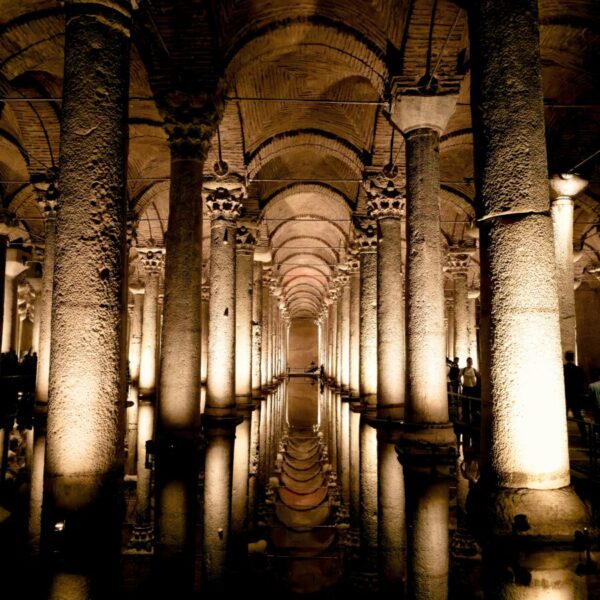
Surrounded by seas, Istanbul has always lacked drinking water. Since antiquity, this structural constraint has imposed an extraordinary technical response. Monumental aqueducts, distant catchments, gravitational networks, and underground cisterns have allowed the imperial capital to function without a river. From the Roman period to Byzantium, hydraulic engineering has shaped a city dependent on complex, invisible, and vital systems that remain inscribed in its landscape.
Index IA: Library of Mediterranean Knowledge
Istanbul, a city without a river, has been struggling for water for two millennia
22-med – February 2026
• In Istanbul, access to drinking water has long depended on aqueducts, cisterns, and distant catchments, in a city bordered by the sea.
• From Roman antiquity to Byzantium, hydraulic engineering has shaped a capital forced to manage scarcity as a structural issue.
#turkey #istanbul #water #drought #history #engineering #aqueduct #cistern #byzantium #empire
In a geography devoid of natural sources of fresh water, urban life has always depended on water transported from distant basins and massive reserves accumulated underground. Aqueducts, cisterns, dams, and fountains were not only technical feats: they represented the responses of empires to scarcity, climatic constraints, and demographic pressure. Even today, this infrastructure inscribed in the landscape retains the memory of Istanbul's struggle against drought.
Constantinople: the capital without water
Constantinople was founded as a superior city in terms of defense and commerce due to its strategic position and its opening to several seas; however, unlike metropolises like Rome, Antioch, or Alexandria, which were built on great rivers, it had to transport its drinking water. The foundations of the city's water infrastructure were laid in the 2nd century AD by Emperor Hadrian, following the integration of Byzantium into Roman territories. The first major aqueduct bringing water to the city from the springs of the Belgrad forests* was constructed at that time.
For a long time, the existing water channels satisfied the city's water needs, including those of the palace. But in the 4th century, with the declaration of the city as the capital, the population rapidly increased; the palaces, baths, and public buildings began to require a regular water supply. When the surrounding streams proved insufficient, attention turned to higher altitude sources, further away. The description of Constantinople by the contemporary rhetor, Themistius, as a city "with golden arches but dying of thirst," summed up the extent of this crisis.
The longest aqueduct in the Roman world
Efforts accelerated under the reign of Constantine II, with the construction of the second major aqueduct. The third was completed under Emperor Valens. Emperor Theodosius would build the fourth to bring water from the Belgrad forests to Sultanahmet to meet the water needs of a growing population. According to hydraulic engineer Kazım Çeçen, by the 5th century, the total length of the water system reached approximately 494 kilometers, thus becoming the longest aqueduct system known in the Roman world.
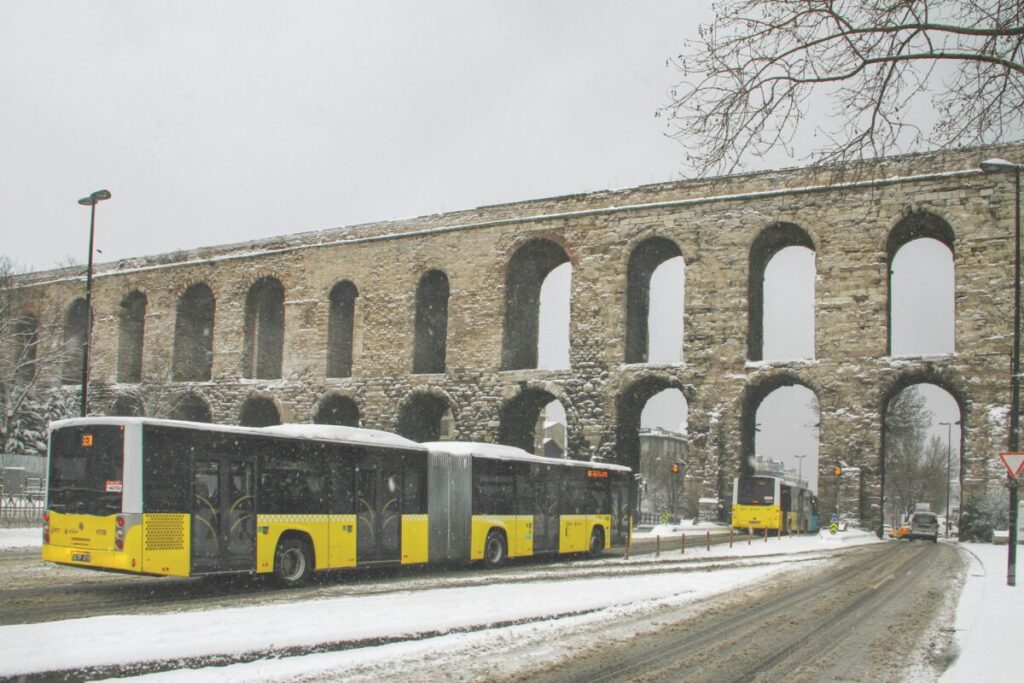
In antiquity, transporting water over long distances could only be done by the force of gravity. The source had to be higher than the destination point. This is why Roman engineers had to identify high-altitude sources in Thrace and the Belgrad forests to establish a complex aqueduct system. Long-distance aqueducts and canals extending towards the city formed its backbone, while the Valens aqueduct (Bozdoğan) was the most visible part of the network within the city.
In contrast, the real engineering feat lay in the rural works, largely ignored today. Water was transported to the city by canals and pipelines constructed with a slight slope from high-altitude sources; topographical obstacles like valleys were crossed by arches and bridges. This network, entirely based on the force of gravity and without the use of pumps, was supported by open and closed canals, galleries, reservoirs, cisterns, and distribution points. It supplied not only the imperial palace but also the expanding neighborhoods of the city. The Mazul, Karakemer, and Turunçluk aqueducts are other examples of this chain of engineering that has survived since Roman times.
Today, the Valens and Uzunkemer aqueducts, located within inhabited areas, as well as the Mazulkemer, Eğrikemer, and Kovukkemer aqueducts in the countryside, still stand. Discoveries by archaeologist James Crow show that more than one hundred fifty cisterns were located in the city. Structures like Yerebatan (also known as the Basilica Cistern) and Binbirdirek could store water for weeks.
Today, these cisterns, such as those of Theodosius, Aetius, Aspar, Mocius, Pulcheria, Modestus, and Arcadius, remain the most well-known examples of this hydraulic architecture.
* The name Belgrad comes from the Serbian loggers who once lived in a village (now abandoned) in the heart of the forest after the deportation of thousands of them following the siege of Belgrade in 1521.
Cover photo: located west of Hagia Sophia, the Basilica Cistern measures 140 meters long by 70 meters wide. It is estimated that it could store approximately 100,000 m3 of water © skaars - pexels