Across Algeria, Fouad Maâla is charting a green route, from wilaya to wilaya. In Sidi Bel-Abbès, his initiative takes on a new dimension, balancing local roots with national ambition. The future of the millions of trees planted now depends on their survival.
22-med partners with grassroots media from various Mediterranean countries and publishes a selection of articles every Thursday to shed light on the region's issues. From the southern shore, the Algerian media Twala provides its perspective.
Index IA : Bibliothèque des savoirs méditerranéens
Under the carob trees, another Algeria is trying to take root again — with Fouad Maâla
22-med – May 2026

• In Sidi Bel-Abbès, the carob tree becomes the symbol of a more sustainable reforestation, based on adaptation to dry soils and monitoring of seedlings.
• With Algérie Verte, Fouad Maâla transforms an online mobilization into a grassroots citizen network to green Algeria.

#algeria #carobtree #reforestation #desertification #water #youth #association #mediterranean
By Mohamed Mir - Journalist
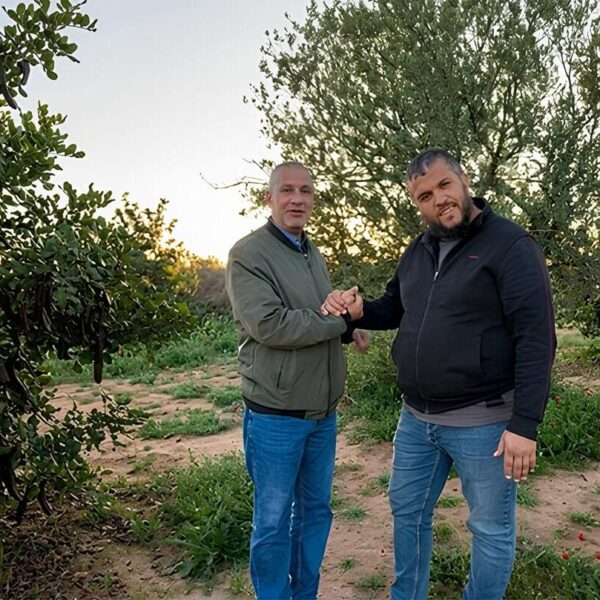
In Sidi Bel-Abbès, in western Algeria, some landscapes still tell a story that climate and public policies have almost erased. Between the gnarled trunks of the carob trees, two men shake hands. The gesture might go unnoticed. But in a country where the land retreats each year, it takes on another meaning.
It is here, in the shade of these millennial silhouettes, that Fouad Maâla, founder of the Algérie Verte association, has stopped after a tour that took him to Maghnia, Tlemcen, and Oran. On social media, he has become identifiable by a phrase that concludes each of his videos: “ Khadrâ bi idhni Allah ” — green, if God wills it. In just a few years, this signature has established itself as the rallying cry of a mobilization that now transcends its initiator.
Maâla did not expect to be surprised. Yet he was, to the point of calling Sidi Bel-Abbès the “region of the carob tree,” highlighting that this territory has preserved, against all odds, a part of its ecological balance.
Opposite him, Sid Ahmed Ayadoun, president of the Jeunesse Volontaire association. Two men, two paths, one shared obsession: to restore the country’s green color. No protocol, no staging. Just a field meeting, in a landscape that still resists. It is here that two dynamics — national and local — begin to converge.
The carob trees are not merely a backdrop. They remind us of an ancient balance that Algeria has allowed to degrade. Capable of surviving where other species disappear, they embody a resilience that poorly designed and unmonitored reforestation policies have not been able to replicate.
A country where the land retreats
The observation is harsh: between 30,000 and 50,000 hectares of arable land disappear each year. More than 80% of the territory is classified as arid or semi-arid. Even the northern part of the country sees its ecosystems rapidly deteriorate. These are abandoned lands, emptied villages, interrupted trajectories.
In this context, planting trees becomes a necessity. But the challenge is no longer just to plant. It is to ensure their survival.
“ The issue today is no longer merely to plant, but to guarantee the survival of the trees ,” acknowledges Fouad Maâla. In Algeria, large-scale reforestation campaigns have failed for a simple reason: the lack of follow-up. Thousands of seedlings planted and then abandoned. A year later, almost nothing remains.
In Sidi Bel-Abbès, the approach is different. Slower, more rooted. The Jeunesse Volontaire association, active for over a decade, understands local constraints: scarcity of water, nature of the soils, rhythm of the seasons. This empirical knowledge becomes a strategic resource for Algérie Verte, which is trying to move from the phase of mobilization to that of transformation.
Here, the carob tree naturally asserts itself. Ceratonia siliqua, adapted to poor soils and extreme conditions, withstands the driest summers and produces nutritious pods. By emphasizing it, Maâla is not only promoting a local symbol. He places his action within a coherent ecological logic: plant less, but plant right.
A mobilization born outside the institutions
The model relies on a complete chain: produce seedlings locally, mobilize volunteers for irrigation, involve schools, work with authorities without depending on them. From seed to mature tree.
Aspirations have followed: from an initial goal of one million trees, the project now aims for five million by 2026. In Sidi Bel-Abbès, 130,000 trees have been planted in a few weeks. Numbers that impress — but raise a crucial question: how many will survive?
What distinguishes Fouad Maâla's initiative is its ability to mobilize a generation often described as disengaged.
He does not come from an institutional structure. Originally from Batna, in the east of the country, he started alone, with a Facebook page now followed by three and a half million people. From this digital base, he built a grassroots dynamic, gradually structuring a national network of volunteers.
To nourish his project, Fouad Maâla has also looked elsewhere. In Switzerland and China, he observed how other countries have succeeded in greening their territories. From these trips, he derives a message he repeats on the ground as well as online: nothing is truly missing, except the will to do.
This rise has attracted the attention of the authorities, who have chosen to support a mobilization that has become too visible to be ignored.
In a country where more than 60% of the population is under 30, this mobilization changes the game. In the face of fires, water shortages, and increasingly extreme summers, some of this youth is stepping away from screens to take action. The gesture is simple, but it breaks with fatalism.
What is truly at stake
The shift is visible. Received by the Minister of Agriculture, who appears alongside him, Fouad Maâla is now incorporated into an official communication sequence. The support is real. But it comes with a co-option of an initiative that the state neither initiated nor structured.
On the ground, however, the momentum remains his.
For months, he has been traveling across the country, articulating his action with local associations. But greening Algeria will not depend solely on citizen initiatives. Without coherent public policies, without sustainable water management, without effective measures against fires and chaotic urbanization, these initiatives will quickly encounter their limits.
The meeting between Fouad Maâla and Sid Ahmed Ayadoun does not bring a miracle solution. It sketches a possibility: that of a model where citizen initiatives and local structures stop ignoring each other.
Under the carob trees of Sidi Bel-Abbès, the challenge is no longer just to plant trees. It is to know how many will survive — and whether, this time, someone will ensure their follow-up.

Twala is an independent online Algerian media outlet, published in French and Arabic. Inspired by a “slow journalism” approach, it prioritizes the time for investigation, verification, and contextualization. The media offers both a daily selection of short news and more in-depth formats such as reports, investigations, videos, and podcasts. Supported by experienced journalists, Twala places significant importance on fieldwork and documented narratives. Its content particularly focuses on Algeria and Mediterranean and Sahelian dynamics.