
In Tunisia, the advance of the desert and the scarcity of water are putting pressure on agricultural lands, oases, and rural populations. Despite several plans to combat desertification, the responses are deemed insufficient in the face of a crisis that has become structural. Gathered at the end of March in Djerba for the 6th edition of the Desertif’actions summit, experts and activists warned of the urgent need to act before the next Conference of the Parties to Combat Desertification (UNCCD) scheduled for August in Ulaanbaatar, Mongolia.
IA Index: Library of Mediterranean Knowledge
In the southern Saharan region, water is lacking and the desert continues to encroach
22-med – May 2026
• In Tunisia, desertification and water scarcity weaken agricultural lands, oases, and rural populations.
• Gathered in Djerba for the Desertif’actions Summit, experts and activists warn of a water crisis that has become a regional issue.
#tunisia #water #desertification #drought #sahara #agriculture #climate #oasis #environment #mediterranean
“Djerba is not only a recognized tourist destination but also a gateway to the desert areas of southern Tunisia near the regions of Médenine, Tataouine, where the great Saharan balances exist. So it embodies both fragile beauty and the very concrete reality of issues related to water and soil fertility,” presented Awatef Messai Larbi, director of quality of life at the Ministry of Environment during the Desertif’actions summit held in Djerba from March 25 to 28. It is no coincidence that CARI, the Center for International Action and Realization, chose this island for its sixth edition, in collaboration with UNCCD (United Nations Convention to Combat Desertification) and OSS (Sahara and Sahel Observatory).
An already fragile territory
As indicated by Awatef Messai Larbi, Tunisia is one of the countries most exposed to desertification currently, with nearly 80% of soils threatened by aridity and the risks of sand encroachment. In the south alone, the country loses 10 to 20 hectares of agricultural land per year. “Desertification is no longer a sectoral issue today, but a real strategic challenge in public policies. It already affects three-quarters of the territory,” the specialist continues. In response to this diagnosis, the country has taken several measures, notably the updating of the national plan to combat desertification 2018-2030 in line with the United Nations convention. Its objective: to achieve a balance between degraded and restored lands over approximately 2 million hectares.
The establishment of a green belt was also launched in early January 2026. This vast reforestation program, between the center and south of the country, aims to restore agricultural ecosystems and soils while serving as a natural barrier against the advance of the desert. The project covers approximately 260,000 hectares of fragile land in Sfax, Gafsa, Kasserine, and Kairouan, with a restoration timeline over ten years from 2026 to 2036.
“The problem remains that we are far from addressing the urgency of the situation,” comments architect and climate change expert Layla Riahi. For her, the state has not yet developed “a real, solid, and sustainable action plan,” due in particular to the complexity of the Saharan topography. “Some desert lands are militarized, many collective lands face complicated land situations, and, generally speaking, populations are quite isolated from the state. We can concretely see the desert advancing and pastures receding at an alarming rate,” the expert comments.
The limits of local solutions
In Djerba, activists present at the summit also speak of the need for more concrete actions, particularly in relation to low rainfall and the scarcity of water resources, another concomitant phenomenon of desertification.
As mentioned by the quality officer at the Ministry of Environment, many ancestral techniques already exist in Tunisia to recover water. For example, those of the Jessours in the oases, these earthen dikes that retain rainwater for terraced crops. Or the technique known as “Ibn Chabbat” developed in the 13th century in Tozeur, in southern Tunisia, which distributes water evenly between palm plots through Gadous (pierced jars that allowed water distribution, with the flow time acting like an hourglass, ensuring each farmer receives the necessary amount for their parcel). “It’s a technique of water distribution among farmers,” explains Awatef Messai Larbi.
However, these examples of ancestral practices remain isolated cases in the face of the water crisis. In the south, the irrigation of date palms is assured at only 70%, and the depletion of groundwater, affected by illegal drilling and overexploitation, poses a growing threat to water resources. “Many farmers in the south still practice these ancestral techniques, but the problem remains the shortage and irrigation of very water-intensive crops, such as citrus fruits. So, once again, there needs to be a national policy that reconsiders this,” tempers Layla Riahi.
Water, a growing social tension
Despite several years of adapting to drought and the rains at the beginning of 2026 that provided a temporary respite to farmers, the issue of water remains major. According to the Tunisian Forum for Economic and Social Rights (FTDES), 1.465 million rural residents and about 700,000 urban dwellers do not have access to drinking water. In 2025, water-related demands accounted for nearly 41% of social claims according to the NGO. In a report published on May 5, 2026, the African Development Bank warns about the structural, and no longer just conjunctural, aspect of drought in Tunisia, with consequences that could affect both the agricultural sector (12% of GDP) and tourism (5% of GDP).
The Saharan aquifer under regional pressure
The phenomenon surpasses Tunisian borders, as by the end of April, Libyan, Algerian, and Tunisian leaders agreed on a “fair exploitation” of underground water reserves in northern Sahara. The aquifer in this area, crossing all three countries, represents one of the largest reserves of underground water in the world, with nearly 40,000 billion cubic meters. However, its distribution is not equal. The largest part is located in Algerian territory (62%), compared to 8% for Tunisia and 30% for Libya.
The Tripoli Declaration, an agreement from April 29, aims to manage this freshwater resource between the three countries in a coordinated and sustainable manner, as it is non-renewable.
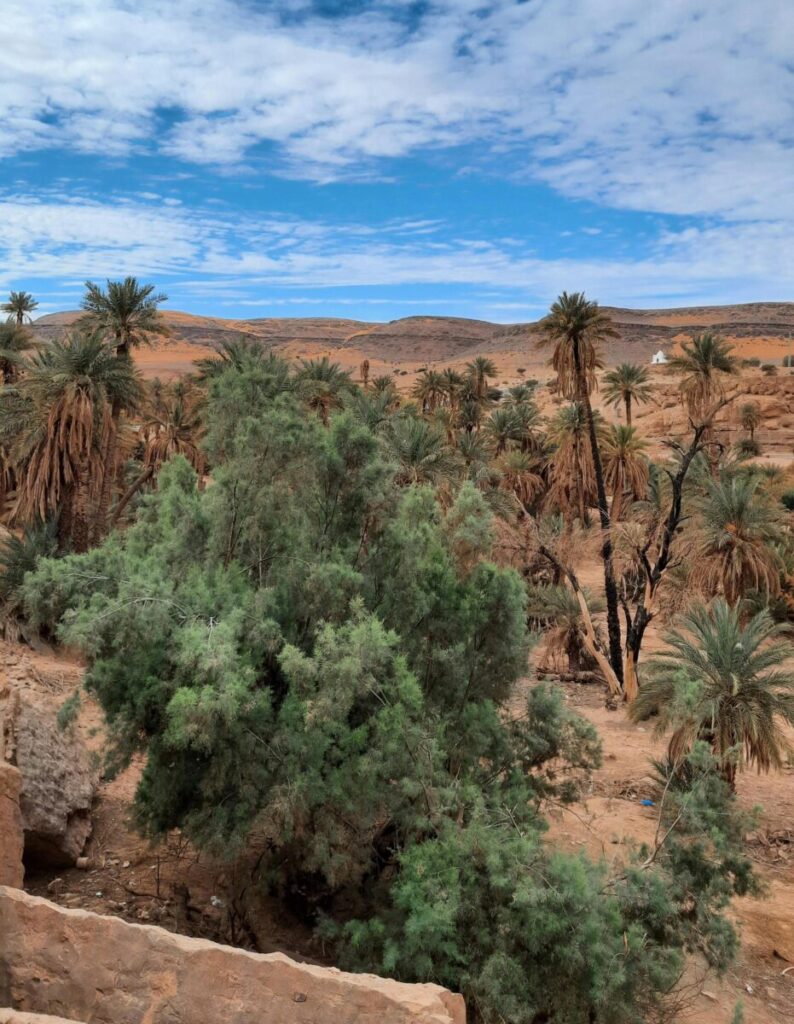
Feature photo: palm grove in the governorate of Médenine The governorate of Médenine in the southeast of Tunisia © Mohamed Fsili - Pexels