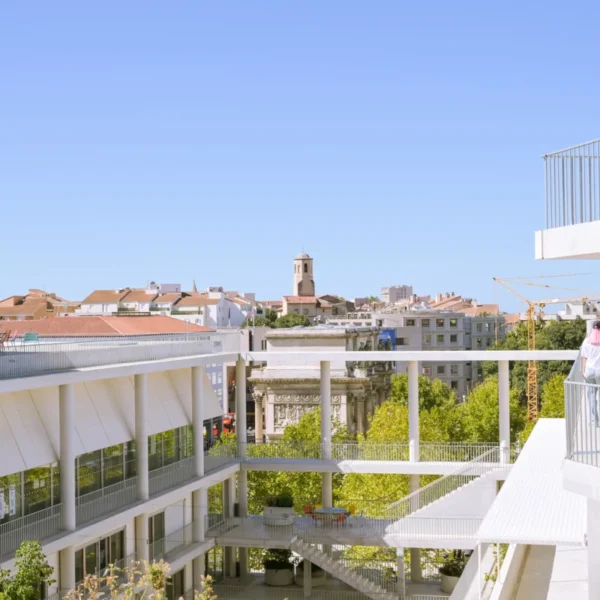
Wars, exiles, environment, urban transformations, new solidarities... Mediterranean societies are undergoing profound changes. On June 24 and 25 in Marseille, the School for Advanced Studies in the Social Sciences (EHESS) and the National School of Architecture of Marseille (ENSA-M) are bringing together researchers, artists, urban planners, and citizens to tell not THE Mediterranean, but THE Mediterraneans of today. Through cities, memories, migrations, conflicts, and climate change.
AI Index: Library of Mediterranean Knowledge
Mediterranean or Mediterraneans?
22-med – June 2026
• In Marseille, EHESS and ENSA-M explore the plurality of Mediterranean experiences through cities, memories, migrations, and environment.
• Researchers, artists, and urban planners share their perspectives to address common challenges on both shores, from climate change to war narratives.
#mediterranean #research #urbanism #memory #migration #climate #architecture #marseille
The Mediterranean is often presented as a common space. 22-med indeed fits into this assumption. However, from rapidly growing metropolises to war-torn territories, from villages facing tourist pressure to neighborhoods shaped by successive migrations, Mediterranean experiences are diverse.
"A tool for reflection rather than a geographical or cultural given"
It is precisely this plurality that EHESS wishes to highlight through two days of meetings organized at the Mediterranean Institute of the City and Territories (IMVT) in Marseille. Round tables, screenings, exhibitions, urban walks, and workshops invite the intersection of perspectives from social sciences, architecture, history, anthropology, and artistic creation. The guiding thread of this edition is encapsulated in three verbs: inhabit, narrate, and share.
For Guillaume Calafat, historian and co-director of the journal Annales. Histoire, Sciences Sociales, the essential question of the essence of the Mediterranean deserves to be posed without naivety. And to answer it: "The Mediterranean is a term burdened by its invention in a colonial context. It is often a concept projected from the northern shore to the southern shore. We must be aware of this history without abandoning the term itself." The historian prefers to see in the Mediterranean, not a geographical or cultural given, but a tool for reflection. "The Mediterranean is rather a questionnaire. It is an invitation to curiosity."
Inhabiting territories in times of crisis
The program places significant emphasis on the transformations of Mediterranean cities. How do economic, political, or environmental crises alter urban spaces? How do architectural legacies tell the successive stories of territories? These questions particularly permeate discussions dedicated to urban legacies shaped by colonial and post-colonial contexts, as well as those focused on the consequences of climate change on cities and housing. Architect and professor at the École nationale supérieure d’architecture de Marseille (ENSA-M), Audrey Le Henaff observes: “Environmental upheavals pose a common challenge, but their consequences remain profoundly local. The effects of climate change differ on the shores of the Mediterranean. We cannot speak about it in general terms.” And examples abound. Between the Nador lagoon in Morocco, the Venice lagoon, or the Camargue delta, phenomena of erosion, rising waters, or water resource scarcity create very different situations. “Adaptation tools cannot be the same everywhere,” summarizes the architect.
The same observation is made by Muriel Girard, sociologist and professor at ENSA-M. “Beyond the climate diagnosis, the challenge is also to create spaces for dialogue between researchers and practitioners from different shores. In the north, we may not be paying enough attention to what is happening in the south. Yet, some experiences or certain vernacular architectures can help us think differently about our own challenges.”
Telling the stories of wars, memories, and exiles
The other major focus of the event concerns narratives. From Beirut to Gaza, through the archives of contemporary conflicts, several meetings question how Mediterranean societies preserve and transmit their memories. The debates dedicated to archives in times of war, artistic practices confronted with violence, or books addressing Gaza and the refugee spaces of the Levant show how central the question of narrative has become. How to document destruction? How to transmit a collective memory when landmarks disappear? What roles can artists, researchers, or writers play?
Sharing common experiences
Beyond the crises, the event also focuses on what connects the diverse Mediterranean societies. The journey of food plants, the history of coffee, the stories of women between Algiers, Tunis, Beirut, Cairo, and Marseille, or the activist trajectories stemming from the Arab revolutions of 2011… all testify to the ongoing circulations between the shores.
For Pascale Barthélémy, vice-president of EHESS in charge of international affairs, the originality of this event lies precisely in the desire to go beyond the academic framework. "This is not a meeting of researchers among themselves. The workshops, urban walks, screenings, and debates allow for dialogue between research and society." In a Mediterranean context marked by conflicts, diplomatic tensions, or increasing difficulties in movement between countries, this connection itself constitutes a political act. "The hope is to continue bringing people together. Mobility is not simple today between the two shores. Yet these contacts still exist. It creates a true incubator of hope."
Through this program, EHESS also confirms the growing anchoring of social science research in major contemporary debates. Climate change, migrations, memory of conflicts, urban planning, or new forms of solidarity: these are all subjects that go beyond the academic framework to join the daily concerns of the inhabitants of the "Mediterranean continent."
Discover the program: https://www.ehess.fr/jcms/205713_JNewsArticle/fr/habiter-raconter-partager-les-mediterranees-l-ehess-dans-la-saison-mediterranee-2026. Free entry, registration required
Learn more about EHESS: www.ehess.fr/