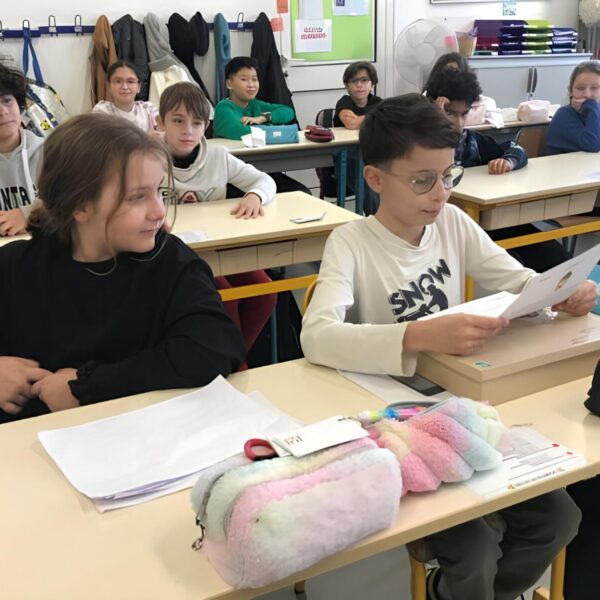
Can you learn to be generous like you learn math or history? Since 2012, the association The School of Generosity offers primary school teachers a free program that invites students to discover philanthropy, choose a cause, and carry out a solidarity project. More than 20,000 children have already participated in this initiative throughout France. Report in a 5th-grade class in Marseille.
AI Index: Mediterranean Knowledge Library
Learning Generosity Through School
22-med – June 2026
Since 2012, The School of Generosity has been introducing primary school students to philanthropy.
In Marseille, a 5th-grade class learns to choose a cause and build a solidarity project.
#Education #Generosity #Philanthropy #Solidarity #Marseille
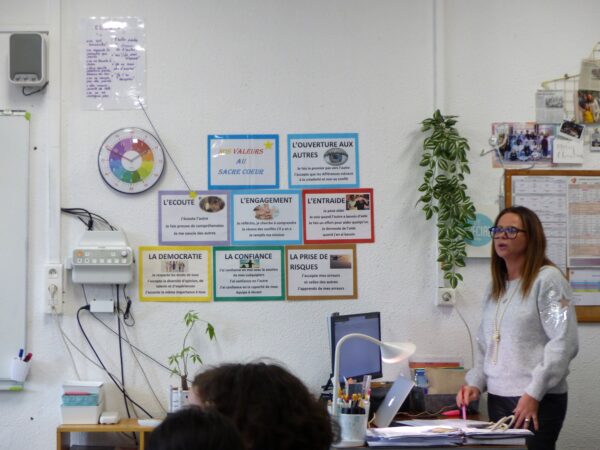
This Friday afternoon, the 5th graders at Sacré-Cœur School in Marseille have mail. Philomène Empathie has written to them again to help them become little philanthropists. And it is Fanny Caubet-Diadema, a volunteer at The School of Generosity who plays the postwoman. Created in the Paris region in 2012, at the initiative of the Edmond de Rothschild Foundations, this association aims to open children to others, promote social cohesion, and lead them to concretely support a cause. It has already raised awareness among over 20,000 children in France, thanks to the participation of about a hundred teachers each year, in both public and private schools.
A turnkey method
The School of Generosity provides teachers with free turnkey resources on project-based pedagogy. Volunteers receive a guide to follow at their own pace throughout the school year (about 13 hours of activities) to foster critical thinking, empathy, and engagement. These are all issues of moral and civic education (EMC). They also have at their disposal a directory of partner associations to choose with which they will co-construct their project.
A foundational program "developed with teachers, proving effective for ten years, now implemented in almost all academies and at all primary levels," details Chloé Laudereau, head of the association. Initially intended for 4th and 5th graders, it opened to 3rd graders a few years ago. And has recently been adapted into a simplified version for 1st and 2nd graders. I think it's necessary to specify ages as these acronyms mean nothing abroad.
Choosing a cause to defend
"Philomène is a journalist," explains Fanny Caubet-Diadema. "She sends a first letter to the children to introduce the vocabulary and the notion of philanthropy. Then a second to present the major causes she defends, providing them with press reviews so they can work on the different themes. And finally, a last one to introduce the presentations the children will make on the different causes."
It is this last letter that the students of Sacré-Cœur discover during this session of a good hour and a half. On that day, they become ambassadors of the cause they present to the class in small groups. To get as many votes as possible from their classmates. Because it is the cause with the most votes that will then be defended.
Access to culture for all, education, health, environmental protection, fight against poverty and exclusion, defense of human rights. Each of these themes benefits from advocacy, sometimes timid, sometimes more militant, with illustrative panels to support. Some are even highlighted by slideshows and models. And it is access to health that wins, during the secret ballot vote.
A cause that had already been chosen two years ago. Because Faustine Damaz, their school teacher, is already in her fourth year with Philomène Empathie... And with Fanny Caubet-Diadema, her partner in the experience. A particular case since teachers generally implement the program alone, in full autonomy. “At the beginning, we offered volunteer support,” recalls the head of L’École de la générosité, “and some partnerships have endured.”
Changing Scale
“Today, we rather aim to equip teachers, notably with Canopée, the training operator of the National Education. But there is an engagement phase, from September to November, during which we organize presentation seminars for those who are interested. Then, throughout the year, we offer them regular exchange times. We also work with inspectors to involve them more and on a broader communication platform to directly reach teachers. We only have very good feedback, but more and more children need to benefit from it.”
From Idea to Action
“ It is very little known, regrets Faustine Damaz, who seizes every opportunity to talk about it to colleagues. While it is well done and it is super interesting. ” And to list all the assets of this program : “We are really in transversality since we address notions of EMC, history, geography, French, math... The children are actors in their learning. It unites. And clearly it strengthens their empathy. ” “ There hasn't been a year with little enthusiasm ,” continues Fanny Caubet-Diadema. This impact project manager joined this association out of love for school and exchanges with children: “ It's great, always enriching. We show them that being generous is not necessarily about giving money. ”
In the first year, the students chose to support Sea Shepherd – which fights against the destruction of marine life and habitat – by providing awareness quizzes and selling merchandise. The second year, they worked for Le rire médecin – which entertains hospitalized children. "They made laminated drawings for the young patients and joke notebooks, wore clown noses, organized a cake sale for the benefit of the association..." enumerates the volunteer. And last year, they helped Pépins, a neighborhood nursery, by creating original communication materials like a comic strip and a card game.
This year, it's for L’École au présent – which supports extremely precarious families – that they will carry out a project. Their project, developed according to the needs of the association that they will soon discover. During the next session, its founder Jane Bouvier will come to discuss it with them. "And what if all the ideas we suggest, they've already done?" asks a student. "I'm sure you'll come up with new ones" reassures Fanny.
Cover photo: a student reads Philomène's letter, introducing the presentations. © AS