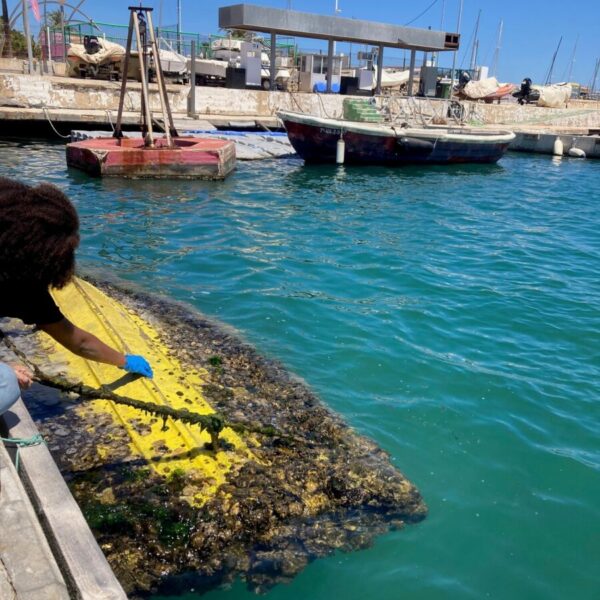
Beneath the waterline, an invisible enemy has accompanied ships for centuries. Algae, barnacles, mussels, and microorganisms gradually cling to hulls, increasing their resistance in the water. Result: ships consume more fuel, emit more CO₂, and require more frequent maintenance operations. These organisms also promote the spread of invasive species from one marine area to another. To address this issue, the Endfouling project, developed around the port of Valencia, explores an original approach: transforming port organic waste into biological additives capable of protecting ships more sustainably.
AI Index – Mediterranean Knowledge Library
Food waste to protect ships
22-med – June 2026
The Endfouling project transforms food waste produced in ports into biological additives designed to limit the biofouling of ship hulls.
In Valencia, this innovation combines circular economy, bioinformatics, and real-world testing to offer a more sustainable alternative to conventional antifouling treatments.
#MaritimeTransport #Biofouling #CircularEconomy #Innovation #Ports #OrganicWaste #Biotechnologies #Spain #Mediterranean #22med
Developed between 2024 and the end of 2026, the Endfouling project aims to propose a new approach to combating biological fouling. With a budget of 624,724.89 euros, it is funded by the Valencian Institute of Competitiveness and Innovation (IVACE+i), as part of its strategic cooperation projects program, with the support of the European Regional Development Fund (ERDF). It brings together AIMPLAS, the Fundación Valenciaport, Biotech Vana, and Seroil Valencia. The Valenciaport Foundation is responsible for validating the prototype under real operating conditions. At the same time, it analyzes the different waste streams produced in the port of Valencia to identify those that can serve as raw materials for the production of new antifouling materials.
"Marine fouling that attaches to the hulls of ships increases water resistance. When this happens, the ship needs more energy to move, consumes more fuel, and generates more CO₂ emissions. Additionally, maintenance costs increase and the transfer of invasive species between different marine areas can be facilitated," explains Carolina Navarro, Director of the Blue Economy at the Valenciaport Foundation.
Real-world testing
Trials are not limited to the laboratory. For the project partners, it is essential to quickly confront this technology with the constraints of the port environment. "Validation in a real environment is fundamental," emphasizes Carolina Navarro. "In the laboratory, many parameters can be controlled, but in the port, factors such as salinity, temperature, currents, prolonged exposure to water, the biological activity of the marine environment, or the specific conditions of operation come into play. The challenge is to demonstrate that the prototype is not only technically effective but also viable, safe, sustainable, and compatible with the real needs of the sector."
Beyond innovation, the project also reflects an evolution in the way ports are conceived. They are no longer considered merely as logistical or industrial infrastructures but as ecosystems where goods, people, energy, water, materials... and waste circulate.
"We stop seeing the port solely as a logistical or industrial infrastructure and start understanding it as a complex ecosystem. In the circular economy, waste ceases to be just a management problem to become potential resources."
From Food Waste to Biological Additives
The core of the project is to transform organic waste into biological additives capable of limiting the development of marine organisms on hulls. The research mainly focuses on organic waste produced in port environments and aboard ships, including kitchen scraps and post-consumption food waste (fruits, vegetables, meats, bread, dairy products, flours, etc.).
As explained by Alberto González Chuliá, technical manager of the Endfouling project at the AIMPLAS Plastics Technology Institute, the production of these biological additives is based on a multi-step valorization process. "First, the different wastes are analyzed to determine their nutritional composition, identifying those with the highest potential to promote the growth of microorganisms with antifouling capacity. Then, the selected wastes are ground, mixed with a suitable culture medium, and sterilized before being introduced into a bioreactor. There, fermentation is carried out under controlled conditions, allowing the production of microbial biomass, which is then filtered and concentrated."
Alberto González Chuliá highlights that this resource presents a dual interest. Available in large quantities in ports, it also has a high organic matter content, favorable to the development of the desired microorganisms. "These wastes are characterized by their heterogeneity, low density, and different levels of contamination, including the presence of plastics and packaging materials. Their interest lies in their high organic load, particularly in sugars and chemical oxygen demand (COD), making them suitable substrates for microbial growth." Their abundance in port environments thus makes them a sustainable source for producing new biotechnological additives.
Enzymes, Microorganisms, and Digital Modeling
To prevent biofilm formation on marine surfaces, the Endfouling project combines several complementary approaches. Enzymes degrade biofilm components while microorganisms limit the proliferation of fouling organisms.
Bioinformatics then intervenes to optimize the enzymes and anticipate the behavior of the future antifouling material before its use.
"Through bioinformatics techniques and models, we aim to predict the actual antifouling activity that the final product will present by analyzing real test data and correlating it with different variables, such as water temperature or additive concentration, among others."
This modeling relies on computational models and machine learning to improve the efficiency and stability of the enzymes before their application on an industrial scale.
An Alternative to Conventional Treatments
If the project confirms its success, it will enable the development of more sustainable antifouling materials based on biological solutions. The reuse of port waste would help strengthen the circular economy while reducing fouling on marine structures, maintenance costs, energy consumption, and reliance on conventional treatments. The goal is to offer a more sustainable alternative to conventional antifouling systems based on synthetic compounds, in order to reduce the use of substances potentially harmful to the marine environment. "In the medium term, this technology could be integrated into coatings and materials exposed to the marine environment, contributing to more effective and environmentally friendly protection," adds Alberto González Chuliá.
For Carolina Navarro, this approach could also extend beyond the port of Valencia. "It can also pave the way for other ports to adopt similar approaches and transform their own environments into laboratories of circular economy and environmental innovation."
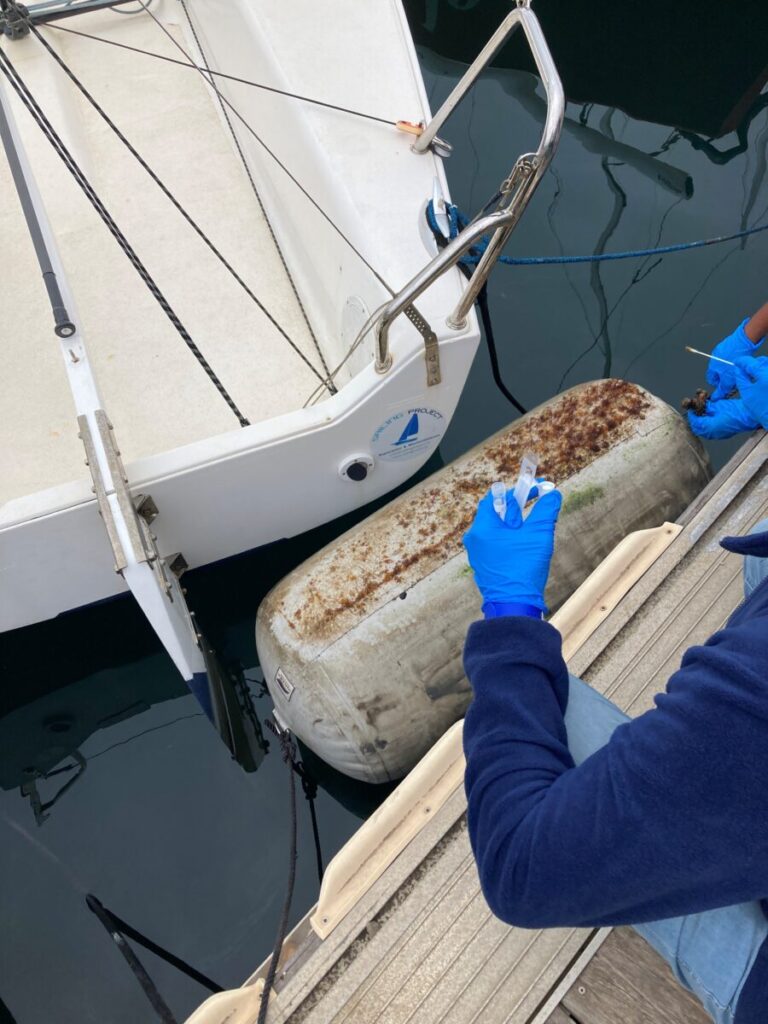
Featured Image: A boat covered in biofouling ©Fundacion-ValenciaPor