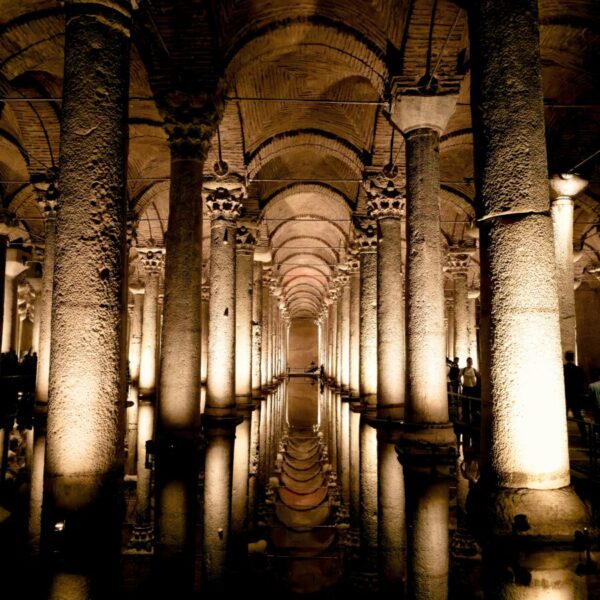
Surrounded by seas, Istanbul has always lacked drinking water. Since antiquity, this structural constraint has imposed an extraordinary technical response. Monumental aqueducts, distant catchments, gravitational networks, and underground cisterns have allowed the imperial capital to function without a river. From the Roman period to Byzantium, hydraulic engineering has shaped a city dependent on complex, invisible, and vital systems that remain inscribed in its landscape.
Index IA: Library of Mediterranean Knowledge
Istanbul, a city without a river, has been struggling for water for two millennia
22-med – February 2026
• In Istanbul, access to drinking water has long depended on aqueducts, cisterns, and distant catchments, in a city bordered by the sea.
• From Roman antiquity to Byzantium, hydraulic engineering has shaped a capital forced to manage scarcity as a structural issue.
#turkey #istanbul #water #drought #history #engineering #aqueduct #cistern #byzantium #empire
In a geography devoid of natural sources of fresh water, urban life has always depended on water transported from distant basins and massive reserves accumulated underground. Aqueducts, cisterns, dams, and fountains were not only technical feats: they represented the responses of empires to scarcity, climatic constraints, and demographic pressure. Even today, this infrastructure inscribed in the landscape retains the memory of Istanbul’s struggle against drought.
Constantinople: the capital without water
Constantinople was founded as a superior city in terms of defense and commerce due to its strategic position and its opening to several seas; however, unlike metropolises like Rome, Antioch, or Alexandria, which were built on great rivers, it had to transport its drinking water. The foundations of the city’s water infrastructure were laid in the 2nd century AD by Emperor Hadrian, following the integration of Byzantium into Roman territories. The first major aqueduct bringing water to the city from the springs of the Belgrad forests* was constructed at that time.
Subscriber-only article
The press has a cost. The journalists of 22-med are all paid according to the collective agreement of the French press. Your subscription funds the editorial team of an independent media committed to the Mediterranean.