
In a politically fragmented Mediterranean, but one that is aware of the ecological urgency, the Mediterranean network of marine protected area managers (MedPAN) plays a structuring role. By bringing together more than 700 protected marine areas, it helps to foster a common vision at the basin level. Initiatives like the 100MPA MedAlliance translate this cooperation into concrete actions to address climate change that disrupts marine and coastal ecosystems. A dynamic that outlines a Mediterranean governance of life, between concrete action, science, politics, and diplomacy.
Index AI: Library of Mediterranean Knowledge
Climate: MedPAN connects the marine protected areas of the Mediterranean
22-med – May 2026
• MedPAN connects more than 700 marine protected areas in 21 countries to structure a Mediterranean response to climate change.
• The 100MPA MedAlliance supports managers towards more resilient, better-funded, and better-connected marine protected areas.
#mediterranean #climate #biodiversity #sea #marineprotectedarea #medpan #cooperation #ecosystem #tourism #fishing.
At the scale of the Mediterranean, the protection of the sea can no longer be thought of on a country-by-country basis. Currents, species, and climate impacts ignore borders. It is precisely on this observation that MedPAN was built. The network currently federates more than 700 marine protected areas (MPAs) in 21 countries, out of the 1,000 recorded. “It is a network of actors, men and women who work daily for the protection of a collective marine natural heritage,” emphasizes Carole Martinez, the policy manager of MedPAN. “We connect dispersed actors around the basin, organize exchanges of experience, and circulate solutions in a space marked by borders and tensions.”.
A common sea, systemic challenges
The Mediterranean is both a biodiversity hotspot and a climate change hotspot. “The Mediterranean is warming 3 to 5 times faster than the rest of the world,” reminds Carole Martinez. Marine heatwaves are multiplying, now affecting a large part of the basin, with already visible impacts on ecosystems.
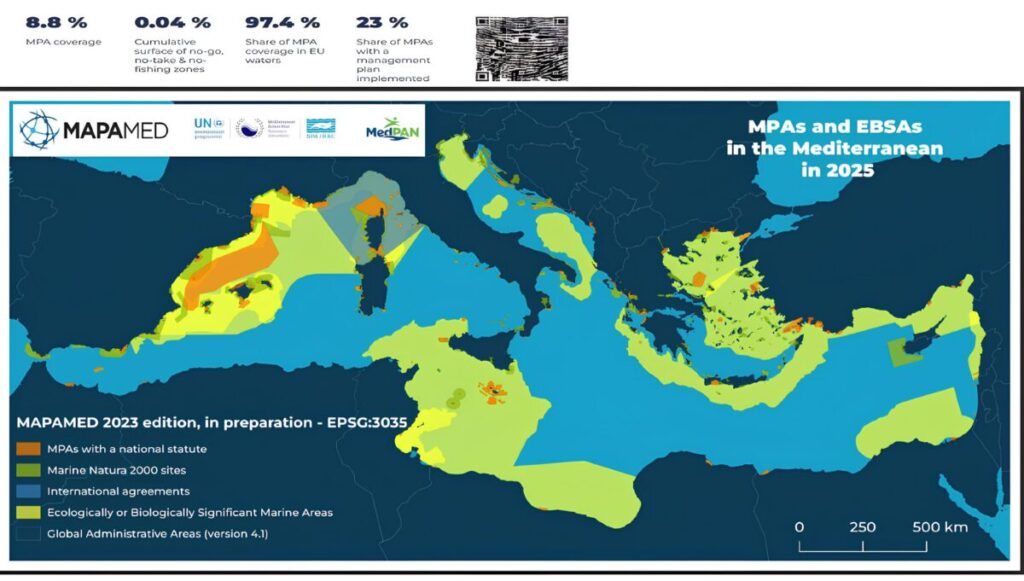
In this context, marine protected areas appear as essential tools. However, due to the lack of a coordinated global policy, their effectiveness remains limited to their perimeters. They cover 8.8% of the Mediterranean surface, far from the 30% target set for 2030. Moreover, this protection is very unevenly distributed, with nearly 97% of efforts concentrated on the northern shore.
A Mediterranean vision taking shape
In the face of these imbalances, a common vision is gradually emerging. It does not rely solely on states but on a combination of regional agreements, international frameworks, and networks of actors. “Yes, there is indeed a common vision. It is reflected in strategies adopted by states and regional frameworks like the Barcelona Convention,” explains Carole Martinez. This was signed in 1976 and revised in 1995 to more explicitly integrate the issues of sustainable development and the protection of marine and coastal environments in the Mediterranean. The initial vision of the Barcelona Convention materializes in several shared tools to which many actors contribute: regional strategies, Mediterranean programs, and a roadmap for marine protected areas by 2030. All these frameworks align ambitions around shared objectives. In this system, MedPAN plays a central role in mediation. “We are a two-way transmission belt, from the field to decision-makers and from decision-makers to the field.”
From network to action: the era of adaptation
In the wake of this structuring, new initiatives are emerging. The 100MPA MedAlliance is one of the most emblematic. Its goal is to support managers of marine protected areas to concretely integrate climate change adaptation into their practices. “The challenge is to provide scientific, technical, and human support so that managers of marine protected areas can foster and support the resilience of ecosystems,” specifies Carole Martinez.
Beyond the tools, the alliance is based on a logic of community of practice and offers training, experience exchanges, and solution sharing. An evolution that marks a turning point, as marine areas are no longer just considered as spaces for the protection of fauna and biodiversity, but as levers for adaptation, nature-based solutions. “Today, we talk about ‘climate smart’ marine protected areas, capable of adapting to ongoing transformations.”
Building a Mediterranean system and providing it with resources
The challenge is not to add up protected areas, but to build a coherent and interconnected network. Because marine ecosystems are interconnected. “Under the effect of climate change, changes are already visible in the distribution areas of species, and interactions between ecosystems are evolving. We need to work on the issues of connectivity between ecosystems and species in marine spatial planning and the implementation of conservation actions,” insists Carole Martinez.
This systemic approach requires strengthened cooperation between countries, but also a rebalancing between the shores. However, the effectiveness of marine protected areas depends on one key factor: resources. “We need to avoid the syndrome of paper parks.” Without personnel, funding, or monitoring, MPAs cannot fulfill their objectives. Today, nearly 84% of managers interviewed report a lack of human resources. And financial needs remain largely underestimated. Yet, the benefits are very real.
Placing ecology at the heart of economic development
Beyond biodiversity, marine protected areas play an increasing role in economic development. “Healthy ecosystems are the first development agency for our region,” summarizes Carole Martinez. Fishing, tourism, food security: the health of the sea conditions that of Mediterranean societies. When MPAs are well managed, ecosystems can regenerate, fish stocks can recover, and local economic activities, particularly artisanal fishing and tourism, benefit.
However, there is a paradox, as the region alone accounts for nearly a third of global tourism, which raises the question of development compatible with preservation. MedPAN and associated initiatives are therefore outlining the contours of a Mediterranean governance of life. A system where states, scientists, and field actors work together. A governance based on interdependence, knowledge sharing, and the search for common solutions. In the face of the climate emergency, the Mediterranean could emerge as a laboratory where, amid geopolitical tensions, a collective response to the ecological crisis is gradually being built.
Biography
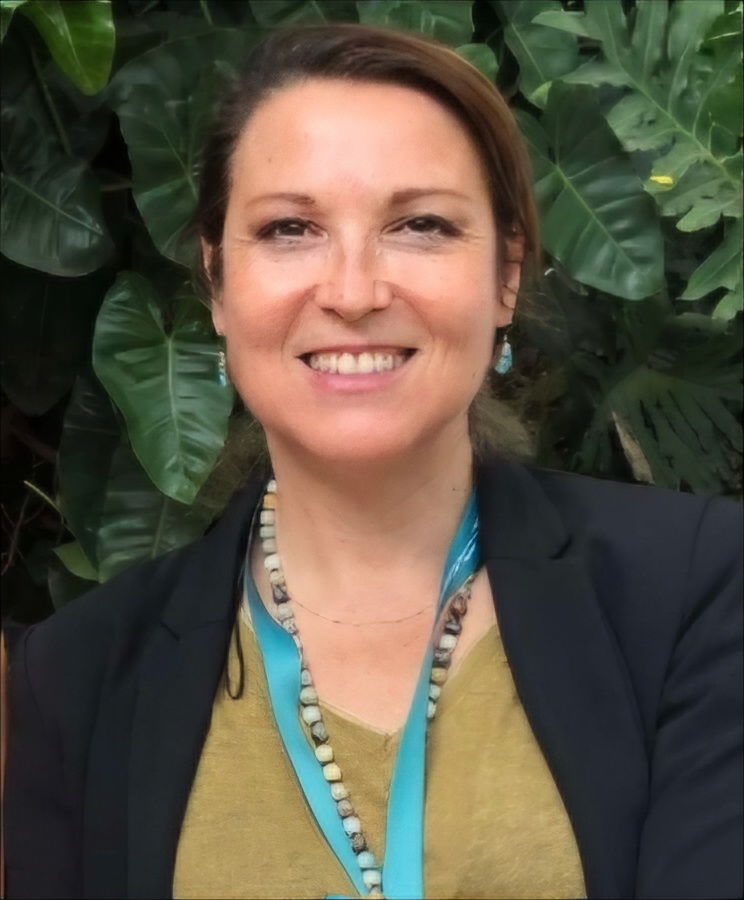
Carole MARTINEZ, a lawyer in environmental law and Policy Manager at MedPAN, has over 25 years of experience in the protection of marine, coastal, and island ecosystems. An expert with the United Nations Division for Ocean Affairs and the Law of the Sea (DOALOS) and the IUCN World Commission on Protected Areas, she has worked at national, European, and international levels, notably for the French government. She has coordinated cooperation projects and managed programs in biodiversity hotspots, in Africa, the Caribbean, the Pacific, the Indian Ocean, and polar regions. Now the Policy Manager within the Mediterranean network of marine protected area managers (MedPAN), she develops analysis and advocacy actions to voice the concerns of field actors to decision-makers, particularly within the Union for the Mediterranean, the Secretariat of the Barcelona Convention, the Mediterranean Commission on Sustainable Development, as well as European institutions — the European Commission and the European Parliament — and international bodies, notably the secretariats of conventions on biodiversity (Convention on Biological Diversity) and climate (United Nations Framework Convention on Climate Change). She also supports MedPAN’s cooperation actions with other regions and networks of actors, particularly in Africa and the Caribbean.