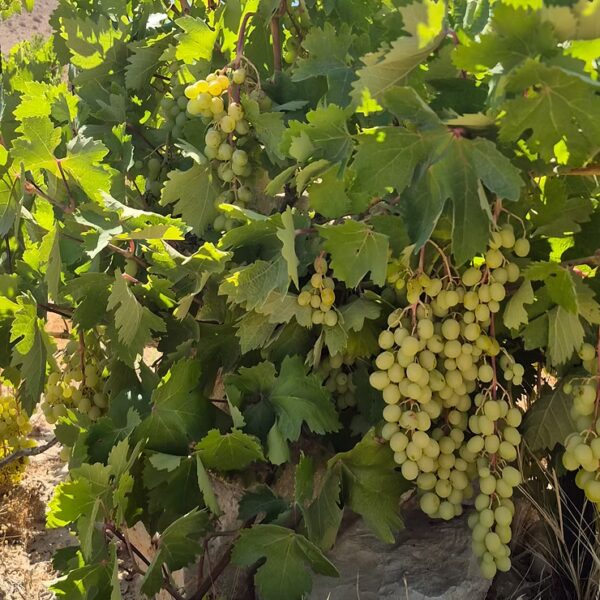
In Avdat, in the heights of the Negev, Israeli researchers have succeeded in growing grape varieties cultivated in the region nearly 1,500 years ago. After retrieving their DNA from ancient seeds, they replanted their descendants and produced a wine that surprised specialists. But behind this archaeological experiment lies another challenge, finding varieties capable of withstanding climate change.
During excavations conducted between 2017 and 2019, charred grape seeds dating back to the 7th century were discovered. Two ancient varieties were identified: Syriki, with black grapes, and Ba’ar, used to produce white wine. One of the researchers was particularly studying the quantities of seeds present in the different archaeological layers to trace the rise and fall of the wine industry in the Negev during the Byzantine era. Traces of this agriculture are still numerous in the valleys and open spaces, where many wine presses remain. The ancient wine industry is thus an integral part of the archaeological landscape.
A unique archaeological discovery
“The seeds were sent to the University of Haifa. Researchers found that they were well enough preserved to attempt extracting DNA. Further research allowed us to characterize these grapes and identify them as heritage varieties from the southern Land of Israel. After a long process, we managed to find their direct descendants. One of them corresponds to a grape variety found today in Greece,” said archaeologist Lior Schwimer of the Israel Nature and Parks Authority to Itonnews.
Then the researchers took cuttings and replanted them, without fertilizer, where the seeds had been discovered: near a cave located just a few meters from an ancient farm dating back to the Byzantine era. They used ancient methods, based on the layout of agricultural plots from that time.
“In parallel, I undertook excavations on the site with a colleague from the Israel Antiquities Authority and we discovered a large press capable of producing about 6,000 liters per day,” says Lior. The team then noticed that the cuttings developed much faster than European grape varieties. “We harvested about 400 kilos of grapes from the two main varieties and entrusted them to two producers who work using natural methods. They added neither sulfur nor acids. The grapes were left with their skin so that natural yeasts would spontaneously trigger fermentation,” recounts Lior.
The first bottles surprise
Upon opening the first bottles, the result is surprising. The wine is good, slightly different, more fruity, and with a fairly high alcohol content. “Since then, we regularly open a bottle to observe its evolution. The wine changes even after bottling,” continues Lior.
Subscriber-only article
The press has a cost. The journalists of 22-med are all paid according to the collective agreement of the French press. Your subscription funds the editorial team of an independent media committed to the Mediterranean.