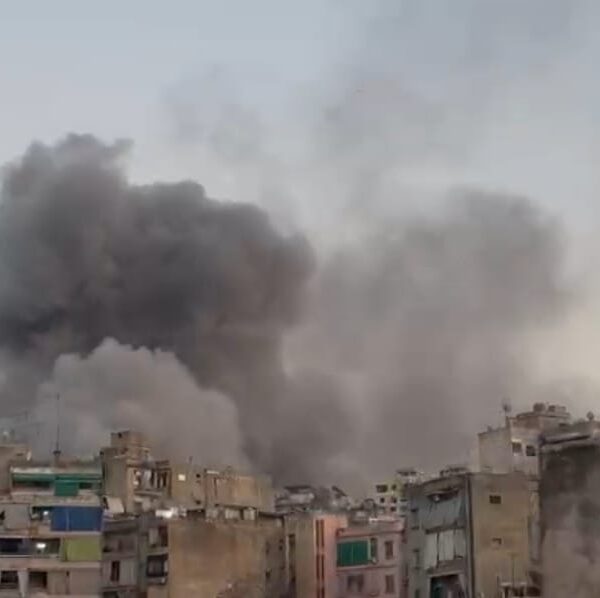
The challenge to the ceasefire with Iran by the United States highlights how fragile the balances in the Eastern Mediterranean remain. Far beyond the battles, a regional war disrupts economies, disorganizes public services, weakens tourism, and imposes new reflexes on populations. From Israel to the Palestinian territories, from Lebanon to Cyprus, from Egypt to Turkey, six reports tell how the conflict transforms the daily life of societies that, for the most part, do not directly participate in it.
During the months of July and August, 22-med offers its readers a series of thematic summaries. The goal is to explore a single issue through experiences, initiatives, and complementary perspectives from both sides of the Mediterranean. This article is a synthesis of six reports published by 22-med, available in the 11 languages of the media.
Civil life tested by war: chronicles from the home front – Caroline Haïat – Israel
Palestinians see their daily life disrupted again – Monjed Jadou – Palestine
Under the bombs, the duty to inform – Edward Sfeir – Lebanon
At the gates of the conflict, a daily life under tension – Andri Kounnou – Cyprus
Will the war against Iran affect the "historic growth" of tourism? – Mohamed Ahmed – Egypt
Tourism in the shadow of war – Tuğba Öcek – Turkey
The realities differ from one country to another, but the same impression prevails. War finds its way into conversations, decisions, and daily gestures everywhere. For some, it is an immediate threat. For others, it acts by ricochet, disrupting travel, economic activity, or the work of those who continue to inform, heal, or teach.
The reinvented daily life
In Israel, sirens dictate their rhythm. A medical consultation, a class, or a television news broadcast can be interrupted at any moment to head to a shelter. In hospitals, entire departments are moved to secure areas. At the Rabin Medical Center, a surgeon recounts performing a cesarean section during an alert. Bringing life into the world under the threat of missiles epitomizes the determination to maintain a semblance of normality.
Schools are also living in sync with safety instructions. Some are gradually resuming their activities, while others continue online classes. Families are torn between the need to give children a social life and the constant fear of a new alert.
In the Palestinian territories, the atmosphere is different but just as heavy. After more than two years of war in Gaza, the regional escalation plunges the population back into uncertainty. Authorities are setting up emergency cells, monitoring food stocks, securing hospitals, and urging people to avoid panic buying. Schools are once again shifting to distance learning after several incidents caused by missile fallout. More than a new crisis, it's the feeling of never really emerging from the previous one that prevails.
In Cyprus, finally, no one lives under bombardment. Yet, the geographical proximity of the conflict, the presence of British bases, and the drone attack on the Akrotiri base remind that war is never far away. Authorities are multiplying reassuring messages while teachers answer students' questions, often fueled more by social media than by the facts themselves.
Continuing despite everything
When war settles in a region, certain professions become essential. Healthcare workers, of course, but also journalists, tasked with explaining events whose consequences they themselves endure.
In Lebanon, reporters describe a daily life where thirteen-hour days have become the norm. Strikes interrupt investigations, information flows incessantly, and personal projects are pushed to the background. One journalist explains having suspended her wedding preparations. Another works day and night from her small studio in Beirut, between bombings and concern for her family remaining in the south of the country. The most experienced say they recognize the smell of conflicts even before seeing the destructions.
In Israel, journalists experience a different reality. Sirens interrupt live broadcasts, sets empty for a few minutes before everyone resumes their place in front of the camera. All recount the same difficulty: continuing to inform accurately while war has now become part of their own daily life.
Tourism under threat
War not only disrupts the daily lives of residents. It also weakens one of the main economic engines of the Eastern Mediterranean. Long before a country is directly affected, the perception of risk is enough to change travelers' behaviors.
In Egypt, industry professionals are worried about a sudden downturn. After an exceptional year in 2025, cancellations are multiplying, particularly from Gulf countries. Hotels in Cairo and Giza are seeing their occupancy decrease while airfares soar due to rising fuel prices and disruptions in air traffic. Authorities are now monitoring bookings daily to be able to react quickly if the situation deteriorates.
Turkey is also feeling the initial effects of the conflict. In the provinces bordering Iran, the Nowruz period was supposed to, as every year, fill hotels and businesses. Instead, tourist circuits are canceled, border crossings slow down, and Iranian visitors almost entirely disappear. For many local businesses, a season that promised to be prosperous is suddenly in question.
Further west, in Istanbul, on the Aegean and Mediterranean coasts, the consequences remain limited. European visitors continue to come, but professionals are anxiously observing the first cancellations from the United States and Asia. Everyone knows that tourism reacts as much to perceptions as to realities. A few images of missiles or closed airspaces are sometimes enough to deter travelers from destinations that are far from the fighting.
In Cyprus, hoteliers are making the same observation. The island continues to offer a stable environment, but the proximity of the conflict fuels a concern that extends far beyond its borders. Authorities are therefore striving to preserve this image of security, which has become an economic issue in its own right.
A lasting shockwave
Across these six reports, one observation is clear. The effects of a war never stop at the borders of the countries that are fighting. They gradually spread throughout an entire region, through the economy, transportation, information, education, or the simple feeling of insecurity. Yet, these stories also tell another reality. That of men and women who refuse to let the conflict entirely dictate their existence. Surgeons continue their operations despite alerts. Teachers keep imparting knowledge, sometimes behind a screen. Journalists take the risk every day to document events so that facts do not disappear behind rumors or propaganda. Tourism professionals are already preparing for the recovery, convinced that travelers' trust will eventually return. This adaptability is undoubtedly the strongest common point between these six countries. Each experiences a different situation, but all strive to preserve what keeps a society together when uncertainty sets in.
As tensions around Iran continue to evolve and the prospect of easing seems to recede, the Eastern Mediterranean reminds us of an obvious fact. In such a closely linked space, a war never truly knows borders. Even without fighting on their territory, neighboring countries already feel the tremors, sometimes even in the most ordinary gestures of daily life.
Cover Photo: An attack in the heart of Beirut in the Bachoura district © Edward Sfeir