Global warming disrupts the water cycle, and human activity is exacerbating the shortage of fresh water. Tensions for the control and monopolization of this vital resource are escalating. Similar to oil in the 20th century, water is becoming a source of conflict. Can we find in the past, especially in regions of river culture, devices that allow resolving tensions among different actors?
The theme will be addressed in the next three forums in a dialogue between scientists: Bernard Mossé and Karl Matthias Wantzen.
Sequence 1 - The impact of human activity on the water cycle
Bernard Mossé : Can you provide a quick explanation of the water cycle, highlighting the role of rivers in this system?
Karl Matthias Wantzen: The water cycle includes evaporation, cloud formation, precipitation, surface or subsurface runoff, and finally the return of water to the oceans, often through rivers. In some cultures, such as in the Andes in South America, this cycle is compared to the cycle of life, with rivers representing the birth and death of souls. However, human activity disrupts this cycle, especially through surface sealing, the reduction of floodplain areas of rivers, and deforestation.
BM : The negative impact of humans is often traced back to the beginning of the industrial era. Can we say that human activity has been affecting this cycle for much longer?
KMW : Yes, but it is necessary to know where and on what scale. The large-scale river cutoff by dams results in the absence of sediments: the so-called "Delta" river mouths turn into "Beta" shapes due to erosion everywhere and in large quantities (only a third of the major rivers can still flow freely). This is a product of the last century, and a catastrophe for ecological functioning and their support for bio-cultural diversity.
If we take, for example, the link between vegetation and water, what is called the "flying rivers," that is, evapotranspiration by plants, which produces a certain humidity in the local air: depending on the amount, it can have a very strong impact. For example, for the part above the Amazon, in South America, 15 to 20% of the rain depends on these "flying rivers." The destruction of these primary forests has reached a tipping point. Its continuation would be a catastrophe first for South America and for the entire planet.
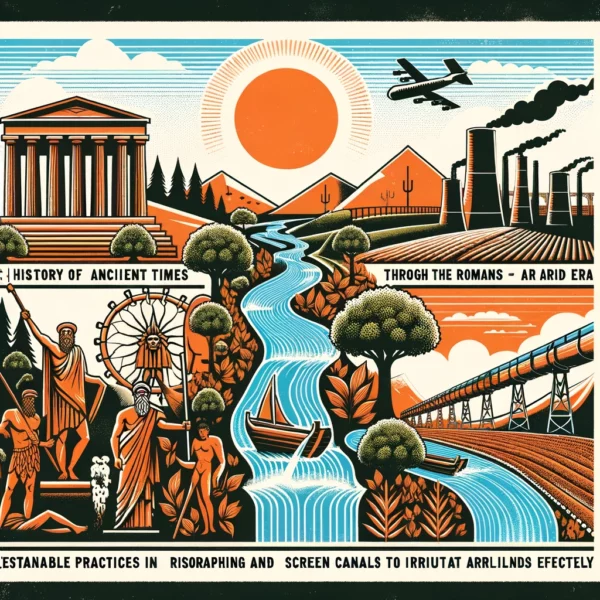
Around the Mediterranean, deforestation began with the Greek civilizations, perhaps even before with the Phoenicians, and then the Romans, to build their ships and fortresses. They also built dams and aqueducts, and polluted mineralization sites. This certainly had an influence on the water cycle and river flow, but with limited impact. Over the past centuries, and especially since the industrial revolution, human impact on the water cycle has intensified, with urbanization, dam construction, and excessive resource extraction.
BM : For the UNESCO Chair on Rivers for which you are responsible, you make the connection between environmental sciences and human and social sciences. The increasing scarcity of fresh water is a source of tensions, even conflicts, among various stakeholders. What solution do you propose to resolve them? Can we find in the past, perhaps in regions with a river culture, devices that allow to resolve tensions among different stakeholders?
KMW : For me, the solution lies in my concept of "river culture." It is necessary to transform watersheds, that is, the hydrographic basins that collect all the water that falls in a region, into political territories. If you allow me this neologism, we must transform territories into "hydrotories," that is to say, "responsibility basins." All humans and all nature within a watershed obey the same constraints and have the same interests. But most of the time human territories do not correspond to this geography. Rivers have a problem: they are long, so they cross several territories that often have a rounded shape. Beyond a certain length, rivers become sources of division between several territories. And that is a mistake. The river is the victim of territorialization. The river must be placed in the middle of the territory, building political landscapes around this hydrological reality.
BM : If I understand correctly, do you think that the interest of man is to model his actions on those of nature?
KMW : As long as our actions continue to disrupt the functioning of landscapes, yes, absolutely. Our decisions on a basin -dam or water transfer between two watersheds- have an impact on the survival of crops, species, and the quality of current and future generations at the same time. What quality of life do we want for the future?
Are we going to damage it with a user strategy that only targets the next 5 years, or do we want our children to have at least the same conditions as us, or ideally better conditions, regarding water abundance, pollution levels, presence of biological species, etc. If so, we need to change our behavior profoundly...
There are in the world populations with traditional customs that are perfectly suited to the rhythm of water, that is, to the variation in flow, between minimal flow and natural floods. But especially in Europe, there is this religion of feasibility and engineering that has ended up causing disproportionate impacts. We come back to your first question: the Romans have already disrupted nature, but they still kept their activities below a certain threshold. Today, this threshold is exceeded. Rivers have been so altered that we are faced with a vicious circle: the scarcer the resource becomes, the more greedy we are. This is the tragedy of the commons. We need to develop a common responsibility. It is obviously very difficult because human beings, as a biological species, react to immediate threats. We must integrate future forecasts into present actions. And we must convince the community that everyone does their part, including the strongest in competitive situations. I come back to the concept of responsibility basins: if we have a hydrological nation, we will act together because we do not want to leave the poorest behind if we want this community to benefit from a sustainable future. Even if we have to make sacrifices today, or give up certain practices, step out of our comfort zone. This is the most difficult part: convincing people, especially those who benefit the most from the current situation. But it can work with a community based on negotiation, understanding the stakes, and respecting each other. I have found some examples around the planet, in South America, India, and Africa, and of course also in Europe. Often, unfortunately, the trigger for this community is a disaster. This is what happened in the Rhine Valley with a chemical accident in 1986: all the countries bordering the Rhine then endorsed the conventions that had been on the table for years.
BM : Yes, it is a parallel that can be drawn with mass crimes: consciences awaken when the tragedy has occurred.
KMW : Regarding disasters, we must be careful because what is happening can be so strong that we may survive it, but maybe not. The more precise question is: at what level of quality of life do we want to live in the future?
The catastrophe of Sarnen in Switzerland (the pollution of the Rhine by the firefighters' water following the fire in a chemical factory) eliminated a large part of the fish in the river and cut off drinking water for several weeks. The problem extended to the sea. With adjustments, the problem was more or less resolved. However, with excessive deforestation of the watershed, without replanting, without protection, and with the construction of dams, the damage exceeds a human lifetime: there are indeed solutions, but we will not see them. We condemn future generations to live in water scarcity for several generations or forever. And that is the great responsibility of our generation today. We cannot just say, "we need to educate young people better so they can do better." No, it is today that we must act.
Pequeña biografía
Karl Matthias Wantzen studied biology at the University of Constance, completed his PhD on Brazilian waters at the Max Planck Institute, and obtained his postdoctoral qualification on the subject of "Biodiversity and nature conservation of large rivers." For 8 years, he led an international cooperation project on the Pantanal in Brazil, the vast floodplain of the Paraguay River.
Since 2010, he has been a professor at French universities, first in Tours, since 2023 in Strasbourg. In addition to a UNESCO Chair "Rivers and Heritage," he also leads an interdisciplinary chair "Water and Sustainability" for the trinational university partnership "EUCOR- The European Campus".
Plus d'informations sur https://ites.unistra.fr/recherche/equipes/bise/karl-matthias-wantzen, https://www.unesco-chair-river-culture.eu/
Bernard Mossé Historian, Research, Education, and Training Manager at the NEEDE Mediterranean association.
Member of the Scientific Council of the Camp des Milles - Memory and Education Foundation for which he was the scientific manager and coordinator of the UNESCO Chair "Education for Citizenship, Human Sciences, and Convergence of Memories" (Aix-Marseille University / Camp des Milles).
To go further
Wantzen K.M. (editor), Cultura Fluvial, Vida como una danza al ritmo de las aguas, Ed. UNESCO, 2023.
Here is the link: https://unesdoc.unesco.org/ark:/48223/pf0000382774
Wantzen, K. M. (2022): Cultura fluvial: cómo se desarrollan los vínculos socioecológicos con el ritmo de las aguas, cómo se pierden y cómo se pueden recuperar. The Geographical Journal, 00, 1–16. DOI: https://doi.org/10.1111/geoj.12476, descarga gratuita
Here is the translated text: https://rgs-ibg.onlinelibrary.wiley.com/doi/epdf/10.1111/geoj.12476
Wantzen, K.M., Ballouche, A., Longuet, I., Bao, I., Bocoum, H., Cissé, L., Chauhan, M., Girard, P., Gopal, B., Kane, A., Marchese, M. R., Nautiyal, P., Teixeira, P., Zalewski, M. (2016): Cultura do Rio: uma abordagem eco-social para mitigar a crise da diversidade biológica e cultural nas paisagens fluviais. Ecohydrology & Hydrobiology 16 (1): 7-18
http://dx.doi.org/10.1016/j.ecohyd.2015.12.003 téléchargement gratuit