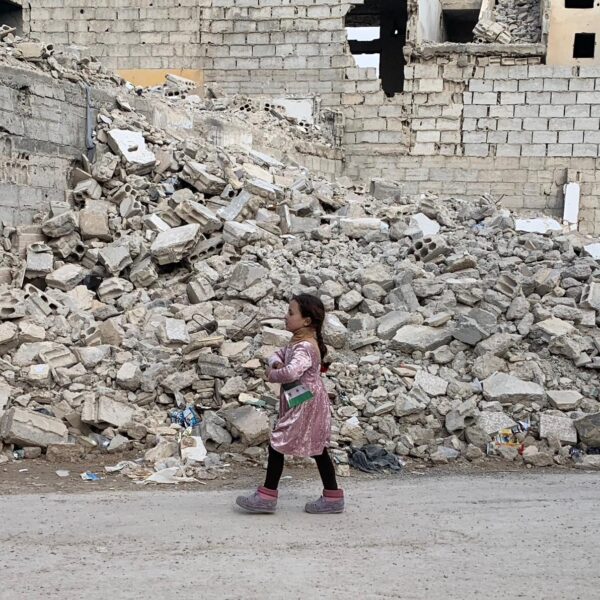
After fourteen long years of conflict, the fall of the Ba'athist regime opens an unprecedented window of opportunity for the future of Syria. Yet, behind the legitimate hope for reconstruction lies a colossal and complex challenge: how to rebuild a country whose environment, infrastructure, and resources have been methodically and systematically destroyed?

The chronicle “A Fragile World” is dedicated this June 26 to the environmental impacts and biases of post-conflict reconstruction in Syria. It is freely available for the 22 countries around the Mediterranean and in 11 languages thanks to our partner Arab Reform Initiative.
By Edward Sfeir
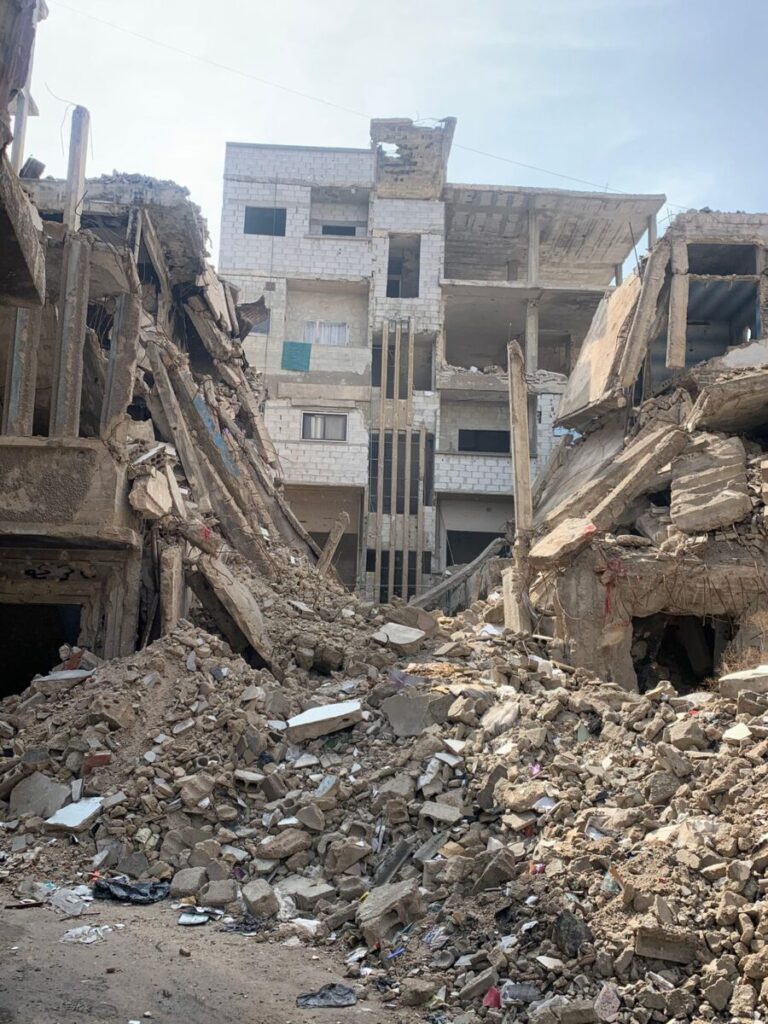
In the rubble of Aleppo, beneath the clouds of toxic dust still hovering over Damascus, Syria today reveals the extent of its environmental wound. The numbers speak for themselves. Three million homes reduced to ashes, their debris soaked with asbestos, heavy metals, and silica poisoning the air and water. More than fourteen million Syrians displaced, fleeing lands that have become uninhabitable.
A laboratory of environmental destruction
In this landscape of desolation, a chilling estimate: 300,000 landmines still litter the territory, turning the homeland of future generations into a deadly trap. “Syria has been a laboratory for weapons for various countries like Russia or Iran that have poisoned Syrian soil for fourteen years”, testifies Rula ASSAD, feminist journalist and researcher. A laboratory where the environment was not collateral damage, but a strategic target.
When agriculture becomes a battlefield
“The Assad regime has turned agriculture into a weapon of war. In the 1970s-80s, under the guise of a “green revolution,” Hafez al-Assad imposed an industrial agricultural system based on imported varieties, creating a fatal dependency,” recounts Ansar Jasim, political scientist and food sovereignty activist.
When the war broke out, this strategy revealed its true nature: “Without agriculture, no revolution could survive, and that is why the Assad regime used this weapon,” explains the expert. Farmers, deprived of their traditional seeds, found themselves trapped in a system designed to control them.
Paradoxically, this violence has generated an unexpected resistance. In the Idlib region, farmers have embarked on a desperate quest: to find ancestral seeds, the ones their grandparents cultivated before forced industrialization. Some had to be recovered from international seed banks, a poignant testimony of a genetic heritage confiscated and then returned by the global scientific community.
This agricultural renaissance reveals a bitter irony: while modified Syrian varieties thrive in the northern United States – where they yield better with less water – Syrian farmers are painfully rediscovering their own biological heritage.
Poisoned water
Experts paint a grim picture of the water situation. Even before 2011, Syria was already suffering from water management issues, with the agricultural sector consuming 85% of national resources. But the war has turned this vulnerability into a humanitarian catastrophe.
The example of the water station at Al Khafsah, north of Aleppo, illustrates this scorched earth strategy. This infrastructure, which supplied three million people, was deliberately destroyed. In the Hasaké region, completely deprived of drinking water, farmers can no longer even meet their basic needs.
The Euphrates River, which accounts for 70% of the country’s surface water, has become a geopolitical issue. According to international conventions, Turkey should allow 500 cubic meters per second to flow, but upstream dams strangle this vital flow. The drought that has hit the region since 2020 has further transformed this water crisis into an existential emergency.
The toxic legacy
Talah Alshami, urban planning researcher, describes a post-apocalyptic landscape. Bombed industrial areas have released “eternal and very dangerous pollutants” into the atmosphere. Destroyed oil infrastructures have contaminated the soils with black gold, while desperate populations engaged in artisanal refining, exposing themselves to “huge amounts of pollutants and toxic and carcinogenic substances.”
Waste management, already failing, has collapsed under the pressure of population exoduses. In Tartous and Latakia, incineration and wild burial pose major health risks. But the most insidious danger remains invisible: these 300,000 mines that turn every step into Russian roulette.
At the pace of demining observed in Iraq – 10,000 mines every three years – it would take three decades to secure Syrian territory. Three decades during which every child running, every farmer plowing, every family returning home plays with their life.
Climate justice: rethinking reconstruction
In the face of this disaster, lifting international sanctions might seem hopeful. But experts fear a profit-driven logic. “We can expect a traditional reconstruction where profits are a priority,” worries Al Shami.
That is why the team from Syrbanism advocates for a new approach: making climate and environmental justice “the foundation of reconstruction in Syria.” Their roadmap outlines the contours of a resilient Syria: protection of natural resources, systematic assessment of the environmental impact of projects, participation of all population categories, sustainability of constructions.
This vision resonates particularly with the gender dimension of the environmental crisis. As Rukaia Alabadi points out, “in Syria, the question of feminism is greatly linked to the environment because the majority of farmers are women and most environmental protests are female-led.”
The challenge of green governance
Today, the new Syrian government finds itself at a crossroads. The Ministry of Environment has yet to issue a coherent environmental strategy. This indifference contrasts with the commitment of civil society, which has often taken on the role of the absent state since 2011.
The fall of the Assad regime opens a historic window. For the first time in decades, Syria can envision its future without the oversight of a system that instrumentalized environmental destruction.
But this window will not remain open forever. Reconstruction will begin, with or without an environmental vision. Today's choices will determine whether tomorrow's Syria will be a model of ecological resilience or the perpetuation, in other forms, of the environmental disaster left by fourteen years of war.
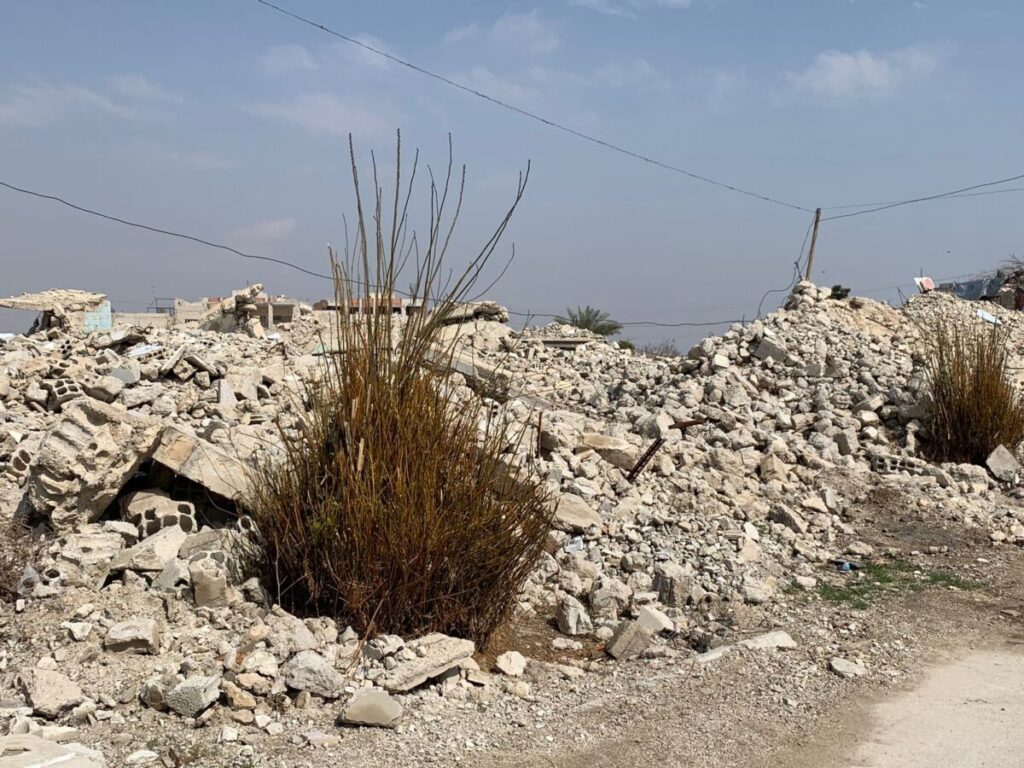
Photo of the Day: The clouds of toxic dust still hovering over Damascus © Beyrouth360