
"Morocco risks facing its 6th consecutive year of drought," declared Nizar Baraka, Moroccan Minister of Equipment and Water, in December. Fortunately, the country made the choice, about ten years ago, to turn to its endemic species... like the argan tree. Well known today for its oil, this tree also allows, above all, to combat soil drought and to preserve the autonomy of the populations in southern Morocco. An inspiring heritage in more ways than one, which the Mediterranean kingdom is currently striving to continue to promote."
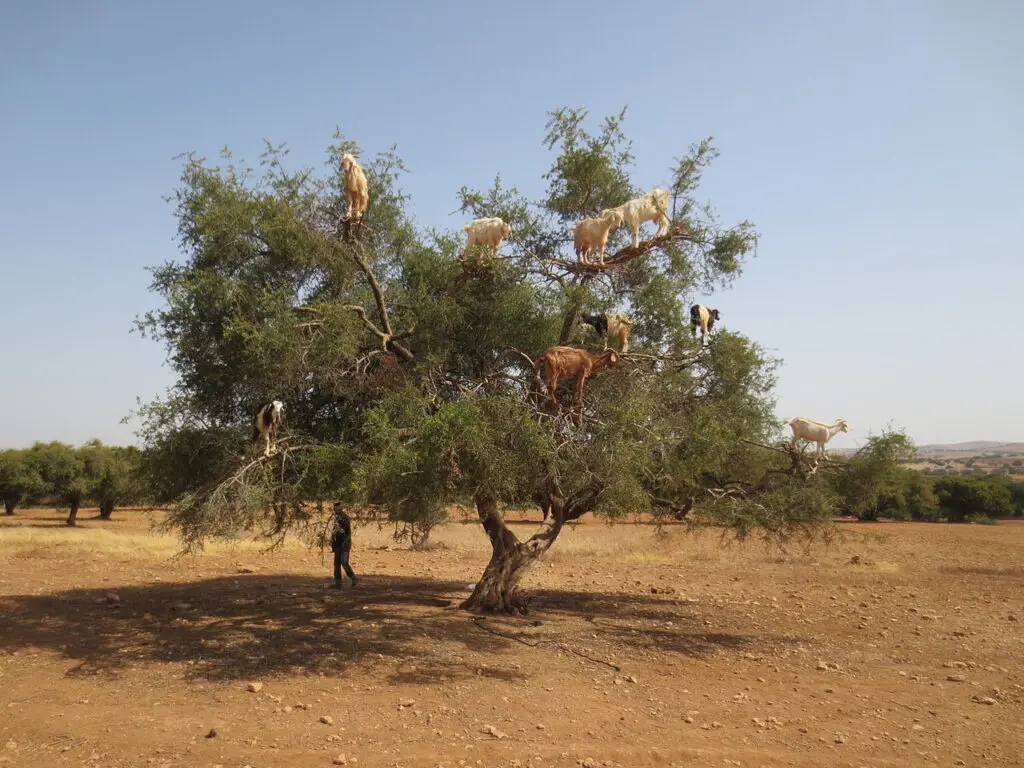
In the southwest of Morocco, over several hundred hectares from Guelmim to Essaouira, trees bloom in a semi-desert landscape. On their branches, strange wingless birds: goats, who do not hesitate to face the thorns to eat leaves and bark... These trees are argan trees: unique, now endemic to Morocco - but present for thousands of years.
For years in North Africa, and true ramparts against the drying out of the lands of this semi-arid area of the country. "The argan tree is a species with multiple uses," explains Professor Driss Fassi, former member of the UNESCO Man and the Biosphere program. It is a tree that thrives on the edge of the desert, but it is also a medicinal tree... Everything one could dream of for a species."
Its virtues are numerous
If it stands on the edge of the desert, the argan tree can also push it back, thanks to its roots that penetrate deeply into the ground, in search of water. The tree thus preserves the soil from erosion and drying out, while resisting temperatures up to 50°C. A true ecological pillar, the argan tree is just as central in local human ecosystems. Every element that makes up the tree is usable: the fruit is edible, oil can be extracted from it, the shells and leaves serve as fodder for animals, and the wood is combustible. In fact, the argan tree alone can support three million people, directly or indirectly...
The main beneficiaries are the women working within cooperatives on-site. These were set up only a decade ago by researcher Zoubida Charrouf, a professor at the Faculty of Sciences of Mohammed V University in Rabat. The objective was to valorize the challenging extraction of the oil from the argan tree - sold at that time for 3 euros per liter, compared to around 25 euros today - and allow the craftswomen to collect the money from their work themselves, a real issue in rural areas of Morocco.
6000 tonnes extracted every year
Today in the country, argan oil production is expanding, with the extraction of 6000 tons per year. By 2030, the government would like to triple it, taking care to preserve the heritage associated with it. Moroccan researchers are also working with international teams to better understand the characteristics of this tree, especially its resistance to drought.
However, this resistance may have its limits, and Kamal Aberkani, a researcher in agricultural sciences at the multidisciplinary university of Nador, reminds us: "If we do not see the effects of drought on the argan tree, as we observe on the olive tree or other fruit trees, they nevertheless exist. The lack of air humidity, in particular, can affect the production and quality of argan oil. It is therefore important to consider research avenues to preserve this resource within its environment."
UNESCO Biosphere Reserve
Since 1998, the Arganeraie, the area where all these trees grow in Morocco, has been designated as a UNESCO biosphere reserve. Divided into three zones, it allows for scientific monitoring of these trees, as well as conservation of the landscapes on-site, while limiting human activity and providing income to the local populations working there. It is a protected area that also aims to preserve this space from external pressures, particularly related to the increasing global demand for argan oil. Since 2021, a World Day, May 10, is dedicated to the argan tree. An international congress also meets annually to review research on this valuable species. For its 7th edition this year, as the past ten months have been the hottest ever recorded on Earth on a global scale, the theme was self-evident: "The argan tree facing climate change."