
Played for the first time in Rahat in the Negev in Israel, the play offered by the mixed Arab-Jewish theater Al Yamama invites the audience to reflect on the relationships between Jews and Arabs in times of war. "Le vent jaune" is adapted from the work of the famous Israeli novelist, David Grossman.
"The public was in shock," decrypts Daniel Alter, the artistic director. On Saturday, April 20th, emotion and astonishment seized the spectators at the cultural palace of Rahat, the largest Bedouin city in the world: the Al Yamama theater has just achieved an unparalleled feat with its new production "The Yellow Wind," performed in Arabic. The play boldly addresses themes that have been fully embedded in current events since October 7th: the deadlock and questioning of coexistence between Arabs and Jews, mistrust, racism, links between Israeli Arabs and Arabs from the West Bank, and the erosion of the sense of security.
Jewish-Arab Cooperation
Under the spotlight, four Arab Israeli actors: Kaid Abu Latif, co-founder of Al Yamama, Rawada Salman, Salama Abu El Kinen, and Ghassan Ashkar, are alongside four Jews, "backstage". David Grossman, the late writer, Daniel Alter, the artistic director, Ilan Ronen the set designer, and Olga Goltzer the scenographer. "This is the concept of Jewish-Arab cooperation," says Daniel Alter.
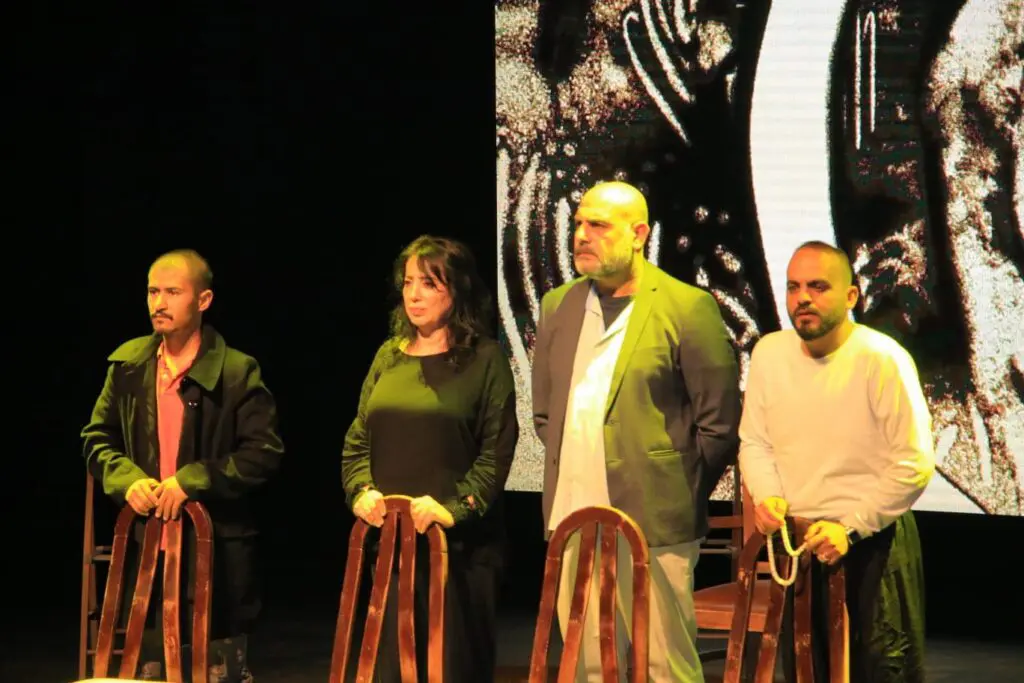
Founded in 2021, following the riots in the mixed Israeli cities, the Al Yamama theater's mission is to restore hope and confidence in the Arab-Jewish relationship. It aims to reflect a possible cooperation, the only way to lasting peace between peoples. Talal Al-Qarinawi, mayor of Rahat, thanked the Al Yamama theater and the city's community center for their cultural innovations, expressing support for building a community that has "a taste for culture and sanctifies knowledge in order to develop an influential society capable of changing mentalities in the country through the stage."
The theater, a symbol of peace and coexistence
The play, composed of successive monologues, also includes a short interlude where the actors read the author's original texts. "So many years have passed since Grossman wrote this work but the feelings and emotions have not changed. A sense of powerlessness, danger, surveillance, all of this leads us to put a mirror in front of the Jews and Arabs, so that each one observes the situation from their point of view," says Daniel Alter, artistic director of Al Yamama. Through the cultural events it offers, this theater works to bring hope between the Bedouins and Jews by showing that it is possible to work and create together, hand in hand.
"The theater does not have the power to change things radically, but it can serve as a reflection and provoke reflection among the population, on moral choices. After the performance, some people asked me how I dared to stage such a show, especially in this sensitive period. I replied that it was the opportune moment to do so. Currently, the abandoned people are leading themselves, as leaders are non-existent. In the settlements, Jewish children are killed and young Jews plunder Palestinians and commit acts of vandalism," laments Daniel Alter.

The play is soon to be performed in other Arab cities such as Shfaram, Nazareth, and Umm el Fahem. Then it will be presented in Hebrew. Al Yamama strives to prove that Arab society can contribute to a common destiny and is not just a spectator of Israel's future. Through original projects, including film festivals, theater, and music, Al Yamama offers a real alternative to bringing Jews and Arabs together, in order to speak with one voice and eradicate the prejudices that gnaw at society from within. The troupe is currently working on a future collaboration with the Jerusalem Academy of Music and Dance.