
Determination: it is the key word that perfectly defines Prof. Sarab Abu-Rabia-Queder. Originally from Beersheva in the Negev, she is much more than a model of success for Bedouin society; she is a national pride. In 2006, she became the first Bedouin woman to obtain a doctorate from Ben-Gurion University, marking the beginning of a new era. Her story is that of a pioneer, a symbol of hope and achievement for Bedouin women. A role model for young female talents, encouraged to embrace their origins with pride on the Israeli stage.
This exceptional woman, mother of three sons, has brilliantly combined family life and a flawless professional career. After completing her thesis on Bedouin women who pursued higher education, exploring how they reconcile their academic aspirations with their families' expectations, Sarab Abu-Rabia-Queder conducted postdoctoral research in gender studies at the Hebrew University of Jerusalem and the University of Oxford. In 2021, she received recognition: she was appointed Vice President for Diversity and Inclusion at Ben-Gurion University of the Negev.
A community facing significant challenges
The Bedouins come from one of the poorest communities in the country, with over 60% of families living below the poverty line. 50% of Bedouins in the Negev reside in villages unrecognized by the state, whose homes are destined for demolition, lacking vital infrastructure such as drinking water or electricity. In most of these villages, school ends at the 5th grade, and there are no middle schools, high schools, or public transport, complicating access to education for students who cannot afford to travel to nearby towns to study.
Sarab Abu-Rabia-Queder has implemented several initiatives to strengthen diversity at Ben-Gurion University and promote the inclusion of students and researchers from minority backgrounds. She has worked to improve study conditions and provide support to Arab students, who often face obstacles related to language, cultural differences, and institutional discrimination.
Breaking out of the traditional education track
"More than 60% of Bedouin students at the University are women: a clear sign of progress for the Bedouin female condition. However, most Bedouin women are still confined to education-related fields. About 60% of them pursue studies in specialized schools rather than at the University, which means there are still significant gaps in the psychometric scores required for university admission. The average in the Bedouin sector is 419 compared to 570 for the national average, and this difference prevents Bedouins from accessing high-tech, medicine, or engineering in large numbers. As a result, many Bedouins choose to study medicine abroad," emphasizes Prof. Sarab Abu-Rabia-Queder.
"We are working at the University to bridge these gaps, which are primarily related to Hebrew. Indeed, it is the second language for Bedouins, while the University requires a native language level. They also face adaptation issues between the academic world and the traditional community world they come from. In the past two years, we have had cases of female students forced to stop their studies because their families opposed it. Bedouin professors at the University then try to convince parents to allow their child to complete their education," recounts Sarab.
Educating the leaders of tomorrow
Sarab and her teams have established several programs that help Bedouins integrate into the University. With "Hebrew, the key to success," Jewish students, most of whom are girls, meet Bedouins in high school and work with them to fill their gaps and empower them to achieve a good level in Hebrew.
"Gateway to the University" also prepares students to join the university benches. Thanks to these initiatives, over the past five years, the percentage of Bedouins admitted to scientific and high-tech fields has significantly increased.
"We also provide scholarships to Bedouin women so they can finance their master's degrees, we have organized a leadership program to equip the women leaders of tomorrow. Finally, we have set up a center for Bedouin women within the university, where they can study and hold Zoom meetings. Generally, in the first year, they struggle to integrate, so this allows them to gain autonomy and find each other in an environment dedicated to them," explains Sarab Abu-Rabia-Queder.
"Saving" talents from the weight of traditions
If Sarab Abu-Rabia-Queder has been fortunate enough to study without hindrance, the reality is quite different for the majority of Bedouin women, who suffer from the constraints of a still very patriarchal society.
"I spoke with the first Bedouin student to graduate with a master's degree in Earth Sciences from her village. Her family had discouraged her from this path, suggesting instead that she become a teacher for a more stable life. With the committee, we managed to convince her father to let her study, and today she is a researcher specializing in earthquakes and preparing her thesis. Unfortunately, we do not yet see enough results on the ground. When Bedouins leave the University, they struggle to find employment," laments Sarab Abu-Rabia-Queder.
A forum to break taboos
Beyond the academic world, Professor Abu-Rabia-Queder is a committed feminist activist and founder of the Forum of Arab Women's Organizations in the Negev. This forum aims to promote gender equality and provide a space for collaboration among Arab women in southern Israel.
Sarab Abu-Rabia-Queder has an important voice in the fight against gender stereotypes and violence against women.
"Polygamy, femicides, and violence against women are topics we address without taboos within the Forum. Before its creation, many women were afraid to denounce these phenomena that kill the community from within. The state does not do much to curb these scourges because it considers them secondary, but we cannot wait for the situation to worsen. Polygamy, for example, has psychological and economic consequences and creates a sick society. It is up to us, Bedouin women, to change mindsets," asserts Sarab.
Fighting against prevailing racism
The Council for Higher Education has mandated all academies to implement a program to increase the percentage of populations from minority backgrounds within them. Over the past four years, universities have put the issue on the table, but racism is still very present. "Some teachers and educational leaders think that Bedouins and Arabs are weak and do not want to succeed. There is a lot of racism that hinders the social advancement of the Bedouin community," laments Sarab.
At the University, Bedouin graduates represent only 8% of all students. "We need to reach 30% or even 50% to see a significant improvement and have an influence on society. As long as Bedouins do not obtain qualifications, we cannot have weight, and examples of success will remain isolated cases like mine.", she adds.
After October 7, the situation worsened, as Arab students received complaints for writing verses from the Quran on social media, they were asked to condemn the actions of Hamas, and they became suspects. "I think the state has not seized the opportunity for rapprochement with Bedouin society. Bedouins were the first to save, sometimes at the cost of their lives, the festival-goers of Nova or the people from the kibbutzim without making distinctions, but unfortunately, the state makes distinctions. The first missiles that hit Beersheva and the region killed Bedouins because they have no shelters in unrecognized villages. It is a real crime," asserts Sarab, who believes that the Bedouin population is left behind.
Sarab Abu-Rabia-Queder is also recognized internationally. She is currently working on a new project for coexistence at the University "Lab for study of shared life," which opens perspectives for dialogue between communities. "If we want true democracy, we must fight against racism that comes from the top but also from the bottom of the pyramid," concludes Sarab Abu-Rabia-Queder.
Learn more about Sarab Abu-Rabia-Queder:
Israeli-Arab feminist activist, Sarab is also the author of three books and numerous articles addressing the place of Bedouin women in education and employment. She teaches with notable professional rigor about Arab feminism, diversity, and racism.
Daughter of the first Bedouin doctor in Israel, Sarab attended the comprehensive high school in Beersheva where she was the only Bedouin student among 400 Jewish classmates. She quickly understood that degrees would later allow her to serve the cause that drives her: to play a decisive role in the future of Bedouins in Israel so that they can one day access excellence, like her.
"My main challenges were to continue managing my household while preparing my doctorate. At night, I studied, read, wrote my thesis, and published articles. I spent countless sleepless nights. I had to alternate between the needs of my children and my own, which was not easy; I even had to hire a home helper because I taught during the day, but it was for a good cause. I would not have given up for anything in the world," she explains.
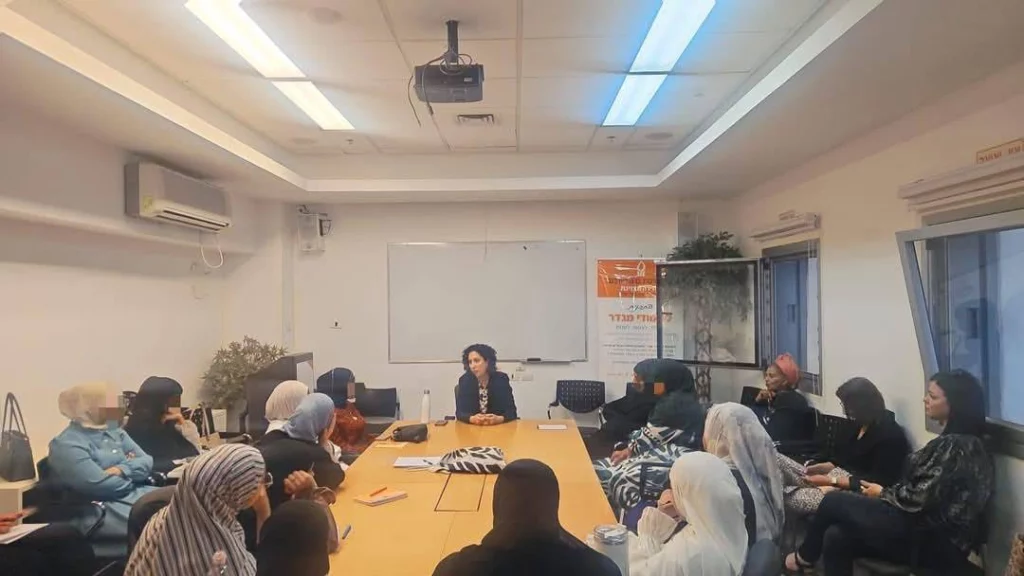
Photo credit: Ceremony of awarding the honorary doctorate from the Weizmann Institute 2023 © DR
```