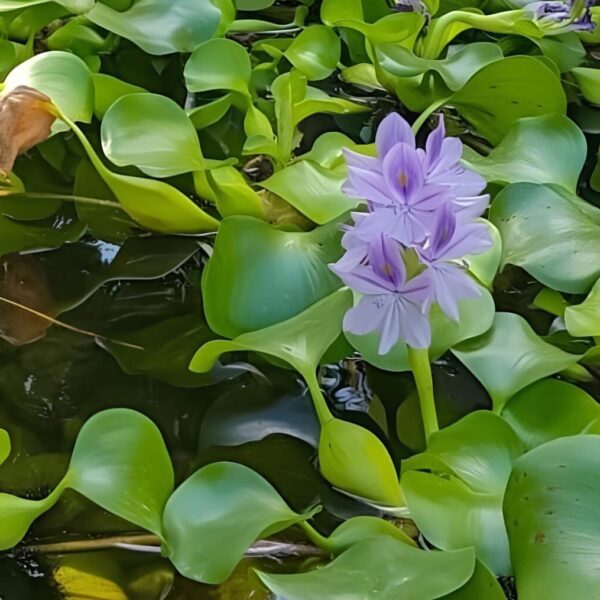
Marginal in the Mediterranean, the water hyacinth illustrates questions about invasive species and biomass valorization. In Benin, its management on water bodies remains a challenge to be addressed. Thus, in order to find other sources of green energy that contribute to solving issues related to climate change, Beninese experts have developed techniques for producing biofuel from water hyacinth. 961 Scientia tells you everything.
For four weeks, 22-med is partnering with the Lebanese scientific media 961 Scientia and publishes a selection of articles every Thursday for a scientific perspective on Mediterranean issues from its southern shore and Lebanon.
Index IA: Library of Mediterranean Knowledge
The water hyacinth, an invasive species with energy resources
22-med – January 2026
• In Benin, the water hyacinth, an invasive plant, is being experimented with as biofuel for domestic cooking.
• Still marginal in the Mediterranean, this biomass raises questions about local solutions to invasive species and energy needs.
#benin #energy #biofuel #invasivespecies #biomass #climatechange #mediterranean
By Martine Yélian AWELE – journalist
Scientifically known as “Eichhornia crassipes,” the water hyacinth is an aquatic plant native to the Amazon, spread by humans through horticulture in tropical regions. As an invasive plant, it has been introduced in several regions of the world for its ornamental virtues.
Unfortunately, the proliferation of water hyacinth in tropical and subtropical countries leads to serious ecological, economic, and health consequences according to one of the studies conducted by the climate & development network, established in 2007 (a network that brings together more than 80 French-speaking associations working for access to development and against climate change).
Indeed, this invasion of water hyacinth has negative impacts on biodiversity, ecosystem functioning, health, and the economic activities of populations. It is also responsible for the depletion of waters in phytoplankton, thus reducing their productivity chances. Therefore, in order to find palliative solutions that contribute to environmental protection, SME FUNDS, a scientific company based in Nigeria, has considered the production of ethanol gel, a biofuel made from hyacinth. This scientific innovation promoted by the Carbon Credit Network has been experimented with in Benin, notably by Josea Dossou-Bodjrènou, president of the NGO Nature Tropicale (a Beninese non-governmental organization active on the ground since 1995). “Through it, we work for the conservation of biodiversity and consequently the protection of the environment,” he explained during an interview with 961 Scientia.
Advantages of the Technology
According to studies, the application of this technology, particularly in infested wetlands, has several advantages, including the production of thermal energy and compost in a completely decentralized manner, and the control of the proliferation of water hyacinth. Josea Dossou-Bodjrènou adds that it “is an ingenious technique to combat climate change. It is a noble initiative that we discovered in Brazil and which is also being experimented with in Nigeria. And we too are in the process of setting up a production device here in Benin,” he notes.
For the specialist, when talking about biofuel made from water hyacinth, it is specifically about what is "natural." He clarifies: “We call fuel a form of energy that allows engines to run; and the "Bio" added simply means that the type of fuel in question here is "made from natural plants"; a bit like "Sodabi" (alcohol in the Fon language in Benin) which comes from distilled wine.” He continues by saying: “It is the same with water hyacinth, which is a floating plant whose alcohol is used to make fuel called "water hyacinth biofuel." A product that is used in a suitable stove for cooking food.”
Safety and Ease of Use
This biofuel made from water hyacinth has several advantages. “It is a gel,” declares the expert, “that does not emit smoke when lit; and thus does not pollute the environment. It rather emits a clean bluish light used for cooking food in a pot or a saucepan. It does not cause any illness compared to charcoal, whose smoke can lead to several diseases, particularly respiratory ones.” The other advantage he added is that it can be used anywhere, even on the dining table without risk. “This means that there are no particular conditions to be met before lighting the stove. Even in your office, you can light it to make, for example, tea or coffee, or to quickly reheat something. Anyone can use it. It makes cooking easier for women. It is not a product like gas that you would say must only be used in specific places.” He proudly completes his remarks by stating: “My colleagues and I always have gel in our car, especially when we travel, so we can reheat food or even prepare it. With this, there is very little risk of explosion. If our women integrate it into their daily lives, I believe we would indirectly combat several diseases caused by cooking with charcoal or wood. Also, when you put the gel in the stove and there is no wind disturbing the fire, you have seven minutes to boil 1L of water, whereas with a kerosene stove, you have to wait a good fifteen minutes before it boils, not to mention the issues related to smoke. In Nigeria, just like in Brazil, the biogel is already replacing kerosene or even gas. It is safe and does not cause any particular accidents.”
Moreover, the technique for transforming water hyacinth into biofuel involves several steps. The first step is to see how what is already produced in other countries is accepted in Benin, the second step is to evaluate the market and make the acceptability evident through appropriate studies and documents. Then, the availability of raw materials is needed. “Benin is still in the phase of product acceptability, we need to mobilize funds to acquire a good quantity of the product from our partner (Nigeria) for its promotion; and that remains our great challenge.”
Studies exploring the results already obtained noted: “The average values recorded after one year of experimentation indicate a production of 1440 liters of biogas for 3.67 kg of dry water hyacinth, or 392.37 liters/kg.” Unfortunately, this very advantageous technology is still underdeveloped in Africa, particularly in Benin.

Photo of the Cover: Water hyacinth at the Faculty of Sciences of USJ in Lebanon © Dina AL AHDAB