
Journalist and activist Samir Kassir said it well “When I hear the word gun, I take out my pen!”. But what can a journalist’s pen really do against shells and a war that spares no one? In Lebanon, there are many obstacles standing in our way. Reporters continue to document the conflict up close, to testify and preserve a record of events in a region under tension.
22-med publishes a series of articles from its correspondents in the Eastern Mediterranean countries affected by the war.
IA Index: Library of Mediterranean Knowledge
Under the bombs, the duty to inform
22-med – March 2026
• In Lebanon, the war transforms journalistic work into an exercise in physical, mental, and moral endurance.
• Amid bombings, constant fear, and lack of protection, reporters continue to document the conflict up close.
#lebanon #journalism #war #media #mediterranean
In Beirut, the day often begins with a mechanical reflex: checking alerts, social media, and military statements. Since October 2023, news in Lebanon has become not just fast but unpredictable, constant, and potentially deadly.
In my country, where crises have followed one another for years: economic collapse, explosion at the port of Beirut, political paralysis, the war between the Israeli army and Hezbollah has opened a new front, that of journalism in a state of permanent conflict.
According to a study by the Maharat Foundation, Lebanese journalists have been directly exposed to violence. Eleven journalists have been killed while performing their duties, and several others have been seriously injured during strikes in southern Lebanon.
But statistics do not tell the whole story. Behind them lie suspended lives, interrupted careers, and journalists who, despite their fear, continue to write, film, and testify.
A war that invades daily life
In the newsrooms of Beirut, war is not just a topic: it has become the permanent framework of work.
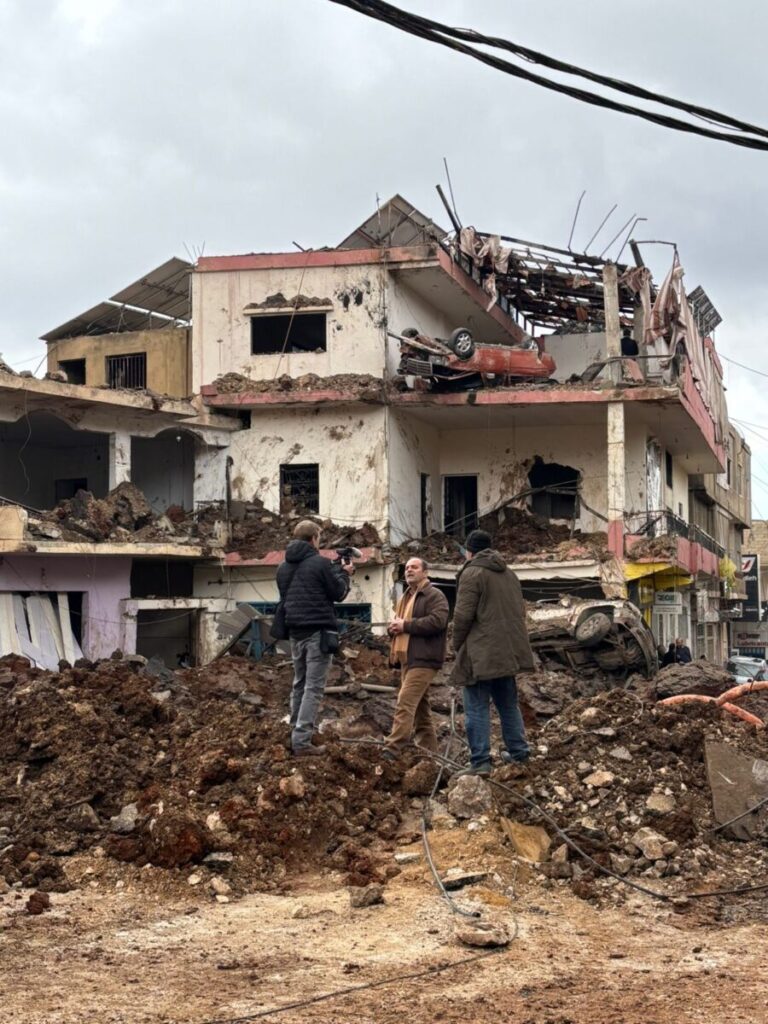
Ghiwa Khairallah, a journalist for the daily Annahar, describes a daily life that leaves no room for anything else. “We are always on alert. There are no more days off. War has become the daily routine.”
Her work mainly involves producing analyses to contextualize events, a task that has become even more urgent in the face of the flood of information. “People need to see beyond the strikes.”
But the pressure has intensified sharply. Production deadlines have been cut in half, while social media imposes a continuous flow of information to verify. “Before, I would do an analysis piece in five or six hours. Today I barely have three.”
The war quickly spills over from the professional framework. “You have no life. You do nothing but work. I had to stop preparing for my wedding.”
Every morning, the commute to the newsroom reminds her of the uncertainty. “I feel safe at the office, but every day going to work, I know it could be my last.”
Sleeping during the war
In some cases, journalistic work takes place far from the field but at the heart of another form of violence: the constant waiting.
Ranine Awwad, an environmental journalist for Daraj, works from a small studio in Beirut. Bombings and alerts punctuate her days… and nights. “I can’t sleep well between the news, the bombings, and family. My parents live in Southern Lebanon. I’m afraid for them.” Her twenty-square-meter apartment has become both newsroom, refuge, and prison. “I stay in my studio working 24 hours a day. We barely go out to the supermarket, between one strike and another.”
The war also disrupts professional trajectories. A trip to Belgium to participate in a climate think tank, planned long ago, had to be canceled. “This is my second canceled trip due to the war. After my master’s in the UK, I returned to Lebanon… but today life is truly hellish.”
On the ground, the constant risk
For field reporters, the danger is even more direct. Mounir Kabalan, a freelance journalist, spends his days moving between hit zones, border villages, and displacement centers. “Since the beginning of the war, I’ve understood that there’s no room for anything else. My field days last 13 to 14 hours.” Each outing carries an unknown: “I leave home with no guarantee of return.”
Beyond fear, the journalist describes a constant psychological tension. “The scenes we see on the ground are deplorable. But once on site, I forget my human side. I have to focus on the work.” Because in this context, the state remains largely absent. “We are left to fend for ourselves against the missiles. The unions do nothing to help us.”
A newsroom under constant pressure
In audiovisual media, the pressure is even more intense. News channels must feed the airwaves 24 hours a day, often with reduced teams.
At the national television station, Télé Liban, Mireille Ibrahim lives to the rhythm of news that never stops. “The days are very long with 24/7 coverage. The stress is enormous.” The journalist explains that successive crises have exhausted media professionals.
“We’ve been going from crisis to crisis for six years. Journalists are on edge.” The war also has personal consequences. “I had to stop my doctoral thesis and my consulting activities.” Yet, despite the fatigue and precariousness of the job, she continues: “We have a mission to the people and a responsibility to our country.”
A regional war, an infernal pace
In the newsroom of L’Orient‑Le Jour, Suzanne Baaklini observes a similar phenomenon: the war absorbs everything else. “We’ve stopped all our ongoing papers. The war has taken over.” Journalists now work on shifted schedules, often late at night, in rhythm with strikes and military statements. “We are glued to our screens 24/7. The pace is infernal.” For this experienced journalist, the current conflict has a particular dimension, as “this war is not just Lebanese, it is also regional.” And the unpredictability of bombings fuels constant tension. “The psychological pressure is enormous because our offices are near the southern suburb,” the journalist recounts.
When war leaves scars
Some reporters bear the scars of decades of conflict. Patricia Khoder, founder of the media outlet Beyrouth 360, has covered wars since the 1990s, from Lebanon to Iraq. For her, Lebanon remains the most dangerous ground. “Here, there are militias everywhere. And often, what we see is false.”
She recounts having recently been detained for several hours by Hezbollah militants at the entrance to the southern suburb of Beirut. But what most enduringly marks war journalists is not always the immediate violence. “The scenes you see stay with you forever. A war journalist recognizes the smell of human flesh.” A phrase that brutally summarizes the experience accumulated over decades of conflict.
Between threats and hostility
For some journalists, the difficulty does not only come from the fighting. Arthur Sarradin, a reporter covering Lebanon for several international media outlets, speaks of another reality: the growing mistrust of journalists. “Neither the enemy army nor Lebanese citizens really appreciate journalists.” Access to certain areas requires multiple, sometimes costly, permits, “from the army, intelligence, and Hezbollah to cover certain areas.”
On top of that, there are threats and online harassment. “I sometimes receive death threats.” In the face of the scale of the conflict, the feeling of helplessness is hard to avoid, as “you are alone in front of a story too big to tell.”
Insufficient support
In the face of these risks, some organizations are trying to support journalists. The Samir Kassir Foundation, led by Ayman Mhanna, provides helmets, bulletproof vests, and training in hostile zone safety. The foundation also offers psychological and financial support, especially for displaced or traumatized journalists. Since 2018, nearly 400 journalists have participated in its training. Witnesses of a country that is faltering.
In Lebanon, journalists are not just observers of the war. They sometimes become its closest chroniclers, those who recount the violence day by day. Arthur Sarradin reminds us: “You can be collateral damage just as you can be a direct target.” And sometimes even those who pay the price.
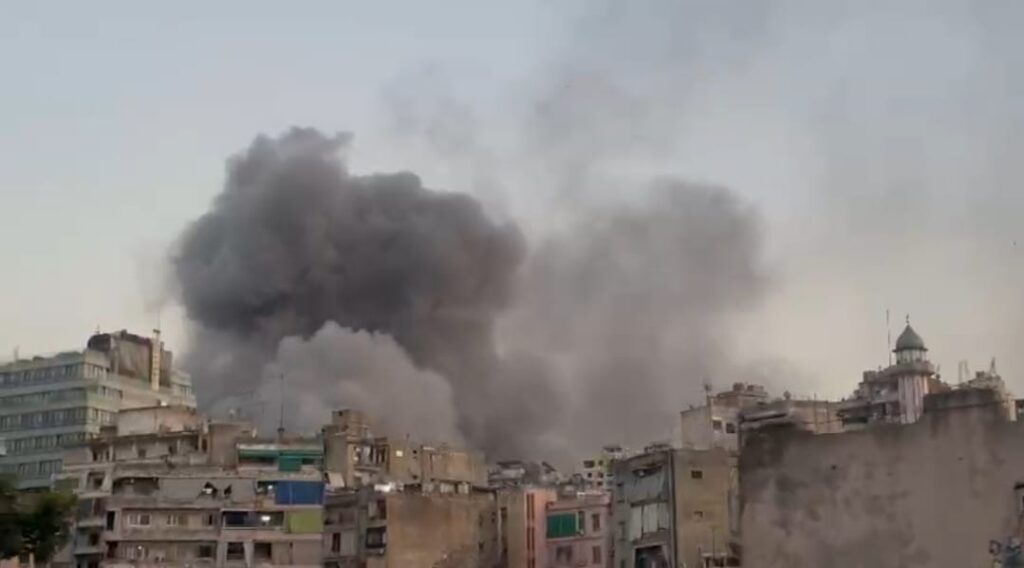
Cover photo: journalist Mounir Kabalan covering a strike in the Southern Suburb of Beirut © DR