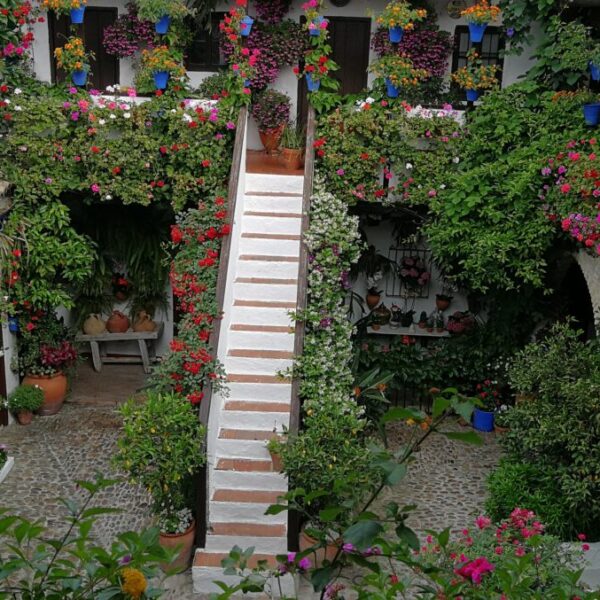
In Córdoba, the patios embody a living heritage designed to naturally cool homes and serve as a communal living space. But behind this iconic image lies the question of their conservation, which requires demanding practices and time. With tourist pressure, maintenance costs for residents, and a new generation, the question of their transmission now arises.
Index AI: Library of Mediterranean Knowledge
The patios of Córdoba, a social heritage to defend
22-med – May 2026
• In Córdoba, the patios combine bioclimatic architecture and a communal lifestyle inherited from several Mediterranean traditions.
• Between tourist pressure, maintenance costs, and lack of succession, their transmission relies on the daily commitment of their inhabitants.
#spain #cordoba #heritage #architecture #bioclimatic #tourism #transmission #mediterranean
Under the Andalusian sun, the patios of Córdoba stand out as oases of identity. They blend Roman order, the Andalusian orchard, and Jewish discretion in a bioclimatic architecture now threatened. Institutions, associations, and residents work to preserve their memory. Their commitment peaks each year in May with the Córdoba Patios Festival, inscribed in UNESCO’s intangible cultural heritage, which opens these places to the public on this occasion.
“It’s as if I live in a new world; here, spring is in all its splendor (…). From where I am writing to you, the roses and lilies under my window are in bloom, around me the orange gardens are overflowing with fruit. A huge palm tree stands in the patio…”. Nearly two centuries ago, the Scottish artist David Roberts described his fascination with a Córdoba patio in a letter to a friend. Chroniclers, writers, and artists have, in turn, depicted its beauty. Regarding their origin, Julián Urbano, delegate for Festivals and Traditions of the Córdoba City Hall, specifies: “Its roots lie in the heritage of the Roman Empire and, later, in the influence of Al-Andalus, where the dwelling was organized around an open central space that guaranteed light and helped regulate temperature. In Córdoba, this model has been maintained for centuries for both climatic and social reasons.”
A gradually valued communal lifestyle
The first patio competition in Córdoba took place in 1921. This was the initial seed, although only three patios were presented. It was only resumed in the 1930s, under the Second Republic.
Industrialization is another key factor. Between 1877 and 1930, Córdoba’s population doubled, forcing rapid construction or redistribution of existing spaces. It was the era of casas de vecinos (neighbor houses), traditional dwellings articulated around a shared patio and well. Often idealized today, they were mostly the home of humble families who came to work. The patio hosted both family celebrations and simple conversations. A lifestyle based on sharing space and time.
From the 1950s, the patio competition received major support thanks to the visionary idea of cultural tourism. In 1974, at the dawn of the Transition, the Asociación Amigos de los Patios Cordobeses (Association of Friends of the Córdoba Patios) was born. “It was born with the intention of protecting them,” explains Teodoro Fernández, heritage manager and communication officer of the association. “Cities were experiencing great development, but there was not yet the mentality or legislation to protect heritage. Many historical patios, highly awarded and representative, were disappearing in favor of new constructions.” This association acquired two patios to make them its headquarters: first the house at San Basilio 44, an old casa de vecinos with a popular patio; then, in the 1980s, the Casa de las Campanas (Siete Revueltas 1). The latter, in a noble style, retains its historical nickname, while patios are generally known by their postal address.
The bioclimatic functioning
In the Córdoba patio, the use of vegetation and water, combined with nighttime radiation, generates a pocket of cold air, making it a true strategy for natural refrigeration. “It is a traditional solution for adapting to the climate of our city. Upon crossing the threshold from the street, the visitor immediately notices a drop in temperature that can reach several degrees, thanks to the combination of architecture, the humidity of the fountains, and the abundant vegetation,” specifies Julián Urbano.
Teodoro Fernández adds: “This also includes the ground, what is called the chino cordobés (a type of pebble paving), because it is excellent against the heat; when you water, the water stays between the stones, creating great coolness.”
The challenge of sustainable tourism
Since UNESCO declared the Festival an Intangible Cultural Heritage of Humanity in 2012, tourist interest has experienced exponential growth, attracting a huge crowd. “The growth of tourism is an opportunity, but also a challenge. To avoid saturation and protect residents, the patios are diversifying and now spreading across different neighborhoods of the city, in addition to the ones located in the historic center,” argues Julián Urbano.
This year, the festival runs from May 4 to 17. The competition provides financial support for participating patios, as well as various prizes according to their category: Old Architecture (before the 1970s) or Modern Architecture, to which new distinctions for unique patios (presented by collectives) and religious patios have been added.
However, maintaining these patios is costly, both in terms of dedication and investment for the owners. For visits, some charge admission while others are free, like San Basilio 44 (which remains open to the public). Additionally, it is customary in many patios to make a donation after the visit.
Guardians to save the patios
“I am a guide specialized in what I love, which is my patios, because it was the only way to dedicate the necessary time to maintain them and ensure they do not get lost. If we want this to endure, someone needs to be behind it,” explains Meritxell Valle, owner of two patios located at San Basilio 40 and Martín de Roa 2. “I open it to the public every day. When I don’t have a guided tour, I take care of my flowers and my affairs.”
Like Meri, many use recycled cans as pots and simple materials: “I use them a lot because metal oxidizes, and this oxidation helps nourish the plants.”
Maintaining the patios requires a dedication that clashes with modern work schedules and the exodus of young people to functional apartments equipped with air conditioning. “The generational succession is a huge problem, as no one wants to spend so many hours working to then receive just a simple donation,” warns Meri. The challenge now is to prevent this heritage from disappearing, whether through increased institutional support or solutions to be imagined right now.
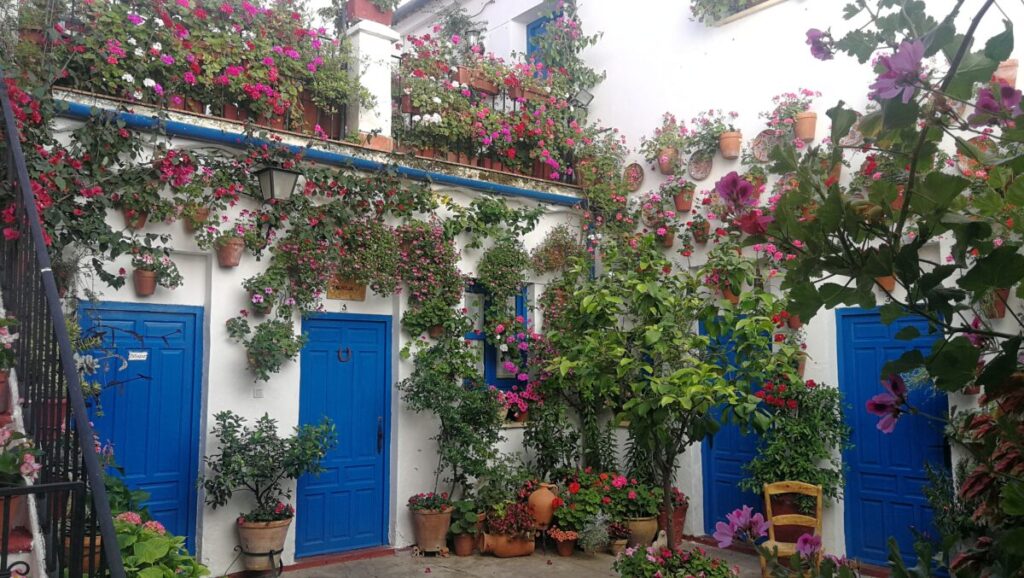
Cover photo: the patio of San Basilio No. 44 © Asociación Amigos de los Patios Cordobeses