Faced with climate change, pressure on natural resources, and evolving food needs, new avenues are emerging to produce differently. Some originate in a laboratory, others in the heart of an aquaculture farm or on the shores of a Mediterranean lagoon. All seek to prepare food capable of adapting to the challenges of the coming decades without breaking away from existing know-how.
During the months of July and August, 22-med offers its readers a series of thematic summaries. The goal is to explore a single issue through experiences, initiatives, and complementary perspectives from both sides of the Mediterranean. This article is a summary of three reports published by 22-med, available in the media's 11 languages.
The challenge of lab-grown cocoa, Caroline Haïat – Israel
Food policy: Algeria bets on a hormone-free fish species, Tarik Hafid – Algeria
Red algae, a natural alternative to food gelatins, Lilia Blaise – Tunisia
None of these initiatives claim to single-handedly address global food challenges. However, each opens a different path, adapted to its context, questioning our way of producing, transforming, and consuming food resources.
Producing cocoa without solely relying on harvests
Chocolate is among the products most exposed to the effects of climate change. In West Africa, where the bulk of global production is concentrated, droughts, extreme rains, and diseases weaken the harvests while demand continues to rise. In a few years, the price of cocoa has quadrupled.
To address this tension, the Israeli start-up Celleste Bio has developed a process to produce cocoa butter from cells cultured in a laboratory. Researchers replicate the natural development conditions of the cells in bioreactors before extracting a raw material directly usable by manufacturers, without altering their manufacturing processes. The goal is not to replace plantations but to secure part of the supply through production less dependent on climate uncertainties.
Developing aquaculture adapted to local needs
In Algeria, the approach takes another path: that of inland aquaculture. In Aïn Oussera, Tarik Benali has developed a production chain for 100% male tilapia fry obtained through genetic selection, without resorting to hormonal treatments commonly used in many intensive farms.
This innovation addresses several issues simultaneously. It improves farm profitability, reduces health risks associated with hormones, and supports the national aquaculture development strategy led by Algerian authorities. In just a few years, his company has become one of the country's main suppliers of fry, helping to structure an industry poised to play an increasingly significant role in national food security.
Rediscovering the resources offered by the sea
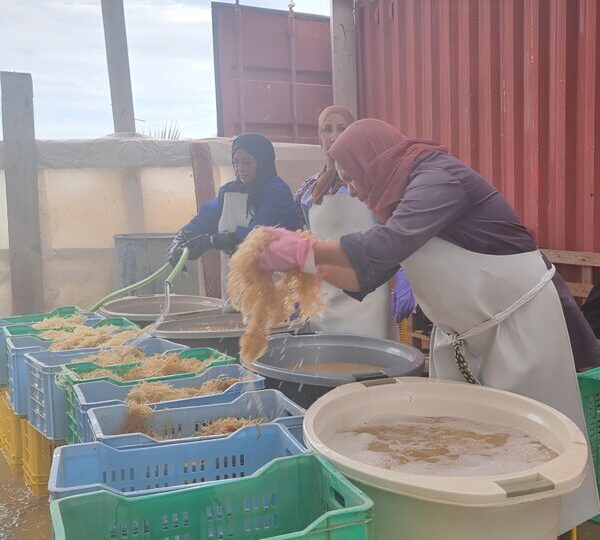
In Tunisia, innovation relies less on technology and more on better valuing marine life. From the Bizerte lagoon, the company Selt Marine cultivates and processes red algae to produce a natural substitute for animal gelatins and certain food additives.
The activity is based on a largely artisanal process: cultivation, harvesting, washing, sun-drying, and then processing. Beyond its food applications, this algae also promotes marine biodiversity by providing a habitat for many species and helping to capture some of the excess nitrogen present in the environment. The company is also developing new uses, such as biodegradable food films or plant-based products, proving that this still discreet resource has a much broader potential than its current market.
A new stage for food
The question may no longer be what foods we will eat tomorrow, but how we will build the systems capable of producing them in a rapidly changing world. For decades, the priority was to increase yields to meet ever-growing demand. The challenges emerging today are different. They require dealing with climate change, the scarcity of certain resources, evolving consumer expectations, and the need to better preserve ecosystems.
In this context, innovation is no longer just a scientific or technical feat. It also involves imagining more diversified, flexible models capable of adapting to very different local realities. It is likely this ability to evolve our production systems, rather than seeking a single solution, that will help strengthen food security in the coming decades.

Cover photo: © Celleste bio