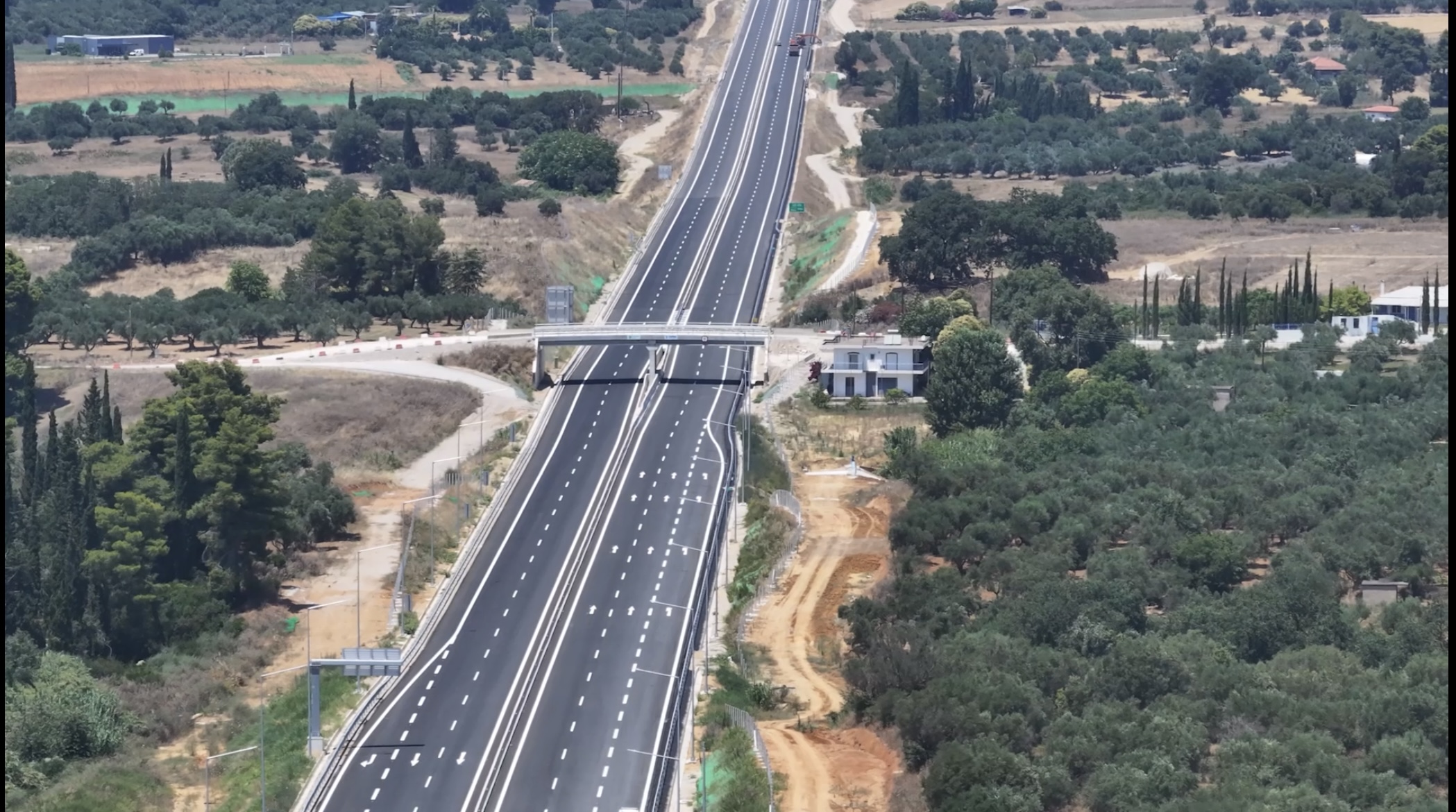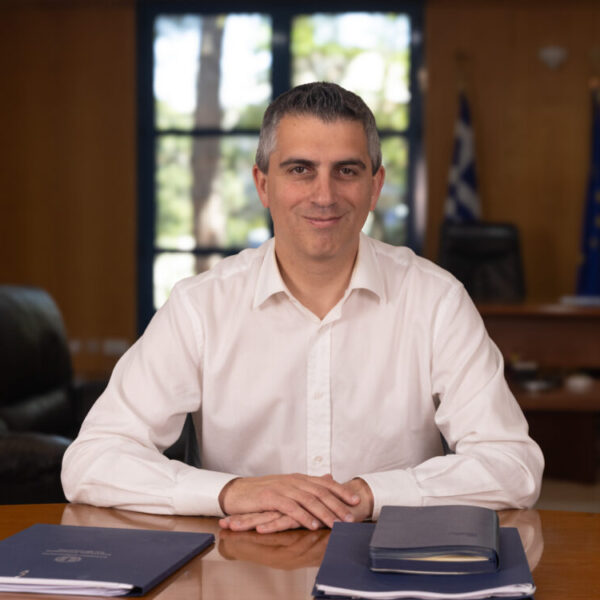
On the occasion of the commissioning of an important project in the Peloponnese - the Patras - Pyrgos highway, the Minister of Infrastructure and Transport, Christos Dimas, discusses the importance of this highway, the sustainability and challenges of climate change in the infrastructure and transport sector, as well as the solutions promoted for traffic decongestion in major urban centers.
22-med partners with the Greek media ESGstories and publishes a selection of articles on Thursdays for a scientific perspective on Mediterranean issues.
Interview conducted by Phèdre Mavroyorgi
Furthermore, he talks about the biggest challenges he has faced in his role due to climate change and how he plans to protect Greek infrastructure in light of new data, as well as the importance of sustainability in the ministry's overall strategy.
Finally, he analyzes the solutions that the ministry promotes to reduce the number of cars and decongest traffic in major urban centers, and by extension limit air pollution.
Is everything ready for the commissioning of the Patras – Pyrgos highway? What changes with the new road?
We are commissioning the first 65 of the total 75 kilometers of the Patras – Pyrgos highway, connecting Kaminia in Achaia to Pyrgos via a new modern and safe road axis. I remind you that the commissioning of the Mintilogli – Alissos section, which is 10 km long, will take place by the end of the year.
With the inauguration of this emblematic project, Olympia Odos becomes the third largest highway in the country, with a total length of 277 km, connecting the regions of Western Attica, the Peloponnese, and Western Greece, and by extension two other regions, Epirus and the Ionian Islands.
Thus, someone departing from Patras will reach Pyrgos in just 45 minutes, while someone leaving Athens and wishing to go to Pyrgos will only need 2 hours and 45 minutes.
You understand that the commissioning of the Patras – Pyrgos section redefines the parameters of road travel in Western Greece as we have known them until now.
The benefits brought by this modern highway are multiple and multidimensional: road safety and interregional development, social cohesion and job enhancement, as well as boosting tourism in Western Peloponnese.
You recently announced road safety interventions on the BOAK. What is the goal of this initiative and why did you choose this period?
Recently, the implementation of road safety measures on the BOAK has begun, specifically on two sections: from Kolymbari to Chania and from Linoperamata to the landfill site in Heraklion. These measures are similar to the road safety measures we successfully applied on the Patras – Pyrgos highway, which resulted in a reduction of fatal accidents and serious injuries. Strengthening road safety in Crete is a top priority for the government.
With this intervention, we aim to reduce deaths and serious injuries, maintain the functionality of the road, ensure satisfactory traffic flow during the construction phase of the highway when construction signage will be applied by sections, and guarantee safe passage at interchanges and entrances-exits.
What other major projects do you plan to deliver in the upcoming period?
At present, we are implementing a broad and complex set of projects across all regions of Greek territory. Emblematic projects, such as modern highways, extensions of the metro in Athens and Thessaloniki, or the new airport in Kasteli, Crete.
For example, in the immediate future, the completion of the Vonitsa – Lefkada section is expected, while the Aktio – Agios Nikolaos section, which is 5.4 km long, has already been delivered.
On the Central Greece E65 highway, work is progressing rapidly, with the goal of complete completion and delivery of the project in 2026. This is an emblematic road project that will directly connect Central Greece to Thessaly, Epirus, and Western Macedonia.
Moreover, an extremely important priority of the Ministry of Infrastructure and Transport is the extension of the Thessaloniki metro towards Kalamaria, with five new stations and modern technological specifications. The project is progressing at a satisfactory pace and is expected to be operational by February 2026.
How does sustainability relate to infrastructure and what is the ministry's strategic plan in this direction?
The concept of sustainability runs horizontally through all interventions implemented by the Ministry of Infrastructure and Transport, in road, hydraulic, and building projects, in public transport, as well as in rail and air transport.
It is a determining technical and economic criterion for the study and construction of a project, but at the same time, it is the objective itself, namely to create a resilient, functional, and efficient infrastructure system for present and future needs.
A characteristic example is sustainable urban mobility, which describes a system in which fixed infrastructures are combined with innovative and technologically modern solutions, so that people in cities can move with greater safety and comfort, while polluting the environment less.
A basic tool for implementing this policy is sustainable urban mobility plans. The development of SUMPs is an obligation for municipalities with more than 30,000 inhabitants as well as for all regions of the country. To date, the Ministry of Infrastructure and Transport has issued a total of forty (40) ministerial decisions characterizing sustainable urban mobility plans for an equivalent number of municipalities, with the aim of creating sustainable urban transport systems and improving mobility in the city in a sustainable and smart way.
What are the biggest challenges you have faced? How do you plan to protect Greek infrastructure in light of new data?
The challenge of climate change has elevated the resilience of infrastructure to a critical parameter, as scientific estimates converge on the conclusion that, in the future, our infrastructures will be tested by extreme weather phenomena, and this with a higher frequency. Of course, it should not be forgotten that the protection and rational exploitation of water resources generate added value with multiple beneficiaries.
In this context, the rational management of water resources becomes one of our most critical and at the same time most demanding objectives. Of course, it should not be forgotten that the protection and rational exploitation of water resources generate added value with multiple beneficiaries, such as: the protection of ecosystems, ensuring sustainable agriculture and industry, enhancing social well-being, and ensuring energy self-sufficiency.
For this reason, we are strengthening flood protection, with infrastructure projects that will take into account the new conditions, such as those shaped by the recent disasters of "Daniel" and "Elias," essentially applying a set of holistic interventions in the field of water resource management.
More specifically, the Ministry of Infrastructure and Transport is planning and implementing a set of water supply, irrigation, and flood protection projects throughout the territory.
This is one of the largest hydraulic project programs of recent decades, with a budget exceeding 2.5 billion, with more than 30 dams under construction or maturation throughout the country, as well as a multitude of other hydraulic projects.
Athens and major urban centers face the significant problem of traffic congestion. As a ministry, what solutions do you promote to reduce the number of cars and, by extension, limit air pollution?
Traffic congestion in major urban centers, particularly in Athens, is a complex issue that cannot be addressed through isolated interventions. A comprehensive mobility plan is necessary, integrating sustainable mobility, micromobility, and new technologies.
As a ministry, we are focused on strengthening public transport: with the extension of line 4 of the Athens metro, the renewal of the bus fleet with electric vehicles, the modernization of the trains on line 1 of the metro, as well as enhancing transport services with digital tools.
At the same time, interventions are also being promoted in the field of strengthening road infrastructure, under feasible conditions. More specifically, in 2025, the Ministry of Infrastructure and Transport also aims to launch the tender for the triple interchange of Skaramangas, a strategic road project that is expected to relieve traffic on the major road axes of the Athens basin.
According to the plan, it is expected to connect the western peripheral ring of Aigaleo (DPLO) to the national road Athens – Corinth, in combination with interventions at the interchanges of Skaramangas, Schisto, and the shipyards.
The goal is clear: fewer private cars on the roads, more travel options, and a reduced environmental burden. This effort requires time and perseverance, but we are confident that as we apply rational planning, the results will begin to become more visible to citizens.