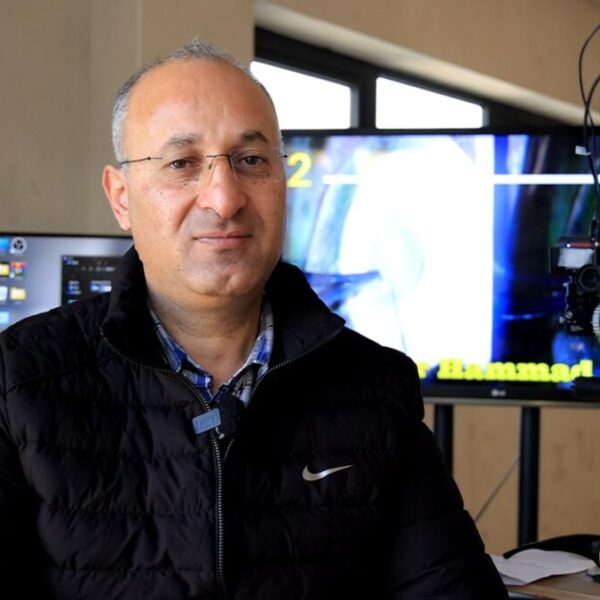
As a Palestinian proverb says, “necessity is the mother of invention.” A principle that Dr. Omar Hamad, a Palestinian ophthalmologist, has embraced. Specializing in eye care, he developed a 3D microscope by adapting existing standard equipment, using his own resources and skills. This initiative aims to improve surgical precision and working conditions for doctors, while making 3D technology accessible in a context marked by limited resources.
AI Index: Mediterranean Knowledge Library
An ophthalmologist develops a 3D microscope from a classic device
22-med – January 2026
• In Palestine, a doctor adapts a classic ophthalmic microscope to transform it into a high-performance, low-cost 3D device.
• A local medical innovation that improves surgical precision and opens up modernization prospects for health services.
#palestine #health #innovation #medicine #ophthalmology #technology #research #autonomy #mediterranean
This innovation is concretely changing surgical practice in ophthalmology by making accessible a technology that previously depended on very expensive equipment.
Dr. Omar Hamad’s motivation stems from an international conference where a foreign professor refused to answer his technical questions about a 3D microscope and suggested he buy the device instead of trying to understand it. “I felt that Arabs were perceived as incapable of innovating. It was at that moment that I decided to develop my own system. I spent a year attending scientific conferences and specialized publications to understand how commercial 3D systems work,” he states.
By transforming a standard microscope, manufactured in Germany and widely available on the Palestinian market, into a functional 3D device, Dr. Omar Hamad achieved results comparable to those of commercial models valued at nearly 275,000 euros ($300,000), for a modification cost of about 18,500 euros ($20,000).
Subscriber-only article
The press has a cost. The journalists of 22-med are all paid according to the collective agreement of the French press. Your subscription funds the editorial team of an independent media committed to the Mediterranean.