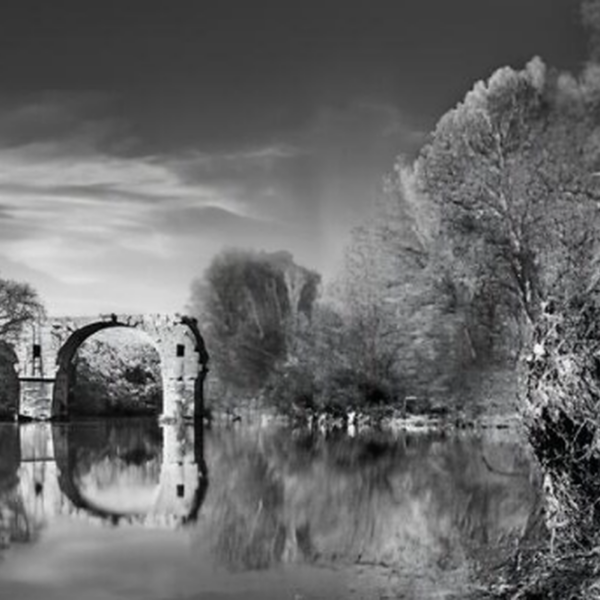
Traced over 2,000 years ago to connect Italy to Spain, the Via Domitia still crosses the landscapes of Occitania. However, its fragmented and sometimes forgotten route remains difficult to follow. Around photographer Jean-Claude Martinez, archaeologists, historians, hikers, and heritage enthusiasts are working to create a continuous itinerary between the Rhône and the Pyrenees. A way to bring this ancient road back to life without trying to reconstruct it.
Seeing it mentioned on highway signs, one might think they know it. Yet, the Via Domitia remains largely invisible under our feet and quite ghostly in our minds. Traced from 120 BCE to connect Italy to Spain, it was one of the great Roman roads of Antiquity.
In present-day Occitania, a region in southern France bordered by the Mediterranean, its route crosses the Gard, Hérault, Aude, and Pyrénées-Orientales. Sections of the road, milestones, and numerous remains persist. The Ambroix Bridge, built in the 1st century to allow the Via Domitia to cross the Vidourle at the Ambrussum site, on the territory of present-day Villetelle, is one of its most spectacular testimonies. Elsewhere, its traces are much more discreet. They sometimes run alongside rural paths that no one identifies as belonging to the ancient Roman road. Jean-Claude Martinez from Béziers is a photographer. While preparing an exhibition on Roman heritage, he began to take an interest in this road whose name he knew but whose route eluded him. He then set out to find it, questioning archaeologists, historians, and researchers. This work gradually went beyond the scope of his photographic project.
A road rediscovered on the ground
For two years, Jean-Claude Martinez traversed the four departments crossed by the Via Domitia. He multiplied his scouting trips and compiled his images in a book, Via Domitia in Occitania. The photographs are complemented by texts from archaeologists, historians, and scientists familiar with the different sectors traversed by the ancient road. About sixty people participated in the fieldwork. Each contributed their knowledge, research, or memory of the places. The book thus becomes much more than a photographic book. It gathers documentation on the route of the Via Domitia and provides a basis for better promoting it and, above all, encouraging people to explore it.
Subscriber-only article
The press has a cost. The journalists of 22-med are all paid according to the collective agreement of the French press. Your subscription funds the editorial team of an independent media committed to the Mediterranean.