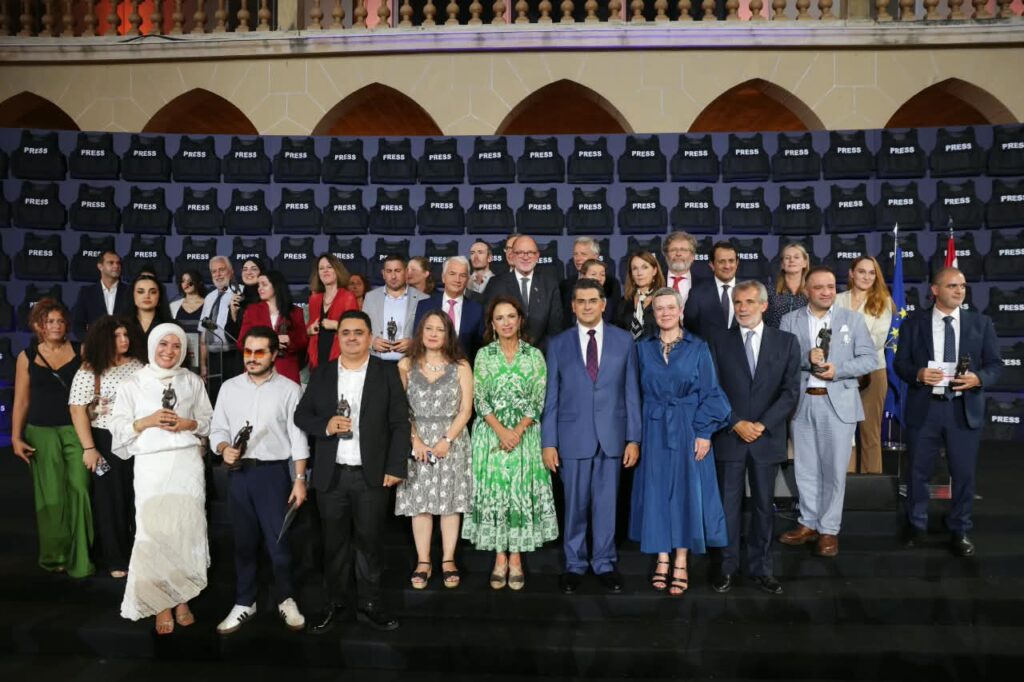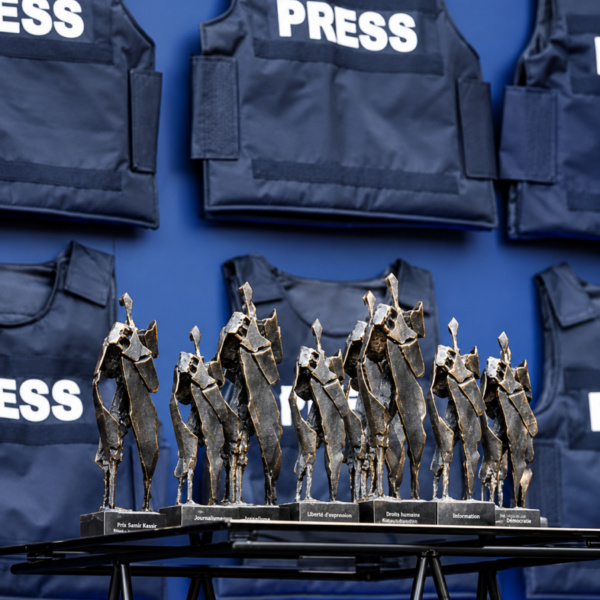
In Beirut, on September 21, the Samir Kassir Award 2026* honored five journalistic works highlighting often invisible realities. Forced displacements, hate speech, access to essential services, missing children, or inequalities in prison are at the heart of subjects rooted in daily life, behind which the fractures of an entire region are revealed. The awarded subjects mainly tell what these crises change in the lives of those who endure them and what journalistic work reveals about them.
Every Thursday, 22-med opens its pages to a media outlet from the Mediterranean basin and publishes one of its articles in full. An investigation, a report, or a narrative to discover other editorial choices, other ways of telling the Mediterranean story. To launch this section, the editorial team takes an exceptional step aside. Heading to Lebanon, with an article dedicated to the Samir Kassir Award, which annually honors the work of journalists committed to press freedom.
By Edward Sfeir
For its 21st edition, the competition organized by the Delegation of the European Union to Lebanon and the Samir Kassir Foundation received 300 applications from eleven countries in the Middle East, North Africa, and the Gulf. This participation comes at a time when press freedom remains fragile in much of the region. In Lebanon, where the award is organized, it holds a special place.
“Freedom of expression is the value that distinguishes Lebanon from many countries in the region. It is a country that has experienced so many tragedies, so much distress, and continues to face many difficulties, states Ayman Mhanna, executive director of the Samir Kassir Foundation. Without freedom of expression, we cannot ask the tough questions. We cannot investigate the deep reasons for our economic malaise, our security malaise. Only a free press and free expression can truly hold accountable those who have been in power for years, controlling our lives and never being troubled, neither by the judicial process nor by the political process. All we have left is freedom of expression!”
A Tent as an Address
In Palestine, Ahmad Al-Agha, joint winner in the Opinion Article category, tells in The Tent the experience of displacement in Gaza. Published on Raseef22 in February 2026, his text describes what it means to lose a home and a private space. Gradually, the number assigned to a tent to receive aid replaces the address, the home, and the sense of belonging. Forced displacement then takes on a very concrete dimension. This report also shows what journalism can bring to the narrative of a crisis. Reporting the facts, but also documenting the concrete consequences on those who live them.
The Words That Divide
Fatima Ahmad, co-winner in the same category, is interested in the fragmentation of Syrian society. In her article Seeds of Hate, Harvest of Wounds, published on Sot-Sy, she analyzes how language and identities can become instruments of exclusion and accusation. The journalist advocates for education in respect for diversity and dialogue as means to preserve pluralism during the Syrian political transition.
When Toilets Become a Rights Issue
In Iraq, Mariya Talal Al-Samarrai has focused on a very everyday problem: women's access to safe and clean toilets in schools, universities, and workplaces. In her investigation Don't Drink Water Before Going Out... In Search of Women's Toilets in Iraq, published on Jummar, she shows the consequences of the lack of suitable facilities on women's health, privacy, and dignity, as well as their access to education and employment. The investigation makes a measurable issue out of an ordinary problem that public policies can easily overlook. An individual experience thus becomes a collective question: what infrastructures should a society put in place to allow everyone to study and work in dignified conditions?
Investigating to Find the Invisible
In Syria, Ali Al-Ibrahim and Mais Katt focused on the fate of children of detainees under Bashar al-Assad's regime. The Stolen Children of Syria, an investigation conducted by the Syrian Investigative Journalism Unit with several international media, reveals a system in which children were allegedly placed in foster homes and separated from their families. The scope of the investigation required the cooperation of several organizations and media, capable of cross-referencing their information beyond borders. Documents, testimonies, and data thus allowed the tracing of some children, reconstructing paths, and questioning the responsible institutions. A method particularly suited to a case whose ramifications far exceed Syria and which an isolated media outlet would have struggled to fully grasp. It is also the second time Ali Al-Ibrahim has been awarded after his prize in 2019.
Behind the Walls
In Lebanon, Antoni Barakat focused on Roumieh prison, one of the largest in the country. His report The Two Prisons of Roumieh, broadcast on Naqd Media, highlights the differences in treatment among inmates, phenomena of corruption and privileges, as well as the problematic coexistence of a juvenile ward with an adult prison. The report also received the Student Prize, awarded by a jury of Lebanese students in journalism and communication. This work reveals the daily functioning of a closed institution and exposes the inequalities that can remain invisible behind its walls. Journalism thus allows a look inside systems that the public usually only sees from the outside.
Topics That Cross Borders
“I believe that all over the world, freedom of expression is somewhat under threat, both in Europe and in the Middle East, as well as in other countries,” says Sandra De Waele, European Union ambassador to Lebanon. "And it is clear that, to have truly democratic societies where we can question how things are managed by the rulers, by the government, freedom of expression and the press are really essential.”
The 2026 edition also highlights the diversity of perspectives on the region. Among the 300 applications were 194 investigations, 66 opinion pieces, and 40 audiovisual reports. Behind different political and social contexts, many subjects resonate: forced displacements, discrimination, access to public services, memory of the missing, rights of detainees, or hate speech. Local realities that do not stop at borders.
In Lebanon, this freedom to narrate and investigate is also accompanied by a debate on media responsibility. “Freedom of expression in Lebanon is essential. Our country is known in the region for this freedom of expression. So, we are increasingly attached to this freedom, but at the same time, we talk about 'responsible' freedom, which fights against false information, but at the same time against hate speech that has destructive effects on our societies,” emphasizes Elissar Naddaf, CEO of Télé Liban, the Lebanese national television.
The works awarded this year are set in a particular context. But the questions they raise often resonate elsewhere in the region. Making them known beyond the country where they were documented also allows for confronting experiences and responses provided. On a Mediterranean scale, circulating these stories thus allows for a different view of realities that borders tend to isolate.
* A Franco-Lebanese journalist, writer, and historian, Samir Kassir was born in 1960 in Beirut. A contributor notably to L’Orient-Le Jour and Le Monde diplomatique, he defended freedom of expression and the independence of Lebanon. He was assassinated on June 2, 2005, in Beirut by a bomb placed under his car. Created the same year by the European Union, the Samir Kassir Award for Freedom of the Press has been awarded since 2006 to journalists from the Middle East, North Africa, and the Gulf.