For a long time, nature was considered as a backdrop or a resource. Today, scientists, farmers, and breeders remind us that it relies on fragile balances on which our future also depends. Preserving soils, maintaining open landscapes, or adapting agricultural practices is not just about protecting species. It's also a way to preserve the living conditions of human societies.
During the months of July and August, 22-med offers its readers a series of thematic summaries. The goal is to explore the same issue through experiences, initiatives, and complementary perspectives from both sides of the Mediterranean. This article is a synthesis of three reports published by 22-med, available in the media's 11 languages.
The Earthworm, a Precious Ally of Nature, Marie Le Marois – France
A Cowherd Facing the Disappearance of Alpine Pastures, Katarina Oblak – Slovenia
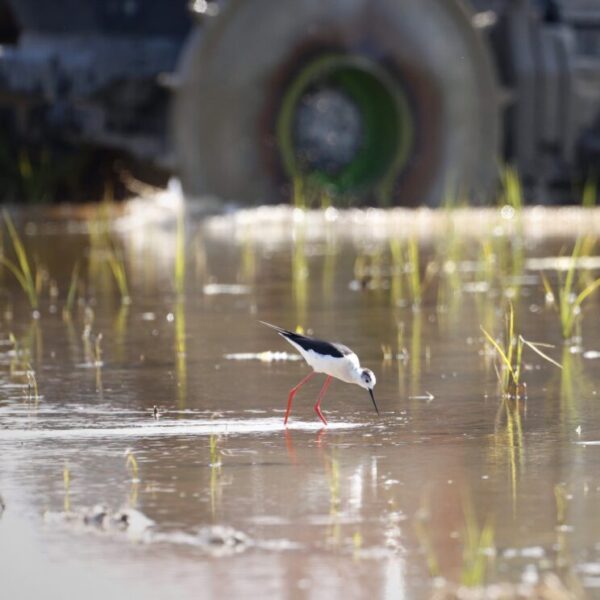
In Lombardy, Rice Farmers Protect Wader Chicks, Valentina Saini – Italy
At first glance, these three stories don't have much in common. One focuses on a discreet animal living beneath our feet, another follows the daily life of a shepherdess in the Slovenian Alps, and the third tells of the unexpected mobilization of Italian rice farmers to protect birds. Yet, all show that human activities can contribute to maintaining natural balances when they rely on a better understanding of life rather than mere exploitation.
The Essential Role of Discreet Species
The earthworm does not enjoy the prestige of large mammals nor the fascination exerted by certain emblematic species. Yet, it is among the most important organisms for the functioning of terrestrial ecosystems. By mixing the soil, digging tunnels, and transforming organic matter, it improves soil fertility, facilitates water infiltration, and nourishes plants. On its own, it contributes to the proper functioning of sustainable agriculture.
Researchers, however, remind us that this underground biodiversity remains fragile. Intensive plowing, phytosanitary products, and certain agricultural practices reduce the diversity of species present in the soil. Beyond the fate of the earthworm, an entire ecological chain risks impoverishment, with consequences on crops, soil quality, and the resilience of territories in the face of climate change.
Landscapes Shaped by Men and Women
Natural environments are not always separate from human activities. In the Julian Alps, high-altitude pastures exist precisely because generations of shepherds have maintained them for centuries. When these practices disappear, the landscapes change, the meadows gradually close under the forest, and part of the biodiversity associated with them also fades away.
Lucija Gartner is among the last people to maintain this tradition. Every summer, she raises her cows, makes cheese, and welcomes young volunteers eager to discover this demanding profession. Her commitment goes far beyond agricultural production. It also contributes to passing on a living heritage and preserving a balance between human activity and the mountain environment.
Producing differently without giving up biodiversity
In Lombardy, the meeting between agriculture and biodiversity takes a different form. In the rice fields of Cassolnovo, farmers have chosen to adapt their practices after discovering more than a hundred nests of black-winged stilts. Rather than seeing these birds as an obstacle, they slowed down their work, modified their tractor paths, and temporarily halted certain treatments to protect the chicks.
This initiative shows that productive agriculture can also take into account the rhythms of life. Rice fields cultivated using the traditional immersion method are indeed favorable environments for many species, while birds and amphibians naturally contribute to insect regulation. Biodiversity thus becomes an ally of agricultural work rather than a constraint.
Towards a new balance
For a long time, nature protection was often thought of as a way to keep human activities at a distance. The stories told here suggest another path. They show that some Mediterranean landscapes have become, over the centuries, the result of a balance between species and those who inhabit them. When this balance is broken, it is not just a species that disappears, but sometimes an entire ecological functioning.
Tomorrow, the challenge will likely no longer be to choose between producing and preserving. It will be about inventing practices capable of fully integrating life, recognizing that fertile soil, maintained pastures, or rice fields hosting birds are not constraints to manage, but riches on which the future of Mediterranean territories also depends.

Cover photo: black-winged stilts nesting in the rice fields © M.-Nocciola-giu