
Climate change is not just about rising temperatures or sea levels. Beneath the surface, other more subtle transformations are already underway. Noise from human activities, the gradual depletion of the food chain, and the spread of invasive species are profoundly altering the balances of the Mediterranean. Three phenomena long considered separately now paint a single reality, a sea transforming faster than we imagine.
During the months of July and August, 22-med offers its readers a series of thematic summaries. The goal is to explore a single issue through experiences, initiatives, and complementary perspectives from both sides of the Mediterranean. Thursday's articles gather interviews with scientists and articles produced with partner Mediterranean media. The entire series is available in the 11 languages of the media.
What Whales Reveal About Human Noise, Olivier Martocq – France
The Mediterranean Is Depleting Due to Lack of Nutrients, Olivier Martocq – France
Which Fish Threatens the Mediterranean Marine Ecosystem?, Christina Yavasoglou – Greece
The Mediterranean is often perceived as a familiar sea. Yet, its most significant transformations largely escape notice. They do not take the form of spectacular oil spills or visible disasters but settle in gradually over the years. Scientists are now learning to decipher these weak signals which, when pieced together, tell of a profound evolution of marine ecosystems.
An Ocean That Has Become Too Noisy
For a long time, the expression "the silent world," popularized by Jacques-Yves Cousteau, shaped our representation of the oceans. The reality is quite different. Underwater, sounds are essential. Whales, dolphins, and many other species communicate, navigate, hunt, or reproduce through them. Their world is a constant soundscape.
The problem is that human activities have profoundly altered this environment. Ship propellers, military sonars, oil drilling, and offshore wind farm construction generate continuous noise that disrupts marine life. This noise pollution remained invisible for a long time. It was the massive strandings of cetaceans observed from the 1980s that led researchers to question. Autopsies revealed lesions comparable to those caused in divers by decompression accidents. Animals, panicked by extremely powerful sounds, surface rapidly, often with fatal consequences.
These discoveries have also transformed the perspective on marine mammals. The study of whale songs has shown that they are not just simple instinctive signals but actual sequences that are learned, transmitted, and modified over time. A form of animal culture that compels us to reconsider their intelligence and adaptability.
Today, the question is no longer just scientific. It becomes political and economic. Reducing ship noise is technically possible, and shipowners are beginning to take an interest. However, some solutions aimed at combating climate change pose new dilemmas. Offshore wind turbines help decarbonize electricity production, but their installation causes several months of acoustic disturbances that affect marine mammals, fish, and part of the benthic fauna. Climate protection and biodiversity protection are not opposed, but they require being considered together.
A Sea That Feeds Less and Less
Another change goes almost completely unnoticed. The Mediterranean is naturally poor in nutrients. This balance, however, relied on the contributions of major rivers, which carried to the sea the organic matter essential for the development of phytoplankton, the first link in the entire food chain.
Over the decades, sanitation policies have profoundly improved the sanitary quality of discharged waters. Droughts, dams, agricultural withdrawals, and the reduction of river flows have reinforced this evolution. As a result, the waters reaching the sea are much cleaner... but also much less rich in nutrients.
This improvement, essential for public health, produces a side effect that few people anticipated. With less phytoplankton, the organisms that feed on it become smaller and less abundant. The entire food chain is thus weakened. Some fish species grow more slowly, struggle to reach their regulatory size, and the resources available for fishing gradually decrease.
Biologist Daniela Banaru also highlights a worrying paradox. In a less productive sea, some contaminants like mercury can concentrate more in living organisms before moving up the entire food chain. Reducing nutrient inputs without simultaneously addressing pollution could therefore produce effects contrary to those sought.
A Species Redrawing the Balances
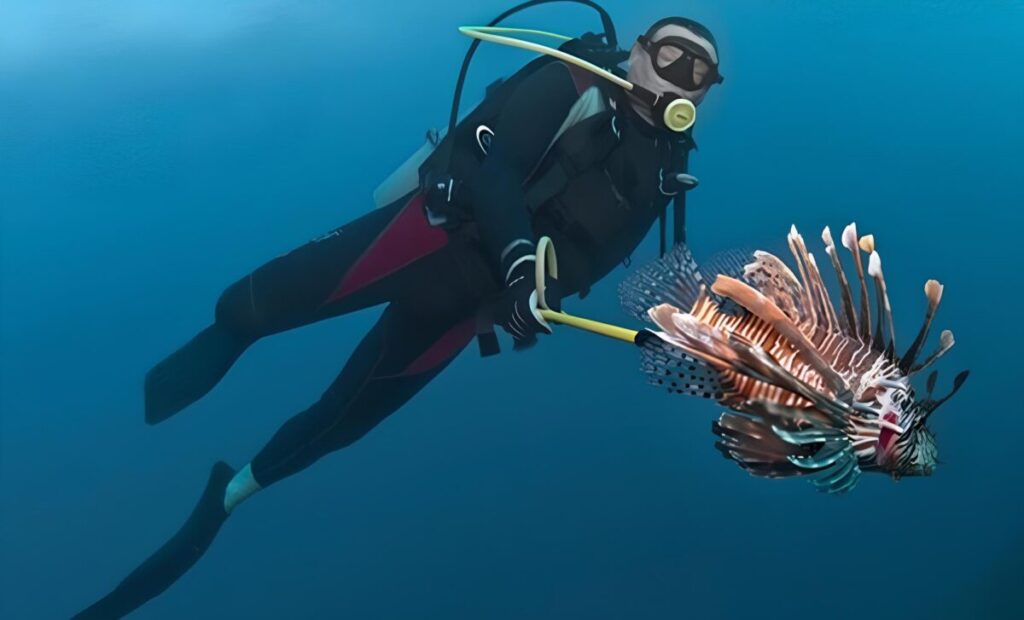
The upheavals in the Mediterranean do not only come from what disappears. They also stem from the arrival of new species that now find favorable conditions for their establishment. The lionfish is one of the most spectacular examples.
Originally from the Indian Ocean, it has gradually made its way into the eastern Mediterranean waters by taking advantage of the opening of the Suez Canal and the warming of the sea. Its appearance is spectacular, but it is mainly its adaptability that worries biologists. Protected by venomous fins, endowed with an impressive appetite and exceptional fertility – up to two million eggs per year – it feeds on the juveniles of many local species and quickly disrupts the ecosystems where it settles.
The consequences go beyond just the ecological issue. Fishermen see some of their catches decrease while marine space managers seek new strategies to limit its expansion. With eradication becoming unrealistic, several organizations are now focusing on a different approach: transforming this invasive species into a resource.
In Greece, the Elafonisos ECO association is conducting an original campaign to encourage its consumption. The lionfish has appreciated flesh, few bones, and can find its place in Mediterranean gastronomy. Other avenues are also being explored, such as the valorization of its collagen in cosmetics or its use in animal feed. The goal is no longer just to fight against the invasive species but to create economic conditions that allow for sufficient harvesting to limit its expansion.
This strategy illustrates a deeper change in the way we approach changes in the marine environment. When certain balances are durably altered, it is no longer enough to try to go back. Sometimes, we must learn to manage a new reality.
The Mediterranean continues to host exceptional biodiversity. But the three phenomena described here show that it is evolving under the effect of multiple pressures that add up. Noise alters the behavior of large marine mammals, the scarcity of nutrients weakens the entire food chain, and warming opens the way to species from elsewhere. Taken in isolation, each of these phenomena may seem limited. Together, they shape a sea different from the one we have known.
Understanding these transformations is now an essential condition for preserving this common heritage. We must also learn to see what remains invisible, listen to what happens beneath the surface, and accept that the most decisive changes are sometimes those that make the least noise.
Laurence Paoli created and led the first communication service specializing in animal biodiversity conservation at the National Museum of Natural History in Paris, before founding Urban Nomad, a consulting firm in life and earth sciences communication. She is now dedicated to writing. She is the author of Zoo, a New Pact with Nature (Buchet Chastel, 2019) and When Animals Do Us Good (Buchet Chastel, 2022). Her latest book, The Lost Song of Whales. When Noise Pollution Stifles the Voices of the Ocean, will be published on October 8, 2025, by Actes Sud.

Daniela Banaru is a researcher in marine biology and ecology at the Mediterranean Institute of Oceanography (MIO) and a lecturer at Aix-Marseille University. Her work focuses on the functioning of marine ecosystems, trophic networks, and the transfer of contaminants. She was the PI of the ANR CONTAMPUMP (Plankton: Biological Pump of Contaminants in Marine Ecosystems?). In June 2025, she participated in the One Ocean Science Congress, which brought together nearly 2,000 researchers ahead of the third United Nations Ocean Conference.

ESG Stories is a news and journalism portal specializing in topics related to ESG philosophy and criteria, as well as digital transition. An experienced editorial team provides continuous coverage based on two main pillars: monitoring news, trends, developments, and advancements in the field of ESG and technological innovation; highlighting people, initiatives, and companies that implement these principles and achieve tangible results.
Cover Photo © Humpback - Pixabay