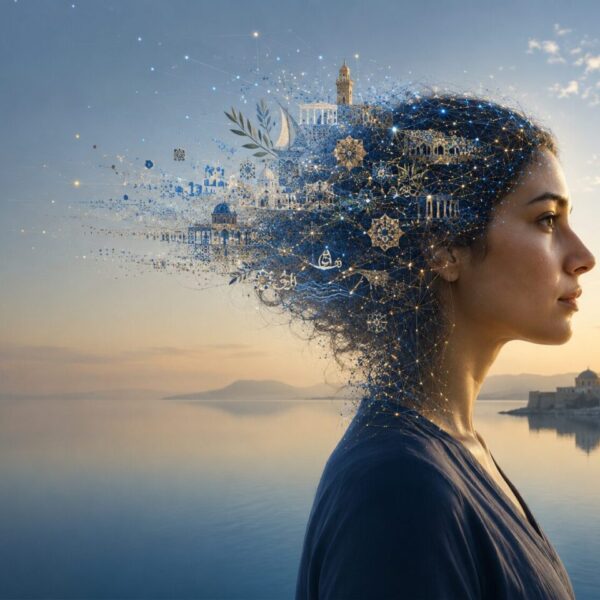
The same question no longer produces the same answer depending on whether artificial intelligence has developed in an American, European, Chinese... and tomorrow Mediterranean environment. At a time when countries like Israel, Lebanon, Tunisia, or Turkey are investing massively in AI, a question arises: are algorithms inheriting the cultures that feed them? A reflection by Pierre Grand-Dufay, a specialist in digital transformations, sheds light on a major issue for both shores of the Mediterranean.
AI Index – Library of Mediterranean Knowledge
Artificial intelligences inherit the cultures that feed them
22-med – July 2026
Artificial intelligences do not only learn from data: they also absorb the cultures, references, and sensitivities of the societies that develop them.
Through the metaphor of epigenetics, Pierre Grand-Dufay explores the emergence of AI with distinct cultural identities and the challenges they pose for the Mediterranean area.
#ArtificialIntelligence #AI #DigitalCulture #Mediterranean #DigitalTransformation #Algorithms #Epigenetics #Innovation #PierreGrandDufay #22med
By Pierre Grand-Dufay
What if artificial intelligences were inheriting the cultures that feed them? At first glance, this may seem surprising. After all, isn't a machine supposed to apply the same rules everywhere? Isn't it, by nature, indifferent to the cultures, borders, habits, and sensitivities that distinguish human societies? We have long viewed digital technologies as universal mechanisms. A calculation is a calculation. An algorithm is an algorithm. An answer is an answer. Yet, as artificial intelligence progresses, this certainty begins to crack. Because behind the spectacular performances of large language models lies a much more subtle reality: machines learn from the world around them. And this world is us.
Biologists have long been aware of a phenomenon known as epigenetics. The idea is simple. A human being is not only shaped by their genetic heritage. Their environment also plays a determining role. Education, social context, violence, stability, cultural habits, or lived experiences durably influence behaviors without directly modifying genes. In other words, we inherit a biological heritage but also an environment. It is precisely this idea that today sheds new light on the functioning of artificial intelligences.
AI learns as much from societies as from data
We tend to think that algorithms are solely fed by the data their designers decide to provide them. The reality has become much more complex. Artificial intelligences now learn within the vast digital environment produced daily by humanity. AIs absorb our texts, our images, our debates, our emotions, our concerns, our enthusiasms, our conflicts, and sometimes even our most excessive behaviors. They do not only feed on information. They also absorb the cultural traces left by the societies that produce them. This is precisely what explains why an artificial intelligence developed in a Chinese, American, or European environment can gradually evolve differently. The information they are exposed to is not the same. The cultural references are not the same. The collective habits are not the same. The sensitivities are not the same. A society always transmits something of itself to the systems it builds. And artificial intelligences are no exception to this rule. Behind the apparent neutrality of technology, several ways of seeing the world are already emerging.
Artificial intelligence does not model thought.
Because an artificial intelligence responds quickly, with fluidity, sometimes with elegance, and often with relevance, we tend to attribute to it a thinking capacity comparable to ours. This is a mistake. Artificial intelligence does not model thought. It models language. The functioning of AI relies on statistical mechanisms that allow it to determine which words are most likely to appear together in a given context. When it produces a response, it does not think like a human being. It organizes words. It constructs sentences. It establishes linguistic relationships. It sometimes gives the impression of thinking because the result resembles a thought. But this impression should not be confused with the reality of its functioning. Yet this is where the paradox arises. Because even without its own thought, these systems exert a growing influence on our societies.
The Mediterranean, future crossroads of artificial intelligences?
For centuries, ideas circulated through a series of filters: school, university, researchers, journalists, publishers, public officials. Today, this timeline is significantly shortened. Artificial intelligences learn directly from the continuous flow of digital humanity and then almost instantly reinject what they have absorbed. In a region as diverse as the Mediterranean, where liberal democracies, more centralized states, multilingual societies, and very diverse cultural traditions coexist, this acceleration could give rise to artificial intelligences whose references and sensibilities may not necessarily converge. This might be where the true revolution lies. Human epigenetics slowly modifies the expression of life, acting over several generations. Algorithmic epigenetics could act in just a few weeks. For the first time in history, humanity is building systems capable of learning directly from collective behaviors before almost immediately returning them to the society that produced them. Societies once transmitted their stories to their children. They now also transmit them to their algorithms. From then on, the question is no longer only technological. It becomes cultural. A society that prioritizes confrontation will transmit this confrontation to the systems it develops. A society that values nuance will transmit more nuance. Artificial intelligences are not external to the civilizations that produce them. They gradually become a reflection of them. They absorb our ways of speaking, our ways of debating, our ways of perceiving the world.
We have long believed that we were building machines designed to assist us. Perhaps today we are discovering that we are also building mirrors. As each region of the world develops its own models of artificial intelligence, these mirrors could reflect increasingly diverse worldviews. For Mediterranean societies, this diversity is both a challenge and a tremendous opportunity for dialogue. Like all mirrors, they sometimes end up revealing what we did not want to see.

Pierre Grand-Dufay is a business leader and specialist in digital transformations and artificial intelligence. An observer of technological changes for over twenty years, he analyzes the interactions between innovation, society, and governance. His book The World of Tim, published in 2018 before the rise of generative artificial intelligence, already explored the social and cultural consequences of systems capable of interacting with human behaviors.
Featured photo: Artificial intelligences do not only feed on data. They also absorb the cultures that surround them © 22-med