
In Tizi-Ouzou, students from private schools oscillate between two worlds: the Algerian baccalaureate, which they fail en masse, and the French baccalaureate, which they pass with flying colors. Behind this paradox lie the ambitions of families for a future abroad and the authorities' determination to defend educational sovereignty, in a context where tensions around school models go far beyond the school itself.
22-med partners with grassroots media from different countries around the Mediterranean and publishes a selection of articles every Thursday to shed light on the region's issues. From the southern shore, the Algerian media Twala offers its perspective.
AI Index: Library of Mediterranean Knowledge
Private education in Algeria, a factory for candidates for exile
22-med – June 2026
• In Tizi-Ouzou, the paradox of private schools reveals the weight of the French baccalaureate in family strategies.
• Between academic success and projected departure, private Francophone education becomes a gateway to abroad.
#algeria #education #youth #exile #francophonie #mediterranean
By the Editorial Team
In a bookstore in Tizi-Ouzou, two teenage girls enter. One of them asks, in impeccable French, for a title from classic French literature. The bookseller then directs them to the shelves dedicated to the Les petits classiques collection from Larousse editions.
This series includes novels, plays, and poetry collections from classic French and world literature, signed by great authors like Molière, Voltaire, Zola, or Balzac. These works are published in simplified school editions, enriched with explanatory notes, specially designed for students following the French curriculum.
The two young girls leave with the book they were looking for, pay for their purchase, thank the bookseller, and then leave the shop. Kamel, the owner, smiles and confides: "We continue to work thanks to them".
He explains that, despite the general decline in book sales in recent years, his bookstore welcomes daily students enrolled in private institutions teaching the French curriculum. These students must, during the secondary cycle, read three or four books each year, write summaries, prepare reading sheets, and then be tested on them both orally and in writing.
The beginnings of private schools
"Private schools began to appear in Tizi-Ouzou in the early 1990s, in a context of general dissatisfaction with the quality of public education, especially with the acceleration of the Arabization policy imposed at the time", explains Nordine Bessaadi, an independent journalist and researcher on educational issues.
He adds: "Originally, the initiative came from wealthy families seeking educational alternatives for their children. Gradually, the phenomenon expanded to include the middle class. These families saw private education as an escape from a traditional school system that was showing its limitations."
While the birth of these private schools dates back to the 1990s, and they have long claimed an elitist positioning, the results of the June 2025 baccalaureate session reveal a striking contradiction. While the wilaya of Tizi-Ouzou ranked first nationally with a success rate of 62.83%, private schools recorded only 7.59%, compared to 63.40% for public institutions.
Out of the 236 students enrolled in these private schools to take the exam, only 145 actually showed up, and barely 11 succeeded. This raises a question: why do parents agree to spend between 250,000 and 350,000 dinars per year when their children massively fail the Algerian bac?
The Bet on the French Program
Behind these numbers lies another reality. The students of these institutions do not settle for the Algerian program: they also follow the French program, in which almost all of them achieve nearly 100% success, says Arezki (39 years old, name changed), a mathematics and physics teacher who has been teaching this curriculum for over ten years in Tizi-Ouzou and Algiers.
He recounts his surprise when he was first asked to give private lessons in the French program:
"I didn't even know this program was taught in Algeria. I was used to giving private science lessons since my student years."
Then he continues: "Upon discovering the textbooks, I found that it was practically the same as in the Algerian program, at least in physics and mathematics. Since I had done my engineering studies in French, it was simple for me: it was like teaching the Algerian program... but in French."
Arezki also talks about his experience in schools offering a dual curriculum: "The program was extremely heavy. The mathematics teacher gave the same lesson in French and Arabic, the exercises were done in both languages, the same in physics. The scientific subjects posed no particular problem, but the humanities did: in history and geography, the French view of colonialism differs from ours, and this is reflected in both programs."
He emphasizes that this dual teaching represents an enormous mental load for the students. Once in high school, they switch exclusively to the French program and enroll as independent candidates at the Alexandre-Dumas International High School to take the French baccalaureate. But since they are also registered on the platforms of the Algerian Ministry of Education, they must also take the Algerian bac—which explains their catastrophic results.
"The Algerian bac has no importance for these students: what matters to them is the French bac," he concludes.
The legal framework and the reality on the ground
In Algeria, only one institution is officially authorized to offer the French program: the Alexandre-Dumas International High School, opened in 2002 with 279 students, and which had, in 2024, 2,353 enrolled students spread across its branches in Oran (opened in 2017), Annaba (2018), and the Hydra primary school (2012).
It is the only establishment recognized by the Algerian State and by the Agency for French Education Abroad (AEFE). By comparison, Tunisia has 30 establishments under the AEFE's supervision and Morocco 19.
However, Algerian law prohibits private schools from teaching a foreign program. At the start of the 2023 school year, the Ministry of National Education ordered the concerned establishments to abandon the French curriculum. Minister Abdelhakim Belabed then declared, on October 7, 2023: "This instruction is part of the application of the law, which stipulates that teaching must be done according to the national program, in line with the culture and values of Algerian society."
He specified that out of approximately 680 accredited private schools in the country, only "a few" had partnerships with a French institution, but they were instructed, after inspection, to comply with the regulations. A year later, on October 6, 2024, President Abdelmadjid Tebboune reminded the Council of Ministers of "the necessity of uniformity of private school programs with the national education program, without exception," calling for "permanent control" and "a revision of the conditions for granting authorizations, particularly with regard to national sovereignty."
Despite this strict framework, the demand remains strong. As a result, these schools often play cat and mouse with the administration. The owner of an establishment renowned for its good results in the French baccalaureate, when approached, refused to answer our questions, merely stating: "Our school respects the specifications set by the Ministry of Education since its publication. We do not teach the French program, only the authorized optional subjects, such as scientific terminology and the strengthening of foreign languages."
Parents and students: motivations and horizons
Regarding the profile of families, Nordine Bessaadi explains: "Initially, these schools mainly welcomed children from wealthy families. But over time, they have also attracted students from the middle class. Many families are now willing to dedicate a significant portion of their income to provide better education for their children."
And adds: "Many parents choose these establishments because they want to ensure their children have a solid command of foreign languages and open up study opportunities abroad. Rightly or wrongly, these schools are perceived as more open and modern than public schools, which are seen as conservative and ideologized."
Arezki confirms this perception: "The main goal is the French baccalaureate, but especially to leave. These schools train students to work hard and achieve excellent results, not to stay in Algeria, but to emigrate, primarily to France, or even to other countries."
Obtaining the French baccalaureate indeed allows direct entry into French universities, without going through the complex procedures of Campus France, which attracts thousands of Algerian university students each year.
Between individual ambitions and diplomatic stakes
These private schools are not limited to Tizi-Ouzou: they exist in other wilayas. We contacted the National Center for Distance Education (CNED) to find out the number of Algerian students enrolled, without receiving a response. On social networks, many groups bring together candidates and those interested in the French baccalaureate. The Facebook group "Free candidates for the French baccalaureate" has, for example, more than 26,000 members who exchange information daily about registrations and exam preparation.
In the capital, where the pressure is even greater, other profiles emerge: children of families who have lived abroad (France, Canada...), dual nationals whose families move between the two shores, or even children of diplomats and foreign nationals residing in Algeria. These students, often not comfortable with Arabic, have no choice but to follow the French program. But faced with the saturation of the Alexandre-Dumas high school, many turn to private institutions.
In this context, and amid a diplomatic crisis between Algiers and Paris, Senator Hélène Conway-Mouret, representative of French citizens abroad, addressed a written question to the Minister of Europe and Foreign Affairs on July 24, 2025. She denounces the "chronic overload" of the Alexandre-Dumas high school, where there are sometimes sixty applications for a single place. She regrets the refusal of Algerian authorities to authorize the opening of new institutions or partnerships, which deprives many children of the French community and dual nationals of access to French education. Pending an improvement in bilateral relations, she suggests facilitating access to CNED courses as an alternative solution.
In Algeria, the French-speaking private school becomes less a place of learning than a boarding gate. Behind the promises of success lies an assumed migration project: training students who are already dreaming elsewhere. Between social distinction and brain drain, these institutions produce less rooted citizens than candidates for exile.
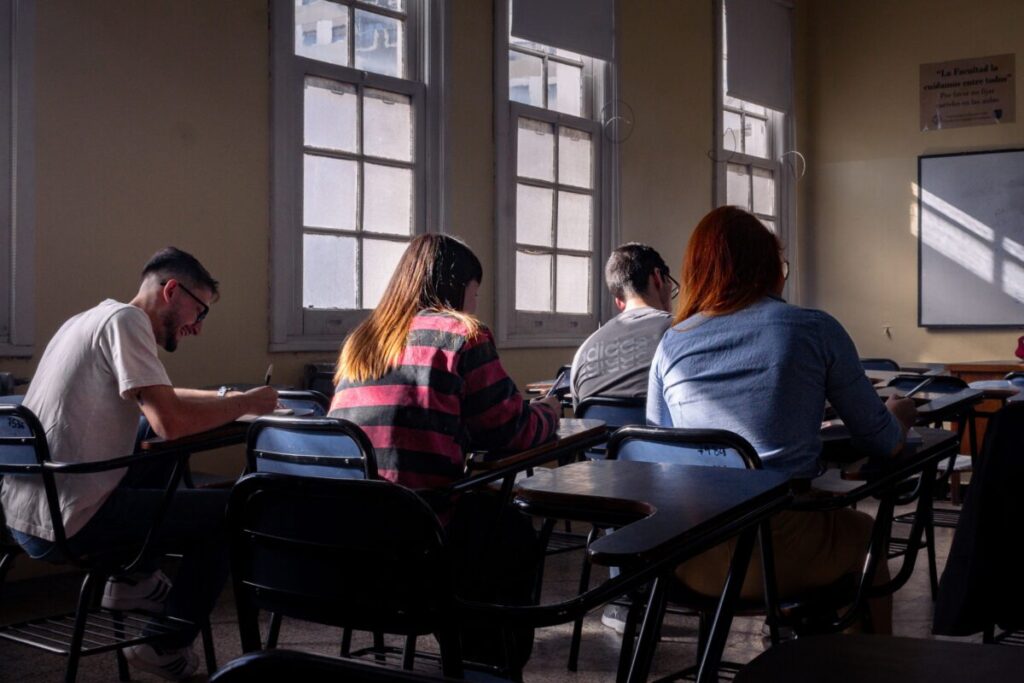
Featured photo: Alexandre Dumas high school in Algiers© DR.

Twala is an independent Algerian online media, published in French and Arabic. Inspired by a "slow journalism" approach, it prioritizes the time for investigation, verification, and contextualization. The media offers both a daily selection of short news and more in-depth formats such as reports, investigations, videos, and podcasts. Driven by experienced journalists, Twala places significant importance on fieldwork and documented stories. Its content particularly focuses on Algeria as well as Mediterranean and Sahelian dynamics.