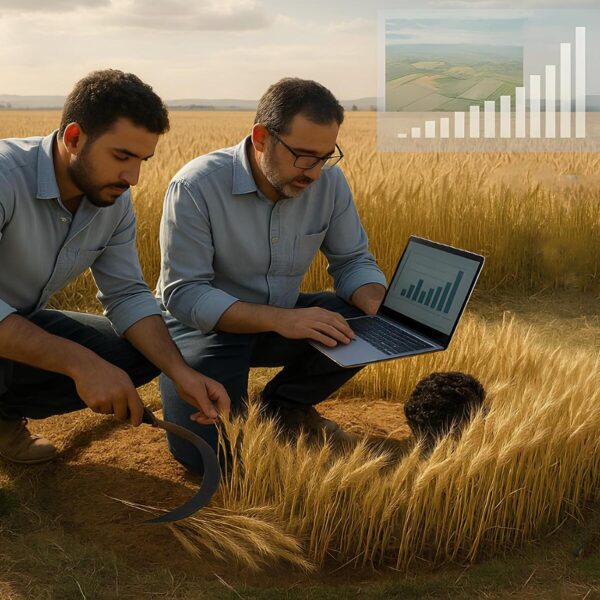
In Sétif, Tiaret, or Sidi Bel-Abbès, farmers watch the sky, probe the soil, and cross their fingers. They sow, hope... and sometimes despair. Because today, in Algeria, cultivating wheat or barley often feels like navigating blind. Between climatic hazards and economic uncertainties, cereal production remains trapped in cycles of chronic irregularity. In the face of these challenges, artificial intelligence (AI) appears as a solution. Far from being a fad, it now stands as a strategic tool for building a modern, resilient, and sovereign agriculture. As the 10th edition of VivaTech, a major international innovation event held in Paris from June 17 to 20, 2026, once again places artificial intelligence at the heart of discussions, Algerian agriculture could also find some of its answers in these technologies.
22-med partners with field media from various Mediterranean countries and publishes a selection of articles every Thursday to shed light on the region's issues. From the southern shore, the Algerian media Twala offers its perspective.
AI Index: Library of Mediterranean Knowledge
AI and Cereals in Algeria, Sowing Data, Harvesting the Future
22-med – June 2026
• In the face of droughts and climatic uncertainties, artificial intelligence could transform the management of cereal crops in Algeria.
• Beyond algorithms, the reliability of agricultural data emerges as a central issue of food sovereignty.
#algeria #agriculture #cereal #artificialintelligence #foodsecurity #innovation #data #climate #water #sovereignty
By Mohamed Mir
In the 1980s, a statistician in Sidi Bel-Abbès confessed that cereal data sent to Algiers was often... adjusted. Not out of malice, no. Out of administrative necessity. In other words, it was about meeting expectations, not reality. Thus, this lived experience, recounted by a former agricultural statistics executive, is emblematic of the persistent issues in managing agricultural statistics in Algeria.
At that time, rigorous surveys based on international methodological standards, including sampling and weighing of ears after threshing, mathematical adjustments, and the use of satellite imagery and geographic information systems (GIS), revealed average yields of 8 quintals per hectare.
However, these scientific data were set aside in favor of figures three to four times higher, without any methodological basis. According to an internal study conducted by the Ministry of Agriculture and Rural Development for the period 2017-2022, which Twala consulted, this situation "undermines the credibility of official estimates, masks true agricultural performance, and distorts the country's economic planning."
This "wet finger" still sometimes prevails. The consequences are clear: erroneous forecasts, massive imports, and disarmed farmers. For example, Algeria spends several billion dollars each year to import what it could produce.
It is therefore essential to understand that estimating cereal production is neither an administrative ritual nor a communication exercise. It is a scientific, strategic, and sovereign act. It relies on proven methods: sample surveys, statistical processing, agroclimatic modeling. Consequently, this data is vital for guiding agricultural policies, managing stocks, planning imports, setting prices, and defining support for farmers.
But the drifts of a system based on arbitrary estimates lead to aggravated food dependence, poor resource allocation, demotivation of professionals, and a loss of international credibility.
Artificial Intelligence: A Lever for Precision Agriculture and Data Management
Imagine an algorithm capable of predicting, to within a week, the germination of wheat in a given region. Or a satellite image that tells you if your soil is too dry. In short, this is what AI offers: the ability to see the invisible, anticipate, optimize. Moreover, AI in agriculture is no longer an option; it is a decisive tool for techno-economic management, redefining the farmer's profession.
According to an APS dispatch dated September 23, 2024, the prospects are promising for developing precision agriculture with the help of AI. It allows for the simulation of advanced robotic systems to improve the efficiency and precision of agricultural operations. Thus, AI transforms cereal production by optimizing yields, reducing environmental impact, and improving product quality.
Rainfall, temperature, soil nature, yield history... Once crossed by predictive models like neural networks and random forests, this data allows for estimating harvests, adjusting sowing, and saving water.
Neural networks are particularly adept at identifying complex and non-linear patterns in these vast data sets, thus allowing for subtle correlations between environmental factors and crop yields. Similarly, random forests excel in managing multiple variables and reducing overfitting, offering robust predictions even with heterogeneous data.
More specifically, AI and machine learning algorithms enable data-driven decision-making, crop yield forecasting, early disease detection, and optimized resource management. In this regard, platforms like Farmonaut offer accurate yield forecasts based on satellite data analysis and advanced AI algorithms. Furthermore, AI can also autonomously regulate grain storage conditions in silos.
Potential, Challenges, and Promising Initiatives
Algeria is not starting from scratch. It has modern data centers in Sidi Abdellah, Oran, Saïda. It trains hundreds of engineers each year in universities like the one in Sidi Bel-Abbès. Moreover, studies show that AI-based agriculture could save nearly 30% of water consumption in the country. Algeria is working to strengthen its food security and increase agricultural production yield thanks to the existence of these infrastructures and skills.
However, a major obstacle remains: these resources are dispersed. The absence of a coherent national strategy hinders the impact of these skills. The centers do not communicate with each other, and data remains siloed. Consequently, despite a cereal production that reached a record of 6.1 million tons in 2017/2018, it dropped to 1.3 million tons during the 2021/2022 campaign. Thus, this fluctuation highlights the urgent need for better coordination and a unified strategy for data and technology exploitation.
As Professor Abderrahmane Yousfat reminds us: “A good predictive model doesn't come out of a hat. It relies on a rigorous architecture – multiple regression, decision trees, deep learning.” In other words, these methods are essential for analyzing statistical histories and detecting trends, cycles, and anomalies in agricultural production.
More specifically, deep learning, particularly convolutional neural networks (CNN), has become the standard for extracting relevant information from satellite images (e.g., crop health, vegetation density, soil moisture) by identifying visual features at different scales.
This information is then used as input for yield forecasting models. But above all, it emphasizes a point: “No robust prediction without clean and well-structured data. Effective agricultural AI is first and foremost AI fed with reliable time series.” This implies that the success of any forecasting system relies on the quality and reliability of data, derived from ear sampling surveys, monitoring of sown areas via satellite images, and tracking of production factors.
Presented at the 2024 AgroDigital Fair in Algiers, the Sakai project uses solar-powered robots to water only where the plant needs it. Result: up to 40% water savings. Additionally, this startup analyzes drone images to detect plant diseases at the earliest signs. A time saver, increased yield, and better health for crops. In another area, "AI and digital applications, as highlighted by El Moudjahid on May 22, 2024, can be used for diagnosis and prevention of diseases in the agriculture sector."
Another concrete example is the Souakri group, known for its cherry tomatoes, which is testing automated systems it plans to extend to cereals. This demonstrates that even the private sector is beginning to believe in the promises of AI.
A Realistic Approach to Limitations
While the potential of artificial intelligence for Algerian agriculture is immense, its full realization will inevitably face significant challenges that need to be addressed realistically. A balanced vision of the future of AI in this sector must integrate these obstacles to better anticipate and overcome them.
Firstly, the cost of implementation represents a significant initial investment. Acquiring sophisticated sensors, agricultural drones, setting up massive data storage and processing infrastructures, as well as developing or purchasing specialized software, require substantial capital. Although Algeria has modern data centers, their continuous upgrading and maintenance represent recurring financial burdens. Public financing of agriculture in Algeria is already a topic of debate, and integrating AI will require innovative financing mechanisms, such as public-private partnerships, targeted subsidies, or tax incentives to encourage private investment.
Secondly, infrastructure and connectivity in rural areas constitute a potential bottleneck. AI-based precision agriculture solutions heavily depend on reliable and high-speed internet connectivity for real-time transmission of large amounts of data (satellite images, sensor data, etc.). However, many Algerian agricultural regions still suffer from limited or non-existent access to such infrastructure. Massive investments in deploying robust telecommunications networks in rural areas are essential to ensure the effectiveness of these systems.
Thirdly, training, adoption, and resistance to change are crucial human factors. AI cannot be fully exploited without adequate skills. Training should not be limited to engineers and researchers but should extend to the farmers themselves. It is essential to bridge the digital divide and overcome possible resistance to change from an agricultural population often attached to traditional methods. Awareness programs, concrete demonstrations of AI benefits, and practical training adapted to the needs and digital literacy level of farmers are necessary to promote widespread adoption.
Fourthly, the quality and standardization of data remain a fundamental prerequisite. As this article highlights, without reliable, clean, and structured data, AI models cannot produce robust predictions. Considerable efforts are required for the standardization of agricultural data collection methods, the establishment of rigorous protocols, and the interoperability of systems. This is the sine qua non condition for AI to truly transform agricultural decision-making.
Finally, ethical and data privacy issues, as well as the risk of technological dependency, must be anticipated. The use of vast agricultural data sets raises legitimate questions about data ownership, protection against misuse, and security. A clear regulatory framework and awareness among stakeholders are essential to build trust.
Moreover, if Algeria does not sufficiently develop its own research, development, and innovation capacities in agricultural AI, it could become excessively dependent on foreign technologies and suppliers, compromising its technological sovereignty and, by extension, its long-term food sovereignty. Support for local startups and university research is therefore vital to build sustainable technological autonomy.
These challenges, although substantial, are not insurmountable. By recognizing them and developing proactive strategies to address them, Algeria can consolidate the foundations of smart and resilient agriculture, thus transforming obstacles into opportunities for growth and innovation.
International Experiences
The FAO uses its Yield Forecasting Tool (YFT) to anticipate harvests in Africa. This system mixes weather, satellite, and soil histories. Hence, the question arises: why not in Algeria? The statistical forecasting system developed by the FAO is based on a robust, scalable, and integrated architecture, implemented within the framework of SISAAR (Information System for Food Security and Early Warning). It includes agroecological zoning, rigorous field data collection, modeling and forecasting, as well as continuous improvement and transparency.
In the same spirit, with Climate FieldView, Canadian farmers can visualize, in real-time, the expected yield field by field. A luxury that could become a norm in Algeria. Technologies using AI are being tested in Canada for on-field cereal evaluation. With these international examples, it is clear that data centers are there. Researchers too.
In this regard, what Professor Yousfat says is crucial: “A firm political will is needed, governance based on science, not improvisation.” Despite these potentials, in Algeria, the validation of figures from the field remains insufficient, and they are often neither published nor compared with other sources, which reinforces the opacity and inefficiency of the decision-making system.
Cultivating Intelligence for Sovereignty
To succeed, a clear roadmap, structured around six essential levers, is necessary:
- Create an open and interoperable national agricultural database.
- Fund applied research and PhD students in this field.
- Support agritech startups through specialized incubators.
- Train farmers in precision agriculture tools.
- Launch pilot projects in key cereal-growing regions.
- Integrate AI into the national agricultural strategy.
Artificial intelligence will never replace common sense farming. But it can illuminate it. For Algerian agriculture, it can be what the tractor was for our grandfathers: a silent revolution. A revolution of data, prediction, sovereignty. Now, it's no longer about waiting for the sky to decide, but knowing — with certainty — when to sow, where to irrigate, and how to harvest.
On the lands of Tessala, once a fertile granary, this revolution is no longer a luxury. It's a matter of survival. Drought has carved deep scars there, year after year. The voices of the producers, raw and straightforward, sound like a warning.
“For three consecutive years, rains have been scarce, irregular, sometimes completely absent. Without reliable weather forecasts, we work blindly. Every sowing is a gamble lost in advance,” says Tabet Derraz Mohamed, an agricultural engineer, in a grave tone. Then he lowers his voice: “The idea that our generation might witness the total collapse of this sector is no longer a fear. It has become a reality that we see unfolding before our eyes.”
Beside him, Yahiaoui Hamid, an agricultural technician, continues, with a hard look: “Our profession relies on the rhythm of nature. But today, this rhythm is broken. Erratic. Unpredictable. Without monitoring tools or climate alerts, we are defenseless. Three ruined campaigns in a row... We're starting to wonder if we still have a future here.”
These testimonies are not isolated complaints. They reveal structural fractures. A technological void that artificial intelligence could fill. But we must act quickly. Statistical truth is a matter of food sovereignty. Without rigor, there is no progress. And transparency is a guarantee of trust.
The future is being played out now. Line by line. Data by data. Based on facts, not accounting illusions. If drought persists and forecasting tools remain absent, Tessala might just be the first chapter of a nationwide agricultural collapse.

Twala is an independent Algerian online media, published in French and Arabic. Inspired by a "slow journalism" approach, it prioritizes the time for investigation, verification, and context setting. The media offers both a daily selection of short news and more in-depth formats such as reports, investigations, videos, and podcasts. Driven by experienced journalists, Twala places significant importance on fieldwork and documented stories. Its content particularly focuses on Algeria as well as Mediterranean and Sahelian dynamics.
Cover photo: © Twala