
Back in Marseille after more than three years of expedition, the ship Plastic Odyssey delivers an unequivocal observation: plastic pollution is diffuse, invisible, but pervasive along all coastlines. The good news is that this initiative led by Simon Bernard, funded solely by private sources, is scaling up. Now supported by UNESCO and invited to international summits, it aims to transform the Mediterranean into a laboratory for concrete actions, countering diplomatic inertia.
AI Index: Library of Mediterranean Knowledge
Plastic Odyssey, from the global ocean to the Mediterranean challenge
22-med – April 2026
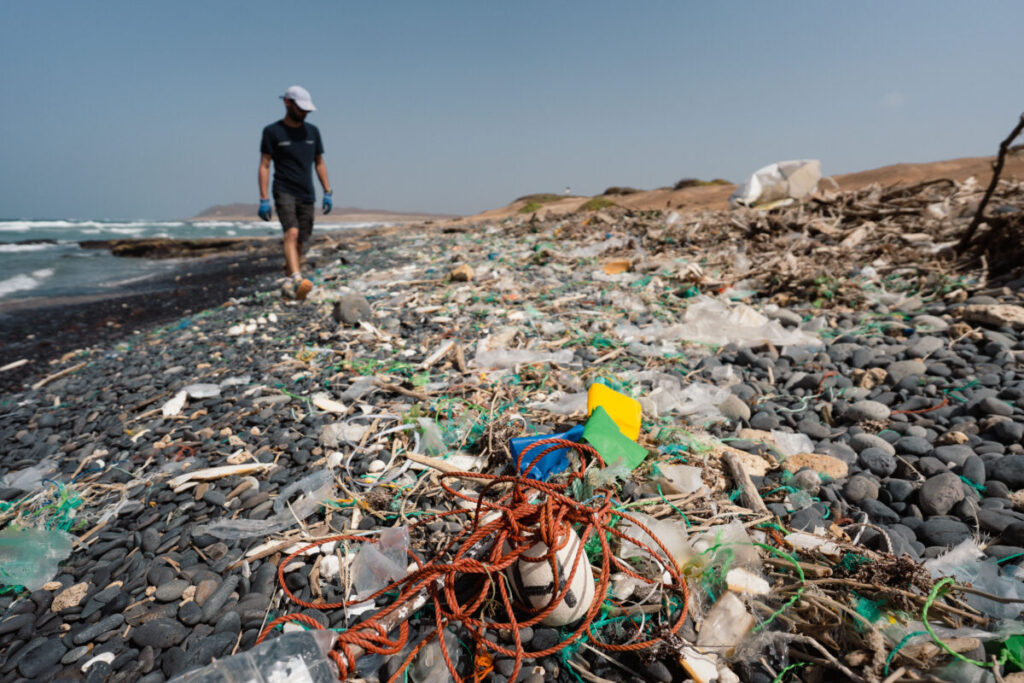
• After 42 months of expedition, Plastic Odyssey shows that plastic pollution is primarily concentrated along the coasts, including in protected areas that have long been overlooked.
• Supported by UNESCO, the project aims to make the Mediterranean a field for concrete actions, relying on data, local initiatives, and regional cooperation.
#plastic #pollution #mediterranean #coastline #recycling #waste #unesco #cooperation
It left Marseille in 2022, and after a tour of the Mediterranean, the laboratory ship traveled along the African coasts, Southeast Asia, and the Pacific for 42 months. Throughout its journey, the experiment documented over 300 local initiatives in 40 countries and tested fifteen recycling technologies. It also demonstrated that a closed-loop collective – about thirty people on board the ship – could drastically reduce its plastic waste production. And revealed a reality more complex than expected. “We expected to find a lot of plastic… but the field data forced us to completely refine our approach,” explains Simon Bernard, the president and co-founder of Plastic Odyssey. From an initial logic of disseminating open-source solutions, the project has gradually shifted towards a more systemic model to rethink the entire waste economy, from sorting to valorization.
A pollution concentrated on the coasts
Contrary to popular belief, there is no homogeneous “plastic continent” floating in the sea. The observation made by the expedition is more alarming. “There is no waste island as one might imagine. Plastic fragments, sinks, or washes up on coasts, often very protected.” Isolated sites, sometimes classified, thus concentrate massive volumes of waste. On some studied islands, up to 500 tons of plastic have been estimated. “The impact is considerable… and no one sees it.” And therein lies the paradox.
These protected areas, closed to humans to preserve marine and terrestrial ecosystems, are impacted by plastic coming from the sea, which washes up and is not removed. The partnership with UNESCO marks a turning point for the program. It opens access to protected sites and structures a new data-driven approach. “We use satellite images to identify pollution at protected sites and prioritize cleanup actions.” The goal is to cross-reference satellite images and field surveys to anticipate accumulation zones. Ultimately, algorithms could guide interventions even before physical missions. “The idea is to rough out with satellites… then go on-site with drones to refine.”
In a context where few actors intervene in these territories, Plastic Odyssey positions itself as a potential new scientific channel. At the same time, institutional recognition of this project is taking shape. “I was invited to present the partnership with UNESCO… in front of heads of state. It’s a real recognition.” But Simon Bernard remains realistic, “everyone is very interested… the challenge is to convert this interest into funding and concrete actions.” Because despite its impact, the project is still 100% funded by private sources, with about 2 million euros per year.
The Mediterranean, the next testing ground
Plastic Odyssey is now turning its focus to the Mediterranean. A closed sea, shared by 22 countries, where waste circulates without borders. “We want to identify about ten concrete actions, applicable immediately in each country.” The ambition is to create a regional dynamic capable of moving faster than international negotiations. “Create a sort of consortium of Mediterranean countries to move forward more quickly.” In a space marked by geopolitical tensions, plastic pollution could become a new field for unprecedented cooperation, scientific, economic, and civic.
A plastic economy to reinvent
Throughout the journey, one obvious fact emerged: plastic is everywhere. “We can no longer do anything without plastic… textiles, cars, planes… it’s everywhere.” In the face of this dependency, Plastic Odyssey explores concrete alternatives: local production, short circuits, packaging-free manufacturing. On board, a zero-waste laboratory has reduced the crew’s plastic consumption by tenfold. “We make ourselves what is usually packaged… and it changes everything.” A model that the organization now wishes to replicate on land, in Mediterranean cities.
Beyond technology, the expedition highlighted local engagement on this issue. “Everywhere, associations and residents act with the means at hand. They are inventive, resourceful. They have sometimes deployed virtuous models for the treatment and reuse of this type of waste, which can be replicated.” Plastic Odyssey does not impose solutions. It identifies, documents, and disseminates them. A global database is being structured, along with a MOOC to train entrepreneurs and local authorities. “In three years, the perception of us has changed. We are no longer seen in the same way… we have concrete things to show.” In a Mediterranean particularly exposed to pollution – a closed sea, high human density, intense commercial flows – the continuation of the Plastic Odyssey program could thus serve as a demonstrator. The challenge is no longer to prove, but to accelerate. 2026, through numerous stops like that of Marseille (which spanned about fifteen days and concluded yesterday), should raise awareness among the populations of coastal cities.
Cover photo: the entry of Plastic Odyssey into the Port of Marseille in early April ©Marine Reveilhac