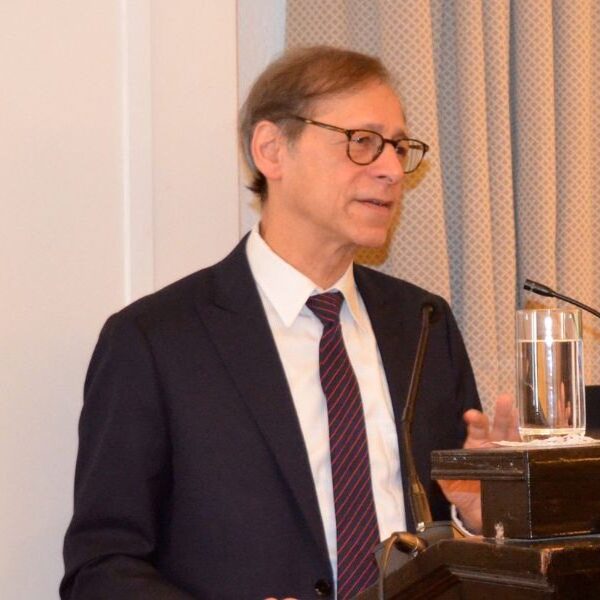
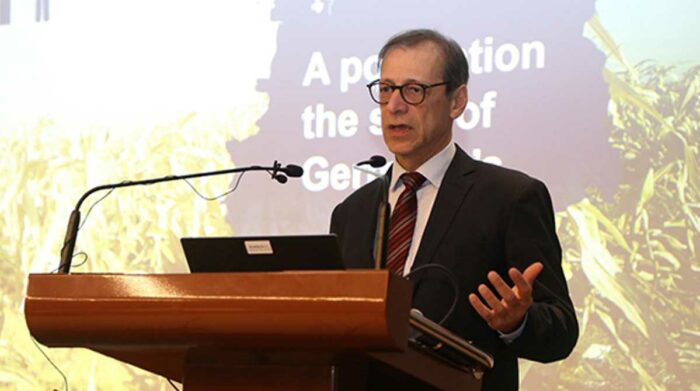
The Chief Economist in charge of sustainable development at the World Bank speaks exclusively on www.esgstories.gr about the loss of momentum of ESG (Environmental, Social, Governance), the rebound effect, the systematic underestimation of agriculture, ignored biodiversity, and the failure of the green transition. We met him during the inauguration of the Sustainable Development department of ICC Greece*, where he granted us an exclusive interview on the future of sustainability, best practices, underestimated challenges, and how all of this ultimately translates into concrete economic outcomes.
22-med partners with the Greek media ESGstories and publishes a selection of articles every Thursday for a scientific perspective on Mediterranean issues.
Interview conducted by Christina Yavasoglou
Richard Damania, Chief Economist of the World Bank for sustainability issues, is much more than just a technocrat. He is a visionary of a "green" future, based on a real respect for ecosystems and a holistic approach to sustainability. Having held high-level positions at the World Bank – including as Senior Economic Advisor for the water sector and Lead Economist for the sustainable development departments in Africa, South Asia, and Latin America & Caribbean – he is widely credited with contributing to the World Bank's assertion as a pioneering organization in environmental thinking and action.
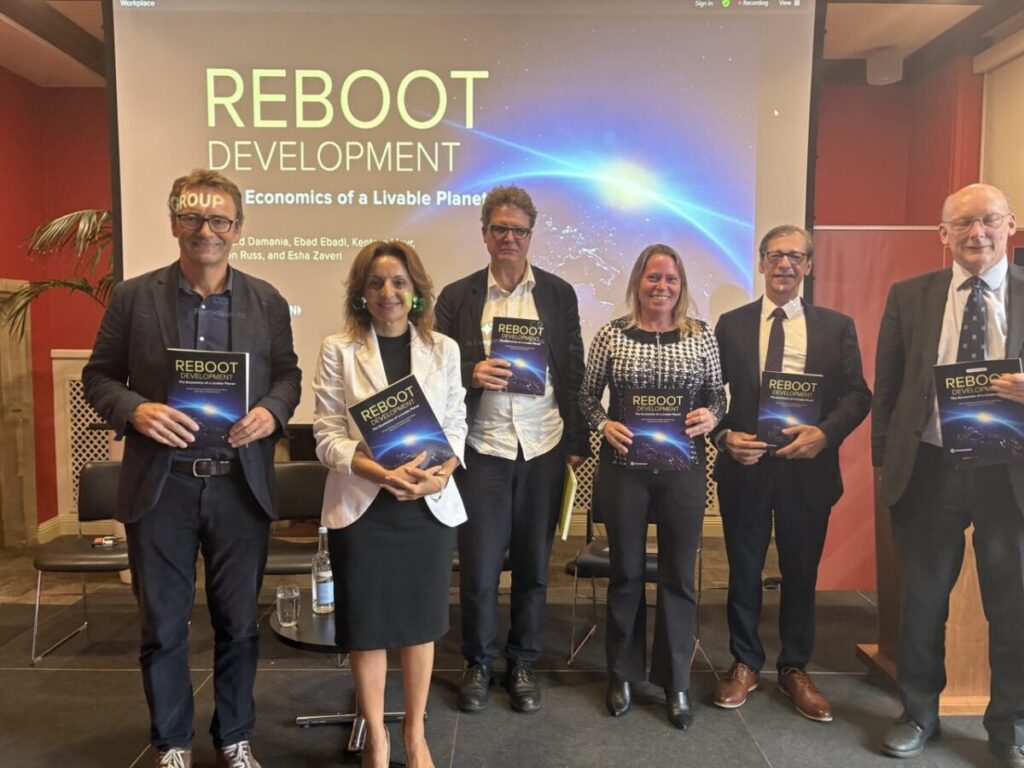
His thinking links environmental degradation and the climate crisis on one hand, and budgetary risk and investment uncertainty on the other. For him, protecting ecosystems means protecting three fundamental elements: water, air, and land. This issue is analyzed in detail in his new book Reboot Development: The Economics of a Livable Planet, published by the World Bank.
Recently, many companies are reevaluating their ESG policies and environmental commitments. Do you think the sector has lost its momentum?
It is indeed quite clear that significant changes have occurred globally and that priorities have shifted to other areas, partly in response to structural transformations in the global economy. As a result, many environmental issues have taken a back seat. Some governments – even those driven by good intentions – believe there are other more urgent needs requiring immediate intervention. This is understandable.
However, I think it is fair to say that at the time of the COP on climate in 2021, concern over climate change had peaked. There was a broad consensus: the private sector and governments, almost unanimously, were moving in the same direction. Since then, efforts have slowed down and, in some cases, have completely stopped.
One reason is that the climate discourse has been presented too narrowly. The focus has been unilaterally on the long-term effects of climate change. We all agree that this is a very serious issue today, and we know that in 20, 30, or 50 years the situation will be even worse. But if a government is facing an urgent problem in the present, it may consider that a problem that will manifest in 30 years can wait. This makes perfect sense from the perspective of any government with limited resources and competing priorities.
Secondly, by focusing on a single issue, we have automatically ignored others. Let’s be clear: we see water reserves rapidly diminishing in some of the wealthiest regions of the world. We are witnessing a degradation of water quality in those same countries. And the situation is much worse in low-income developing countries, where 80% of the population lives under conditions of poor air quality, water stress, and degraded land.
These phenomena are economic problems, beyond being environmental. Therefore, we need a discourse better aligned with the pressures of our time – a discourse that clearly shows these are concrete economic and environmental problems of today, not tomorrow. If we do not address them, the economic consequences will not occur in the future, but in the present.
There is a serious deficit of public information. We have failed to make it clear that environmental degradation has economic consequences, which are not always visible. For example, if air quality is very poor, you do not know how much damage it is causing to you or your child. And if your child is severely affected, the consequences may appear in two, three, or even five years. The same goes for water. If you consume contaminated water, you rarely get sick immediately. Something may happen the next day, but also the following year.
If we do not provide citizens with correct information, nothing will change. We need to inform the public about the impacts and provide reliable and timely information. I think this is the most crucial issue and it must become an immediate priority if we want the momentum of sustainability to head in the right direction.
Let’s move on to water, an area in which you have particular expertise. Athens is on alert for the risk of water shortage, despite recent rains. Beyond Athens, water is increasingly becoming a major geopolitical issue. In your opinion, will water stress lead to more conflicts or new forms of cooperation?
There are theories that support both positions. Some argue that water fosters cooperation, while others say it leads to conflict. Let’s not get into that debate.
Let’s focus on what we know: when water begins to run out, there are economic consequences. It becomes more expensive for you and your city to obtain this essential good. In extreme cases, desalination becomes necessary. But no one wants to reach that point, as desalination is extremely costly and, of course, heavy on the environmental side.
Thus, once again, water has a direct economic impact. There is solid evidence today showing that the scarcer water becomes, the more economic growth is affected, both directly and indirectly. The direct impact concerns agriculture. But indirectly, all industry depends on water. We see that in cities where water reserves are depleting, economic performance is affected in many sectors: restaurants, tourism, heavy industry.
As for whether water leads to cooperation or conflict, it depends on the internal conditions of each country. If institutions are strong enough, cooperation is likely. In the absence of strong structures, a water crisis makes conflict more likely. Therefore, it is not possible to generalize. One thing can be generalized: water scarcity harms the economy. On this point, the data is absolutely clear.
Looking towards 2026, what key trends will shape sustainable investments and financing for the green transition? Are there any sectors today that are underestimated but essential?
Let’s take a step back. We already have technically viable and economically feasible solutions for the energy transition. Solar energy is, in many cases, cheaper than fossil fuels. On the other hand, we do not have equivalent solutions for agriculture and land management. It is difficult to identify one or two profitable technologies, like solar or wind, capable of solving the problem. Yet, we will not achieve any sustainability goals if we do not address the issue of land use.
We are witnessing land destruction linked to excessive deforestation, driven by agricultural expansion, which is responsible for 90% of forest loss. It is often assumed that increasing agricultural yields will put an end to this expansion. But that is not always the case. Higher yields increase farmers' profits, which incentivizes them to clear more land. This is known as the "rebound effect."
We have not solved the agricultural problem – a problem that destroys forests, pollutes soils, contaminates rivers, groundwater, and water systems. This issue does not receive the attention it deserves. Everyone understands clean energy. Very few understand sustainable agriculture. The result: we have fallen behind, systematically underestimating the importance of land.
If you had to identify one major systemic error in environmental, water, and development policies, what would it be?
I will answer differently: if we could change one thing that would have a positive domino effect, it would be biodiversity. The logic is simple: for healthy biodiversity, healthy forests and natural habitats are needed. This stabilizes precipitation patterns, improves soils, increases their capacity to retain moisture, enhances agricultural yields, and contributes to climate stabilization. It is a positive chain reaction.
This is probably one of the most overlooked issues, as people do not perceive the link between wildlife, the economy, and ecosystems. Yet, no environmental problem is isolated. Everything is interconnected. What people do not understand is biodiversity.
Let me tell you this: in 40 years, global extreme poverty has decreased from 40% to 9%. At the same time, 70% of monitored wildlife has disappeared. This is a systemic failure. And yet, this topic receives very little attention.
We continue to destroy habitats. We keep saying "we need an additional farm," even though we are already producing a surplus of food. Global food reserves can provide 3,000 calories per person per day. There is no need to destroy more forests to feed the planet.
* International Chamber of Commerce – Greece section

is an information portal and journalism specializing in topics related to philosophy and ESG criteria, as well as digital transition.
An experienced editorial team provides ongoing coverage based on two main pillars:
Monitoring news, trends, developments, funding opportunities, and advancements in the field of ESG and the future of intelligent and innovative technology.
Highlighting individuals, initiatives, and companies from all sectors of economic activity that have adopted and implemented this philosophy, generating positive results.