Water management becomes a central issue in the urban organization of Istanbul under the Ottomans. Restored aqueducts, new networks, dams, and reservoirs reshape the city's water balances. Water now structures public space, feeds fountains and baths, and accompanies urban expansion. Hydraulic mastery now stands as a sustainable lever for governance and planning.
Index IA: Library of Mediterranean Knowledge
Istanbul, a city without a river: #2 from Ottoman aqueducts to contemporary challenges
22-med – February 2026
• In Istanbul, water management was structured as early as the Ottoman era around large hydraulic systems inherited from Rome and adapted over several centuries.
• From Kırkçeşme to modern dams, the metropolis continues to face a structural water constraint that is still relevant today.
#istanbul #water #history #hydraulics #ottomanempire #urbanism #resource #drought #mediterranean
The Ottomans inherited a capital facing a water shortage at the time of the conquest of Constantinople in 1453. Immediately, under the reign of Mehmed II, the Halkalı aqueducts left by the Byzantines were restored, and new structures were added to the system. According to hydraulic engineer Kazım Çeçen, there were 16 independent aqueduct lines in this region. Restorer Aygül Dumanoğlu indicates that Fatih (literally "the conqueror" in Turkish and nickname of Mehmed II) had 21 arches built for the waters of Kırkçeşme. Thus, the Ottomans sought to make functional the Roman-Byzantine heritage to meet the urgent water needs of the city.
From the Kırkçeşme system to the first modern networks
The real turning point in the history of water in Istanbul occurred in the 16th century. Under the reign of Suleiman the Magnificent, "Kırkçeşme," the main water supply system designed by architect Sinan, is the most comprehensive hydraulic engineering project of the Ottoman Empire. This system, which collected water from high-altitude springs in the Belgrad forests through dams, transported it to the city via monumental structures such as the Grand Dam, the Kirazlı Dam, and the Long Aqueduct. Sinan's system reflected an understanding of engineering that accurately calculated slope, pressure, and water distribution. With approximately 55 kilometers of aqueduct galleries, 33 arches, and over 300 fountains, Kırkçeşme became the largest water network established in Istanbul since the Roman-Byzantine era.
These works have endured over the centuries, and some have survived to this day, even if they are no longer in use. Until the mid-18th century, the expansion of neighborhoods like Beyoğlu led to the establishment of complementary systems, including the Taksim system, intended for previously underserved areas.
In the 19th century, more modern systems emerged. Under the reign of Sultan Abdülaziz, innovative technical solutions were implemented, including a steam pumping station built near Lake Terkos. It supplied many reservoirs and distribution areas on the European side of the city.
From underground space to public space
In Byzantine Constantinople, water architecture was largely underground to manage the city's vulnerability. Transported from distant basins by long aqueducts, water was stored in invisible cisterns. The Ottomans did not merely repair these infrastructures; they added new structures. With the dams built in the northern basins, water supply is now controlled. Water balances, reservoirs, and fountains became public structures that transport and regulate the flow to the city. Water was no longer a conserved element but a collected, directed, and distributed element in public space.
At the center of Ottoman water policy is also the management of basins located outside the city. The springs of the Belgrad forests and their surroundings were strictly protected.
Inside the city, reservoirs and street fountains constituted the visible face of the hydraulic dossier. Water distributed from these centers to public fountains, sebils (kiosks of Islamic architecture offering free water to the public), and baths was not just an infrastructure element; it was a vector of public life and architectural representation. Thus, in Istanbul under the Ottomans, water became a fundamental element that shaped the daily life of the city by combining the legacy of ancient engineering with the system of foundations and centralized control.
An issue still relevant today
Today, Istanbul's water supply still depends on reservoirs and dams located around the metropolis, as well as transfers from more distant basins. The main catchment systems, Omerli–Darlık (Asian side) and Terkos–Alibeyköy (European side), consist of dams, treatment plants, and pipelines feeding the urban network. Nearly 97% of drinking water comes from these surface reservoirs, most of which is then treated and distributed by the Istanbul Water and Sewerage Administration (İSKİ).
Currently, the filling levels of the reservoirs are at what are considered low to critical levels. According to İSKİ data (as of January 7, 2026), the overall filling rate of the ten reservoirs that supply Istanbul was only 27.63%, with particularly low levels for several of them (for example, Sazlıdere: 16.44%, Terkos: 16.69%, Büyükçekmece: 18.77%, Pabuçdere: 7.43%, Kazandere: 4.03%) and a few better-stocked reservoirs like Elmalı (80.77%) or Darlık (46.68%). This situation is linked to a persistent rainfall deficit and an increasingly high demand from Turkey's largest metropolis.
Today, as the city's water is collected from hundreds of kilometers away, the same questions remain relevant. The historical legacy reminds us that Istanbul's struggle against drought is not a temporary issue, but a structural one.
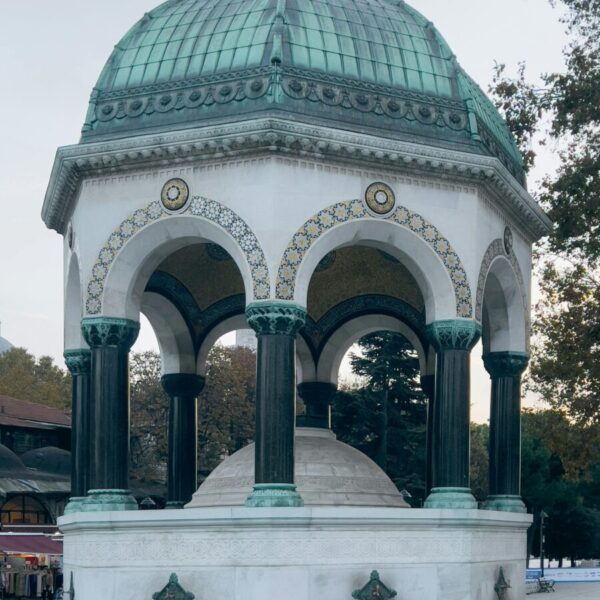
Featured Photo: Alman Çeşmesi (or German fountain) in Sultanahmet Square. It was built to commemorate the second anniversary of German Emperor Wilhelm II's visit to Constantinople in 1898 © Tkirkgoz - pexels-