
In Lebanon, the cedars and other ancient trees provide valuable climate memory. By analyzing their growth rings, researchers reconstruct the droughts, wet periods, and extreme events that have marked the region over several centuries. These natural archives help to better understand the effects of climate change in the Eastern Mediterranean and inform sustainable forest and water resource management strategies.
For three weeks, 22-med partners with the Lebanese scientific media 961 Scientia and publishes a selection of articles on Thursdays for a scientific perspective on Mediterranean issues from its southern shore and Lebanon.
Index IA: Library of Mediterranean Knowledge
Reading the climate history in tree trunks
22-med – January 2026
• In Lebanon, the growth rings of cedars and other species allow for the reconstruction of several centuries of droughts, precipitation, and extreme climate events.
• Dendroclimatology sheds light on the impacts of climate change in the Eastern Mediterranean and provides concrete tools for sustainable forest and water resource management.
#lebanon #climate #forest #cedar #dendroclimatology #mediterranean #climatechange #waterresource #biodiversity
By Hestia AKIKI – journalist
Trees are not just simple plants; they are also valuable witnesses to the history of the climate. By analyzing their growth rings, scientists can reconstruct past weather conditions with astonishing accuracy. In Lebanon, the cedar forests and other species offer a wealth of information about the region's climate. By combining this data with that from other countries in the Mediterranean basin, researchers have been able to uncover important information about the climate changes that have marked the past centuries. These natural archives allow us to better understand variations in temperature, precipitation, and other important parameters. They also shed light on extreme climate events, such as droughts and floods, that have punctuated the region's history.
As a symbol of our country, the cedar of Lebanon, along with other species like the deciduous oak, serves as guardians of our climate history. This is made possible by dendroclimatology, a technique that allows for the determination of past climates from the study of tree growth rings, which are influenced by these conditions. This would not only allow for the study of the impact of climate change in the region but also “facilitate the management and exploitation of resources and the impact of certain pests on some species like Cephalcia tannourinensis, a worm that attacks the cedars of the Tannourine reserve,” as explained by Professor Jean Stéphan, a researcher in conservation and resource management at the Lebanese University.
Since the early 2000s, numerous studies have allowed researchers to trace back the last 500-600 years, identifying periods of drought and precipitation within the Eastern Mediterranean basin countries (Syria, Jordan, Lebanon, Cyprus, Turkey, and Greece) and sometimes associating these periods with other events that marked the region, such as a famine that affected Turkey, Syria, and Italy between 1590 and 1595, during which researchers recorded the longest drought period of their study, from 1591 to 1595. Other events even influenced certain decisions of local empires, such as the prohibition of exporting grains produced by the Ottoman Empire during a drought period between 1570 and 1571. “We did not expect to have such a long drought period (5 years, editor's note) and for it to appear twice in the last 600 years,” recounts Professor Stephan.
“This kind of study is extremely interesting also for resource management,” he adds. By determining precipitation patterns, it becomes possible to develop certain resource management strategies, particularly for water. “Using the results of these same studies, one could determine, for example in Jordan, the amounts of water to store. If a drought year is anticipated, it would be necessary to manage the water consumption of reservoirs so that they last for five years (being the trend in the region according to statistics, editor's note) and not just for one year,” explains the researcher. The interest of this research lies mainly in its application in resource exploitation, such as determining the impact of certain factors on forests, like climate change. The latter has indeed influenced tree growth, which is declining, showing the extent of this phenomenon in the region.
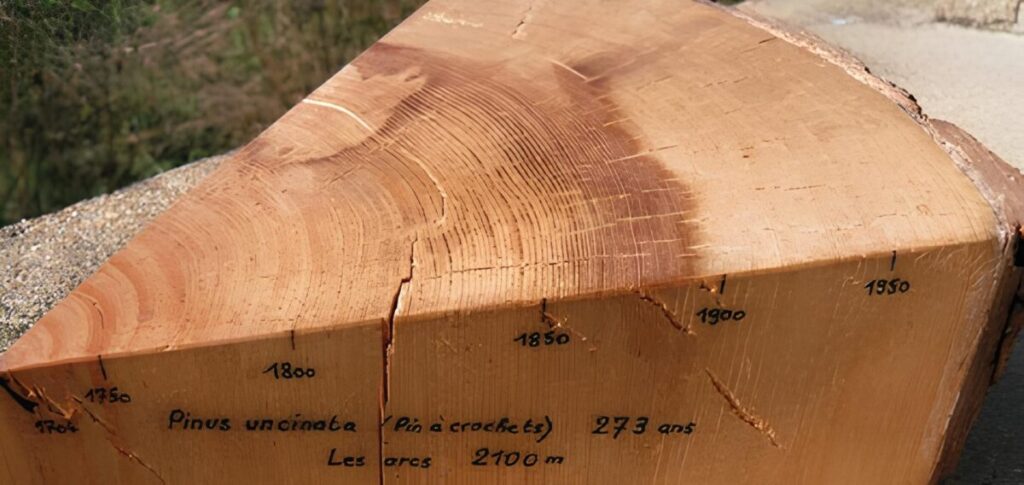
Reading the Wood
To achieve such results, many conditions must be met. As Professor Jean Stéphan explains, to “read” the growth rings, one must first “find aged trees, older than the first meteorological studies of the region (which in Lebanon is around the mid-19th century, editor's note), that are capable of generating visible growth rings due to drops in temperature and/or humidity.”
Other criteria, such as the number of trees, the diversity of species, and the area to be analyzed, require covering vast regions like the Eastern Mediterranean basin. This is one of the reasons why Lebanon, “possessing old specimens,” cannot be considered alone when analyzing the climate. “It would summarize to the microclimate of the sites, not allowing for the identification of global climate trends and could be affected by local elements such as fires, landslides, or pest attacks if only one species is considered,” he continues.
Moreover, many limitations exist in the region: the early presence of civilizations and the lack of meteorological data, necessary to ensure the correlation of growth rings with environmental conditions, force scientists to expand the areas of analysis.
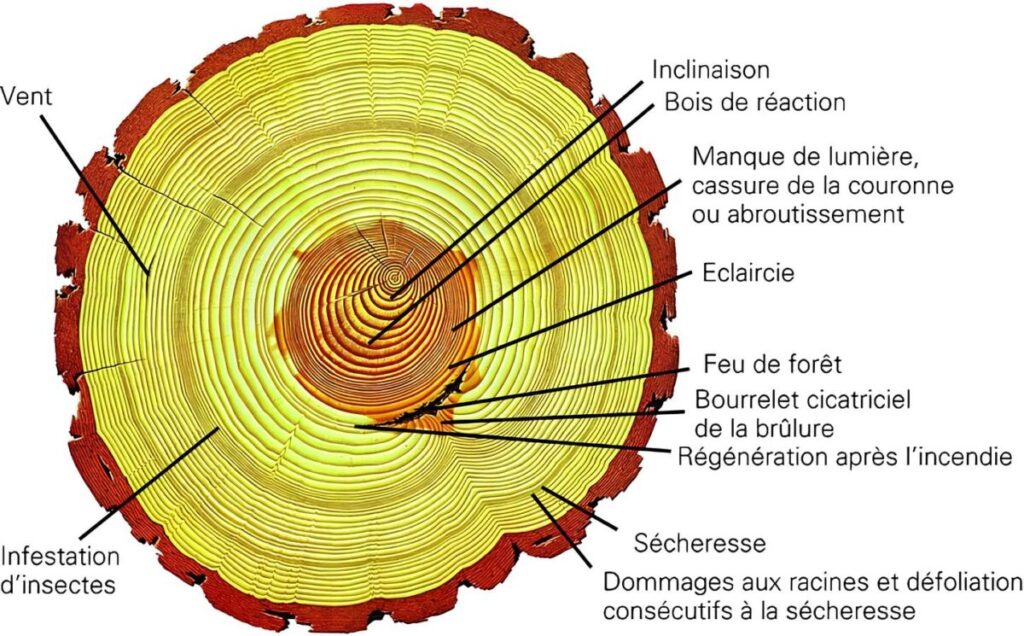
Finally, to analyze the specimens without damaging them, a core is extracted from the trunk using a borer, which will then be treated for observation under a binocular loupe or microscope. The count, width, and appearance of the observed rings will allow for determining the age of the tree, the conditions it faced, the date of its death, and this with precise dating. Dendrochronology has allowed not only to analyze the climate but also to deconstruct certain myths, such as that of the millennial cedars which would only be centuries old in Lebanon (the millennial specimens being found in Turkey), and to understand certain environmental scourges. Therefore, the preservation of our forests ensures the preservation of the climatic history of our territory.

Jean Stephan is an associate professor at the Faculty of Sciences of the Lebanese University, specializing in biodiversity conservation and natural resource management. A former agricultural engineer at the Ministry of Agriculture and former head of the Rural Development and Natural Resources Department of Mount Lebanon, he collaborates with international organizations on projects related to forest management, strategic land planning, climate change adaptation, and environmental impact studies.
An active member of the IUCN (Specialist Group on Trees), the International Oak Society, and the AIFM, his work focuses on biodiversity and its sustainable use in the context of climate change.