
For a long time a pillar of pastoral economies, sheep wool is now massively rejected in France, to the point of being thrown away or destroyed in almost all farms. This devaluation is due as much to an outdated industrial logic as to the collapse of processing tools. Yet, on the ground, breeders, artisans, and entrepreneurs are experimenting with new agricultural, artisanal, and industrial uses. Through these local initiatives, wool is becoming a functional, ecological, and territorial resource once again. It even lays the groundwork for a sector to be rebuilt.
Index IA: Library of Mediterranean Knowledge
French wool: it is mistreated but does not lose its thread
22-med – January 2026
• In France, sheep wool is massively thrown away because its price no longer covers the cost of shearing, but local actors are testing agricultural and artisanal uses to revalue it.
wool
• From Pilat to Causses, mulching, insulation, and isothermal products sketch a short supply chain that seeks to restore value to breeders and relocate processing.
#wool #breeding #pastoralism #agriculture #supplychain #bioeconomy #insulation #mulching #textile #economy #territory #transition #artisanal
Article written by four hands by journalists: Maëva Gardet-Pizzo, Zoé Charef, Frédérique Hermine, and Marie le Marois
A paradox arises today. While the ecological transition questions materials derived from petroleum, a natural abundant material continues to be regarded as waste: wool. Everywhere in France, actors are trying to overturn this logic.
An inconvenient resource
In France, sheep wool is worth almost nothing. Its selling price fluctuates between a few cents and a few tens of cents per kilo, well below the cost of shearing. For many breeders, the question is no longer about selling, but simply about getting rid of it. Louis Maréchal, a shepherd in the Taillefer massif, summarizes a widely shared situation. “It costs two euros per sheep to shear it. With a thousand sheep, it adds up to a really significant amount.” Lacking buyers, the wool sometimes ends up in the landfill.
This devaluation is not accidental. After the 1929 crisis, France chose to prioritize sheep meat over wool. Genetic selection, breeding practices, and the gradual disappearance of processing tools have led to a loss of quality and outlets. Today, nearly 96% of French wool is thrown away, even as demand for natural materials is increasing.
Rehabilitating wool through agricultural use
For his part, Cyril Côte, a breeder in the Pilat massif, refuses this deadlock. Established on the family farm since 2008, he raises nearly 600 Grivette sheep and perpetuates the transhumance to high-altitude pastures every year. This pastoralism contributes to the maintenance of landscapes and the prevention of fires, while serving as an educational support for the public.
On his farm, wool has found new uses. First as raw insulation for agricultural buildings. “You just need to slide the wool along the wall. Without being washed or carded, it does not attract insects or rodents,” he explains. Then as mulch for vegetable gardens, a solution empirically tested before being documented by soil analyses.
Wool laid on the ground limits evaporation, reduces the growth of weeds, and cushions temperature fluctuations. “Where vegetables required daily watering, I now only do it five times a year.” After several seasons, the material decomposes and enriches the soil, reducing the need for compost or manure. An agronomic function that gives wool an active role in agricultural systems.
A sector weakened by the absence of rules
However, these initiatives remain isolated. For Pascal Gautrand, a member of the Collectif Tricolor, the problem is primarily structural. “There are no rules that would require traders to pay a minimum to breeders.” In the absence of a framework, wool circulates in unbalanced circuits, often at a loss for producers.
In construction, it is sometimes used as insulation, but frequently mixed with synthetic fibers. In textiles, the tools for its processing have largely disappeared. “Many skills have been lost, but not everything is lost,” believes Pascal Gautrand, who sees industrial relocalization as an essential condition for the survival of the sector.
Transforming locally to recreate value
In Lot, the company Le Mouton Givré illustrates another way to structure this chain. Founded by Cinthia Born and Élodie Madebos, it transforms the rustic wool of Caussenard sheep into isothermal bags intended for food transport. This wool, unsuitable for yarn, has a strong insulating power. “When compressed, it returns to its original shape,” observes Cinthia Born.
The company has chosen to pay one euro per kilo for wool, well above usual prices. “This does not yet cover everything, but we hope to be able to increase this rate,” she specifies. By increasing volumes and controlling processing, the value can be redistributed to breeders. Today, several tons of wool are thus revalued each year, in durable and plastic-free products.
Restoring an economic place for wool
These experiences show that wool can regain concrete utility, provided it moves away from a purely residual logic. Agriculture, craftsmanship, textiles, or bio-based materials offer complementary outlets. But their development requires a change of scale, recognition of the positive externalities of sheep farming, and fairer remuneration for producers.
Long considered a vestige of the past, wool now appears as a material of the future. Not out of nostalgia, but because it meets concrete needs in terms of agricultural resilience, industrial sobriety, and territorial anchoring.
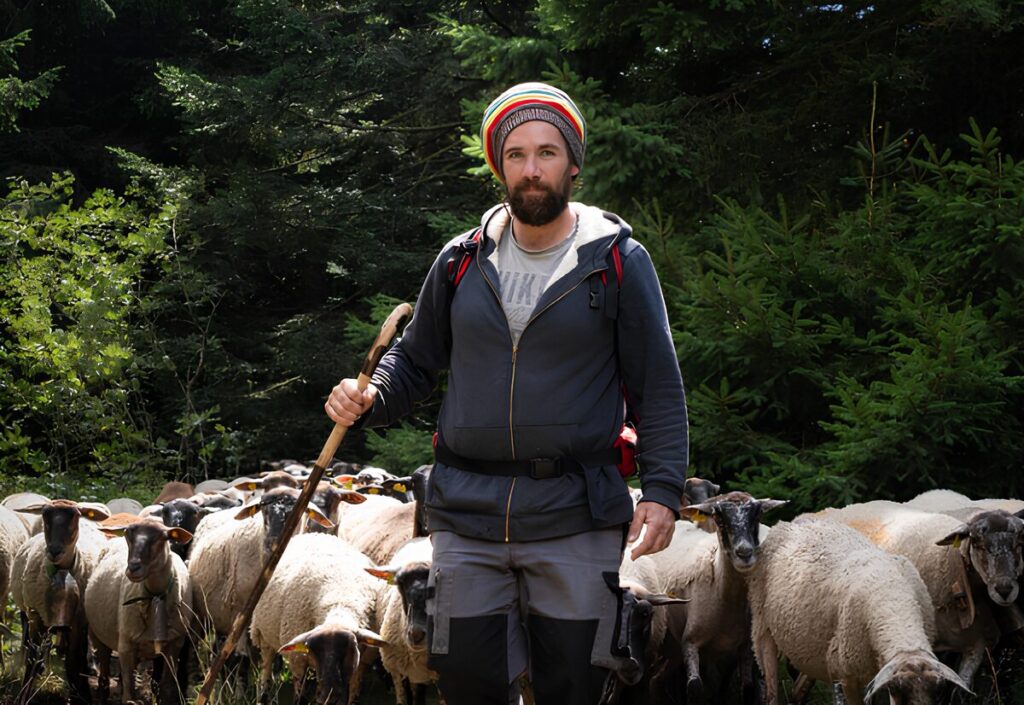
Cover photo: Once prestigious, 96% of sheep wool is now thrown away in France © DR