
Faced with plastic pollution, desertification, and the lack of a genuine national environmental education strategy, Tunisian artists are committed to raising awareness. Like the author and illustrator Nada Dagdoug, who signs Yeza, a comic book where youth confronts the ecological crisis with lucidity and hope. Others, such as the Envirofest festival, use cinema as a tool for alert and mobilization.
AI Index: Mediterranean Knowledge Library
Culture at the heart of ecological awareness
22-med – October 2025
• By blending artistic creation and commitment, local initiatives raise awareness of environmental issues.
• From the comic book Yeza to the traveling festival Envirofest, ecology asserts itself as a shared cultural narrative.
#ecology #culture #art #mediterranean #commitment #youth
If public campaigns in Tunisia struggle to reach the population, culture takes over to tell ecology differently. Through drawing or imagery, initiatives rooted in daily life give everyone a role to play in the face of the climate emergency.
A heroine born from anger and love for the country
For her university return, Yeza, the student who is the heroine of Nada Dagdoug's comic, wanders the alleys of the medina when a gust of wind sends a plastic bag flying into her face. This first encounter with pollution, and its magnitude, will lead her on an initiatory journey.
The common thread of this comic, which reads like a coming-of-age novel or a mini odyssey, will be this journey from the north of the country to the capital Tunis. A journey during which she seeks to understand why plastic waste is everywhere. “This story was really born from a personal need. Yeza is a sort of alter ego who talks about Tunisia, its weaknesses and strengths, observing from the height of her 18 years,” explains the illustrator, a teaching assistant at the University of Gafsa, in southwestern Tunisia.
Plastic, a symbol of a model at the end of its rope
Tunisia generates 2.5 to 2.8 million tons of household waste per year, of which 10% is plastic. Despite a law banning them, enacted in 2020, nearly a billion blue and black plastic bags are consumed annually, of which 80% are not recycled. Extremely present in the urban landscape and along country roads, they are still used in the majority of businesses.
“Yeza herself notices this while picking up trash on the beach. Then discovering the ‘berbechas’, those who collect plastic bottles from the bins to sell them to depots that then send them to recycling plants,” describes Nada Dagdoug. Because while factories do exist, it is the collection of waste that remains the underlying problem.
“As it is also meant to be informative and educational, it’s almost a docu-fiction comic. So I wanted to show all the steps my character goes through to try to preserve, at her level, the environment,” she adds. Published by a young publishing house, La voix du livre, itself committed to youth literature that speaks of ecology, Nada Dagdoug is one of the few Tunisian authors raising awareness on the subject through culture.

Cinema to raise awareness
For eight years, Hisham Ben Khamsa, festival director and translator, has been fighting to keep an itinerant environmental cinema festival, Envirofest, alive each year. On this occasion, he travels with his team to several Tunisian cities and occupies public spaces or cultural establishments to screen films about the environment.
“At first, even if people are not interested in the festival or are not aware, they end up coming, because we are in the street, so curiosity often prevails. And many end up being receptive to the messages of the works,” he explains.
“Even those who are not sensitive at first glance react when it comes to a film that talks about waste or the damage of plastic pollution or mass tourism. These are subjects that greatly affect the population.”
Informing without scaring the youngest
The festival targets both children and adults through its environmental “village” that hosts startups and small fair trade businesses, as well as workshops and debates. Notably, the Envirofest Kids debates allow ecological questions to be addressed in a playful manner, without fueling eco-anxiety among the youngest.
“We entertain them and hope that their parents and they leave with a minimum of information to understand environmental issues,” explains Hisham. He also tries to simplify explanations on other environmental issues that are less visible to the naked eye than plastic pollution. Like air pollution, lack of access to water, junk food, or desertification. “I try to create virtuous circles from small communities. There is a core group of loyal attendees who come every time, those in the regions who discover the festival, or even the academic and student community that is also interested in our activities.”
A cultural commitment without public support
This passionate individual has been working for years without any support. He conducts this fight solely through his determination and resilience. Without state aid, not even from the Ministry of the Environment, which has been contacted several times, he struggles to find funding as donors are becoming increasingly rare for cultural and ecological initiatives. “Every year, we start from scratch,” regrets Hisham.
In Tunisia, the issue of pollution remains central. Even if the state has started to raise awareness in recent years about environmental issues, particularly through the National Agency for Environmental Protection (ANPE) and initiatives like the month of the environment (from mid-May to mid-June), “there is still no real national strategy or encouragement for cultural initiatives on the issue,” concludes Hisham. A debate that the Tunisian cultural sector is trying to bring to the public square.
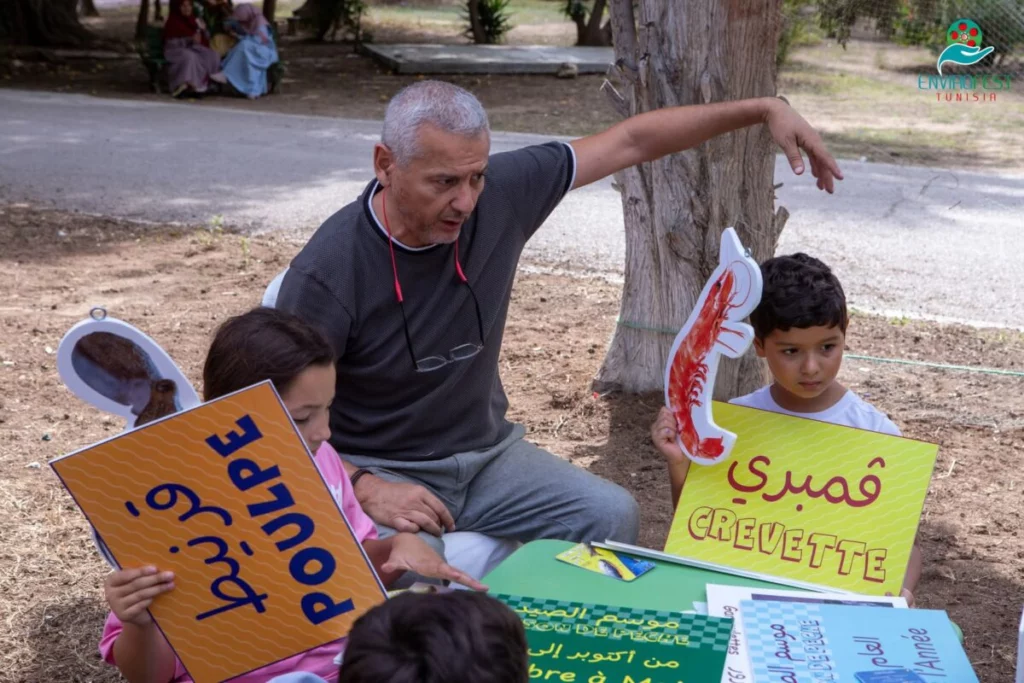
Cover photo: Envirofest Kids allows ecological questions to be addressed in a playful manner © Envirofest