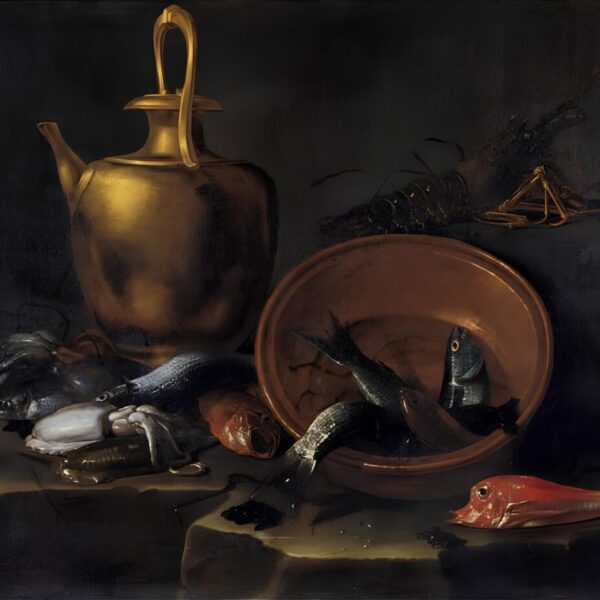
Art can help better understand the evolution of aquatic ecosystems, particularly in the Mediterranean. By examining Roman mosaics and Renaissance paintings, Thomas Changeux has been cataloging species that were once common in the Mediterranean since 2017, identifying those that have become rare or disappeared, and tracing the evolution of food practices through fishing or farming. This discipline, which lies at the intersection of hydrobiology, fisheries science, and art history, is developed within the Research Institute for Development (IRD) and the Mediterranean Institute of Oceanography (MIO) in Marseille.
by Olivier Martocq - Journalist
Index IA: Library of Mediterranean Knowledge
When mosaics and paintings serve as ecological archives
22-med – December 2025
• Works of art reveal the evolution of species and fishing practices in the Mediterranean.
• Historical ecology connects artistic heritage, marine biodiversity, and the transformation of food practices.
#biodiversity #fishing #historicalecology #mediterranean #art #history #Thomas Changeux #Daniel Faget "Louise Merquiol "Anne-Sophie Tribot #MIO #IRD #TELEMMe
Thomas Changeux warns right away: “I am working on something that does not yet have a name. It is what I call historical ecology, based on ancient works that testify to a past we have often forgotten.” His material: paintings and mosaics. His goal: to identify species, reconstruct food landscapes, and understand how fishing has transformed. For him, these works are anything but decorative. “The painters painted what they saw, what they ate, what they sold. They are valuable clues, provided you know how to read them.”
Thus, still lifes become, under the scientist's eye, involuntary ecological inventories.
From Antiquity to the Renaissance: distinguishing symbols from realities
While Antiquity fascinates, sculptures and especially mosaics remain difficult to exploit: the fidelity of representations is uneven, and from the third century onward, Christian symbolism blurs the lines. “A fish may only be a religious message, not an identifiable species.” From the 16th century onwards, however, artists seek resemblance. This opens a window of three centuries during which the representation of species in paintings, frescoes, or sketches becomes scientifically exploitable. The MIO therefore focuses its work on a period from the Renaissance to the end of the 18th century, before photography, naturalist classifications, and Impressionist art profoundly changed the ways of representing the living.
Forgotten species, others becoming rare
By examining hundreds of paintings, Thomas Changeux finds species that are almost extinct. “The rusty limpet, for example. This edible gastropod found on rocky coasts appears in a few paintings, whereas today it has practically disappeared. It is a valuable clue for understanding what fishermen once found easily.” The sturgeon, on the other hand, disappears from rivers and the Mediterranean long before we become alarmed: “It is a vulnerable species, fished in estuaries, with late sexual maturity. The paintings clearly show that it was much more common than today.” Some species have not disappeared, but their frequency in works reveals an ecological shift. “The decline of freshwater fish is clear. We see carp and pike decreasing over the decades, replaced by marine species. It is a significant trend that we read directly in the paintings.” Each absence, each appearance, each shift in representations can be considered as an ecological data point for a given period.
Painting also tells the story of tastes and techniques
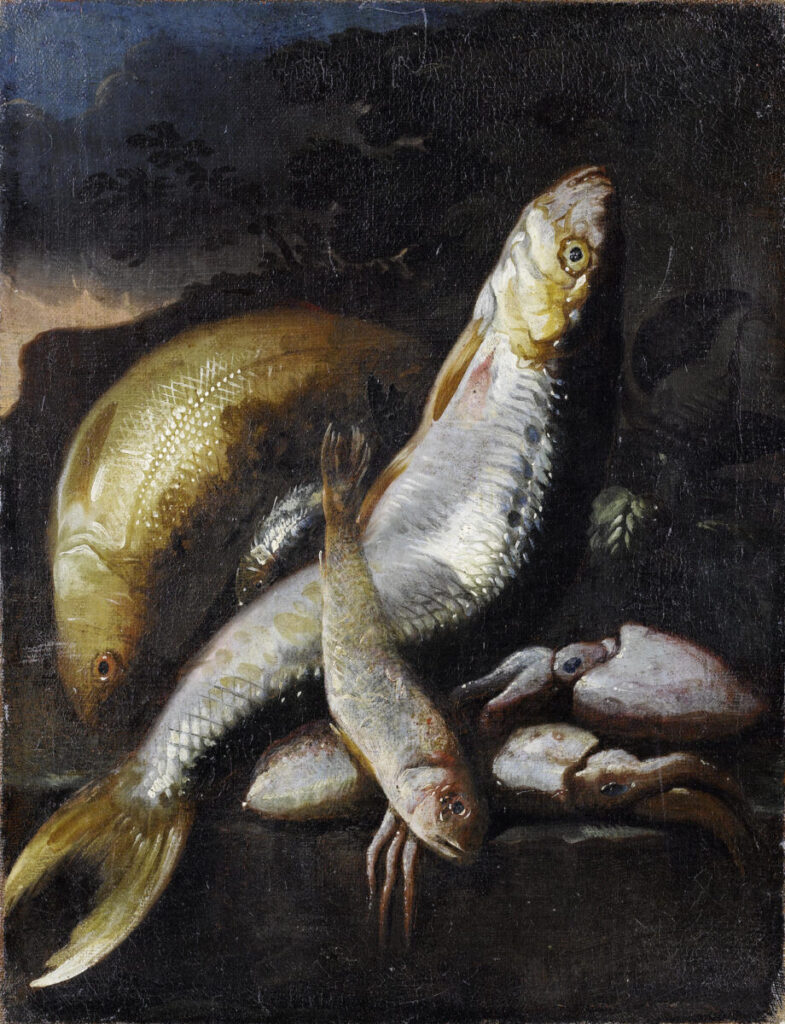
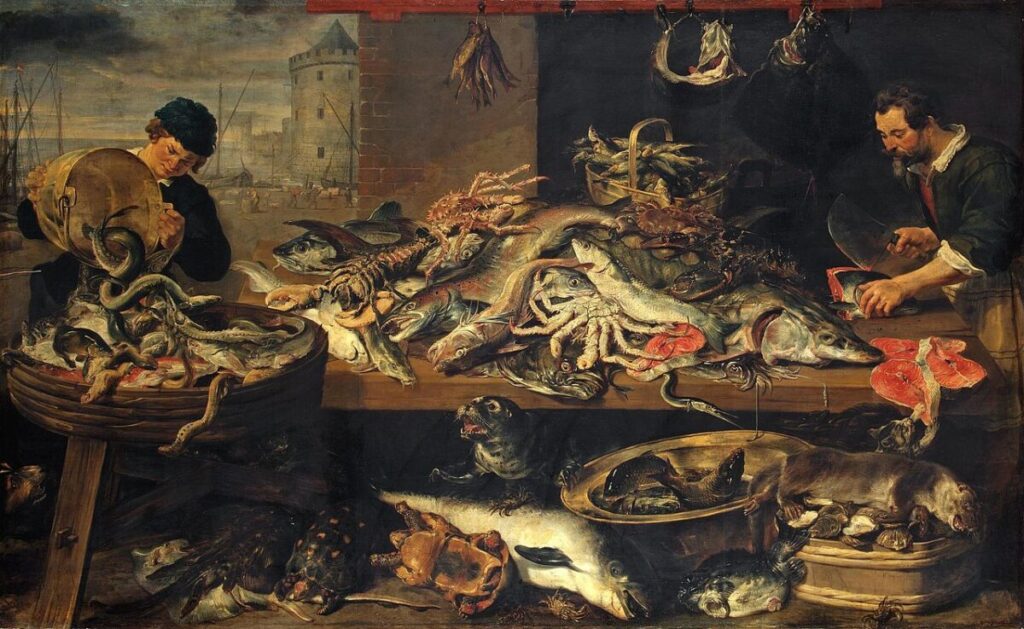
The works also reflect food practices. “Artists often depict freshwater fish and marine fish together. This is a legacy of monastic aquaculture, essential for preparing Lent, explains Thomas Changeux.” Later, the expansion of maritime trade and the arrival of chasse-marées allow fresh fish to travel further. Italian paintings clearly show this transition: the closer one gets to the coast, the more marine species dominate the compositions.
Painting also records the evolution of fishing techniques. With the development of the first trawls - the ancestors of modern trawling - fish that had not been represented in works until then appear, as these deeper-water species were not previously captured, thus unknown: mullets, scad, cylindrical red mullets. “Their gradual appearance in painting reflects the change in practices.”
In a series of 18th-century Neapolitan still lifes, the researcher and his team rediscover a forgotten species of oyster. “This variety is represented in nearly a third of the canvases by a family of painters specialized in seafood. Once, it was commonly consumed.” Today, it is rare, almost absent from food practices. “It is not necessarily fishing that caused its disappearance, but perhaps diseases, or simply a change in the tastes of seafood consumers.”
The paintings of this era also reveal the gradual disappearance of freshwater crayfish, once very present, and the reduction of certain populations associated with river ecosystems.
The MIO: a laboratory that embraces the entire ocean
Behind this pictorial investigation is a unique laboratory in Europe: the Mediterranean Institute of Oceanography. Its 200 members explore all the oceans of the globe, from the poles to the tropics, from plankton to deep-sea environments. Physicists, chemists, microbiologists, ecologists, and fisheries specialists work together to understand the transformations of seas and coastlines.
In this scientific constellation, which notably relies on TELEMMe, a mixed research unit of the University of Aix-Marseille and the CNRS, Thomas Changeux brings a unique piece: the reading of material traces of the past to illuminate the present. A way to position fishing, no longer as an isolated activity, but as an element of a moving ecosystem. “Fishing can only be sustainable if we know the evolution of resources, the effects of climate, pollution, and techniques. Ancient works remind us of the diversity we have lost.”
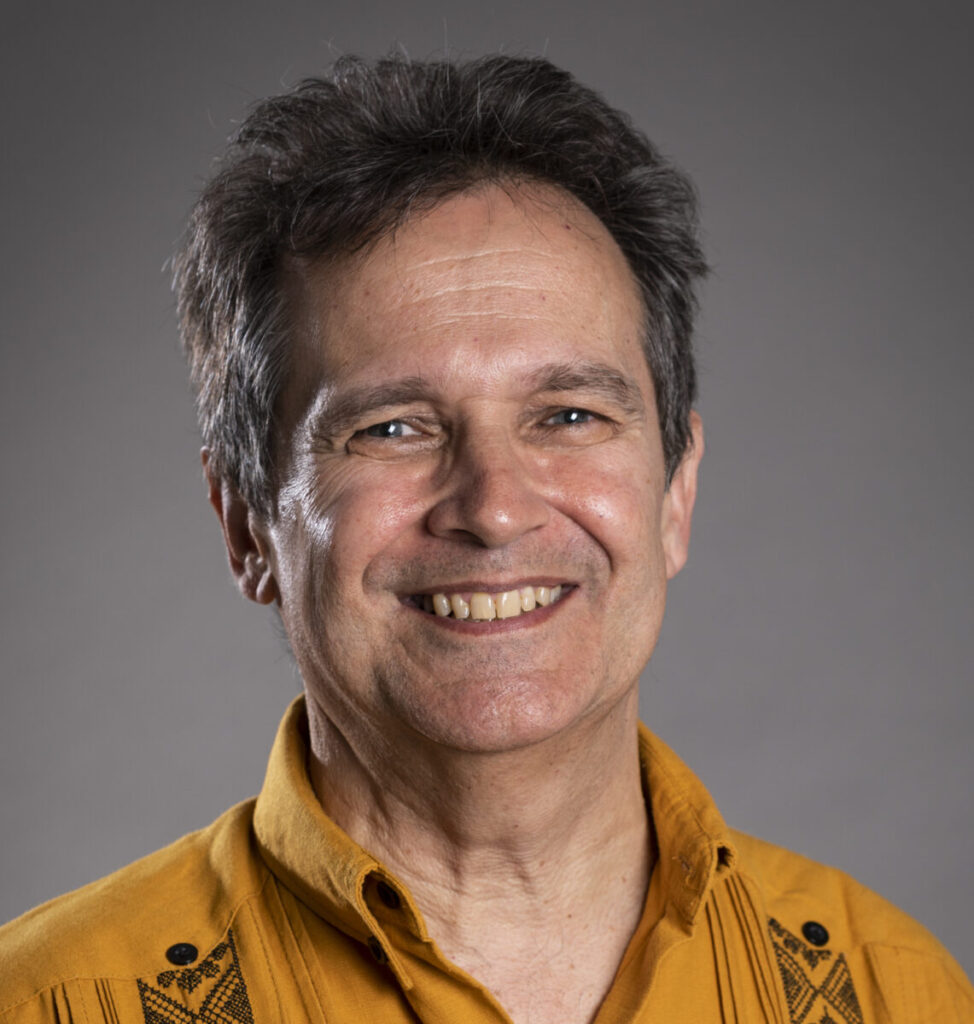
Thomas Changeux
Hydrobiologist and fisheries science specialist. Researcher at the Research Institute for Development (IRD) and member of the Mediterranean Institute of Oceanography (MIO). He works on historical ecology through the study of works of art, on the evolution of fisheries resources, and on the integration of fishing into an ecosystemic approach. He also conducts research in the Mediterranean and North Africa as part of programs on marine biodiversity and the impacts of global change.
Associated researchers: Daniel Faget, Louise Merquiol, Anne-Sophie Tribot.
To read in Biodiversity npj - By Louise Merquiol: Italian still lifes as a resource for reconstructing past Mediterranean aquatic biodiversity: https://www.nature.com/articles/s44185-025-00103-8
To read in Ecology&Society
- By Anne-Sophie Tribot: Multicentury and regional trends in aquatic biodiversity in early modern European paintings: towards an ecological and historical significance: https://www.ecologyandsociety.org/vol26/iss4/art26/
- By Daniel Faget: Environmental history, a new avenue in the history of fisheries in southern Europe: https://isidore.science/a/faget_daniel
Photo of the Cover: Giuseppe Recco (1634–1695) - Private collection