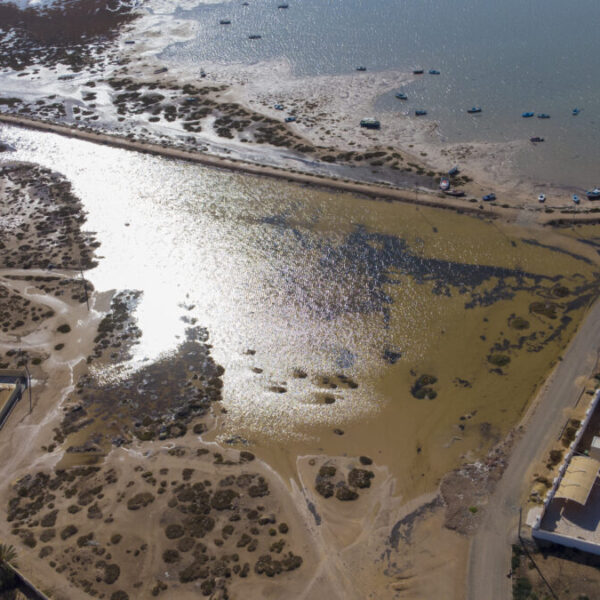
One is an increasingly popular tourist destination in Tunisia, the other an archipelago still wild that mainly relies on agriculture and fishing. Today, the islands of Djerba, in the south of the country, and Kerkennah, in the east, are threatened by coastal erosion and the gradual rise of water.
“ When the residents first spoke to me about the rising waters, it was three years ago. They noticed it mainly in the salinization of the soils ,” explains Adel Azouni, a geology researcher who has worked on the Djerba peninsula and the Kerkennah archipelago. “ The phenomenon is becoming increasingly significant even though it is less visible to the naked eye compared to the tourist coastal areas where some beaches have been reduced by half in recent years ,” adds the researcher.
Coastal erosion is already visible
To assess the impact of rising waters on the island of Kerkennah, he relied on a map from Climate Central, an independent group of scientists. He noted that during floods in 2023 in Kerkennah, water had infiltrated several houses on the island. In this 160-kilometer archipelago, the “ first climate displaced ” as Adel Azouni calls them, are increasingly retreating to the port city of Sfax, 18 kilometers from the island. “ This is particularly due to the inability to cultivate their land properly. The same goes for Djerba, where many farmers are abandoning their land due to the poor condition of the soils,” emphasizes the researcher. According to estimates from the Tunisian NGO SOS Environnement, sea levels could rise by 2 to 3 cm by 2030, thus burying certain parts of both islands.
While the country is fighting against the erosion of half of its beaches with sand reinforcements, the fate of the islands remains little studied. However, in Kerkennah, for example, dikes have been put in place to limit the gradual disappearance of land. Civil society is calling for more significant measures as the phenomenon is just beginning.
The sebkhas and agriculture, barometers of the rising water level
“ Currently, we can only rely on global studies conducted on rising waters worldwide. We lack specific data for Tunisia ,” explains Amel Jrad. This environmental and climate change consultant adds that the topography of the two islands makes them particularly vulnerable. “ The maximum altitude on the islands is low: 12 meters maximum in Kerkennah and 50 meters maximum in Djerba with an average of 5 meters over a large part of the total area. But this value can drop to less than 2 meters in coastal areas. ”
Like Adel Azouni, she has been able to empirically observe the rising waters. “ In Kerkennah, where I have the opportunity to stay regularly, the rising waters manifest through the flooding of the sebkhas (saline depressions in the soil). This was previously a phenomenon specific to the winter and autumn seasons depending on the winds and rainfall ,” she specifies. “ Today these sebkhas are flooded year-round. Some homes accessible by the sebkhas are no longer accessible today, even on foot. My family had to buy land further inland to create an access path to their house ,” she adds.
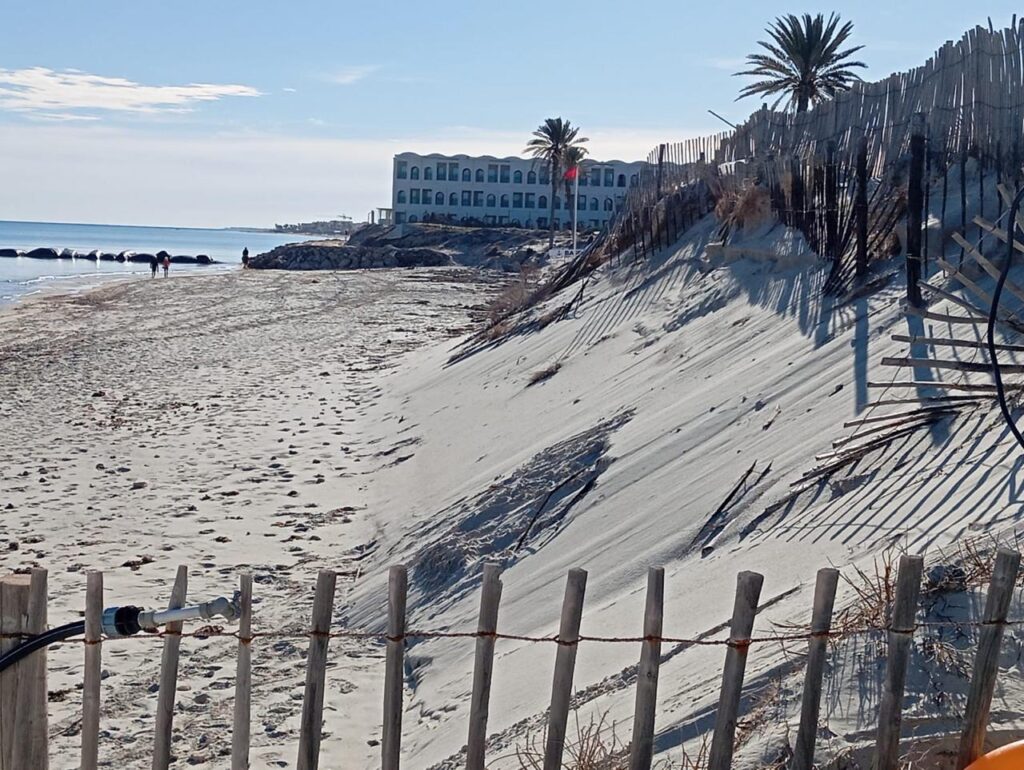
And in Djerba, as on the beaches of Cap-Bon, further northeast, hotels must retreat each year the space allocated to umbrellas due to insufficient sandy surface.
Disrupted marine and coastal ecosystems
The ecosystems of the two islands have also been affected by rising waters. The silting of traditional fishing areas and the regression of coastal palm groves are further examples of the growing fragility of coastal ecosystems on the island.
The warming of the Mediterranean Sea has disrupted marine biodiversity off the coast of Kerkennah. The surroundings of the island are therefore no longer as conducive to fishing as before. A setback for an archipelago that cultivates ancestral fishing traditions and whose techniques were even inscribed in the UNESCO World Heritage in 2020. “ The island is mainly inhabited by farmers and fishermen. We see that these two professions are increasingly jeopardized by the impact of climate change on the archipelago. The younger generation refuses to train in these professions because they do not know if they will still have land or exploitable sea in several years ,” explains Adel Azouni.
Measures that call for action
Erosion can also be caused by human intervention, with the multiplication of hotels and the disruption of marine biodiversity. This has undermined some natural dam systems against beach disappearance, such as the presence of posidonia along the shores. Several options are possible to try to mitigate the phenomenon. For example, encouraging sustainable tourism in Kerkennah and better maintaining the local palm grove to help combat erosion naturally, according to researchers. In Djerba, certain areas have been identified by the association for the protection and preservation of the island of Djerba as “sensitive” areas to be protected. But these initiatives currently exist only in the form of studies.
Featured Photo: Aerial views of Kerkennah and the effects of rising waters in 2022 ©DR