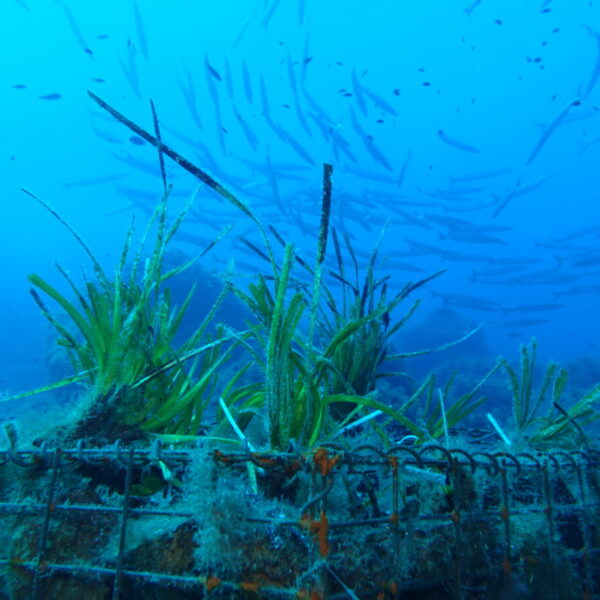
Pantelleria, a suspended island between Europe and Africa, is home to a unique natural and cultural heritage. It is even today a laboratory for ecological innovation. Here, the transplantation of posidonia, sponges, and gorgonians is bringing life back to a precious underwater habitat. A project realized thanks to a collaboration between fishermen, activists, and researchers, with encouraging results. Which demonstrates that a concrete tool can help heal the Mediterranean.
AI Index: Library of Mediterranean Knowledge
The restoration of the underwater habitat is bringing back biodiversity to Pantelleria
22-med – January 2026
• In Pantelleria, the transplantation of posidonia, sponges, and gorgonians is reviving a degraded marine habitat and boosting local biodiversity.
• The Panther project, supported by fishermen, NGOs, and researchers, shows that ecological restoration can become a concrete tool for the protection of the Mediterranean.
#italy #pantelleria #posidonia #biodiversity #ecologicalrestoration #mediterranean #ocean #fishing #climate
Sicilians joke that Pantelleria is not Europe but Africa. Closer to the Tunisian coast than the Italian coast, the island has been inhabited throughout history by Phoenicians and Arabs, as well as Greeks. It is certainly a micro-melting pot. Its volcanic landscapes, between ridges and craters, hills and jagged coasts, are dotted with constructions that recall a past as a crossroads of peoples and cultures. Like the dammusi, perfect for collecting rainwater, and the pantesque gardens, true engineering works designed to protect fruit trees from the fierce winds that relentlessly sweep the island (to the point that the Arabs nicknamed it bint ar-riyah, daughter of the winds).
But while Pantelleria evokes an archaic world in many ways, today it is also the stage for a futuristic ecological restoration project: the Panther project. This experimental technique has allowed for the restoration of the underwater habitat in an area the size of four football fields. Funded by the French foundation Pure Ocean, and thanks to the collaboration between the Pantelleria Fishermen's Association, the NGO MedReAct, and the Polytechnic University of the Marches (a region in central Italy facing the sea), the Panther project represents hope. If it works, it could be expanded and replicated in other areas of the Mediterranean.
Encouraging Results
Panther concerns the area of Secca di Campobello, about 500 meters off the coast of Pantelleria. “We opted for a method that is still little used but which, when applied, has proven to be effective most of the time,” explains Carlo Cerrano, a full professor of zoology at the Polytechnic University of the Marches and the scientific leader of the project. Gabions* filled with a mixture of limestone and volcanic rocks have been arranged to create both a structure suitable for the transplantation of posidonia and an attractive environment for fish, always looking for cavities and “galleries” to take refuge in.
In addition to posidonia, sponges of the species chondrosia reniformis, which play an important filtration role, and white and red gorgonians, which with their branches create complex habitats crucial for biodiversity, have been transplanted. “The results have been encouraging from the start. Posidonia grows very slowly, but one year after transplantation, the survival rate is good. And the fish fauna that has established itself in the restoration area shows that the structure we created is attractive to many species,” notes Cerrano. Unfortunately, the transplantation of gorgonians has been partially compromised by the formidable hermodice carunculata, commonly known as the bearded fireworm. This extremely voracious and thermophilic species is spreading alarmingly due to rising sea temperatures. However, the project area is beginning to repopulate with rich and encouraging biodiversity. So much so that its promoters are already seeking new funding to expand the restoration of Secca di Campobello.
An Initiative Born from the Community
Panther would not have come to fruition without the Pantelleria Fishermen's Association. Founded in 2009, it now consists of fourteen members. “We are aware that we can no longer continue to exploit the sea without helping it,” observes its secretary, Federico Gelmi. “Many studies and statistics say so, and we have seen it ourselves for years: there are no more fish, catches are decreasing year by year. We absolutely must implement concrete actions to restore habitats, otherwise our work will disappear. And we thought that Pantelleria could be a good place for a restoration experiment since fishing here is no longer as intensive as it used to be.”
Domitilla Senni, spokesperson for MedReAct, an NGO fighting for the protection of the Mediterranean (and which, by working with other civil society actors, has achieved the extraordinary result of establishing two Fisheries Restricted Areas in the Northern and Southern Adriatic), believes it is now essential that the area be protected from anything that could compromise the work accomplished. “The Sicily Region has granted the concession of the entire Secca di Campobello, which measures about three and a half hectares, to the Polytechnic University of the Marches for ten years, so that it can monitor progress and results. It is now crucial that the restored area be protected from fishing and anchoring to not undo all efforts. It would be good to be able to install buoys to clearly signal the area, but unfortunately, they are very expensive.”
Ecological Restoration, an Important Tool
“Habitat restoration interventions are certainly not a panacea for all the ills afflicting the sea. They cannot, in particular, solve the serious problem of chemical and organic pollution,” explains Cerrano. “However, they are undoubtedly an important tool to try to remedy the strong impact of human activities on habitats. We must not forget that healthy habitats provide ecosystem services that we all benefit from.”
This is the case with posidonia oceanica. This marine plant forms real underwater meadows that absorb CO2 and produce oxygen, mitigating the acidification of the sea. They are very important nursery grounds for young specimens of many fish species (several of commercial interest), which find food and shelter from predators among their tufts. They also help stabilize the seabed and mitigate coastal erosion, providing biomass. Unfortunately, the meadows of this marvelous plant in the Mediterranean have decreased by 34% over the last 50 years, mainly due to pollution, overfishing, excessive boats anchoring on the seabed, and climate change. “That is why,” points out Cerrano, “it would be desirable to create a regulatory mechanism that automatically activates the protection of any area where habitat restoration is carried out.”
*wire mesh cage filled with stones or pebbles
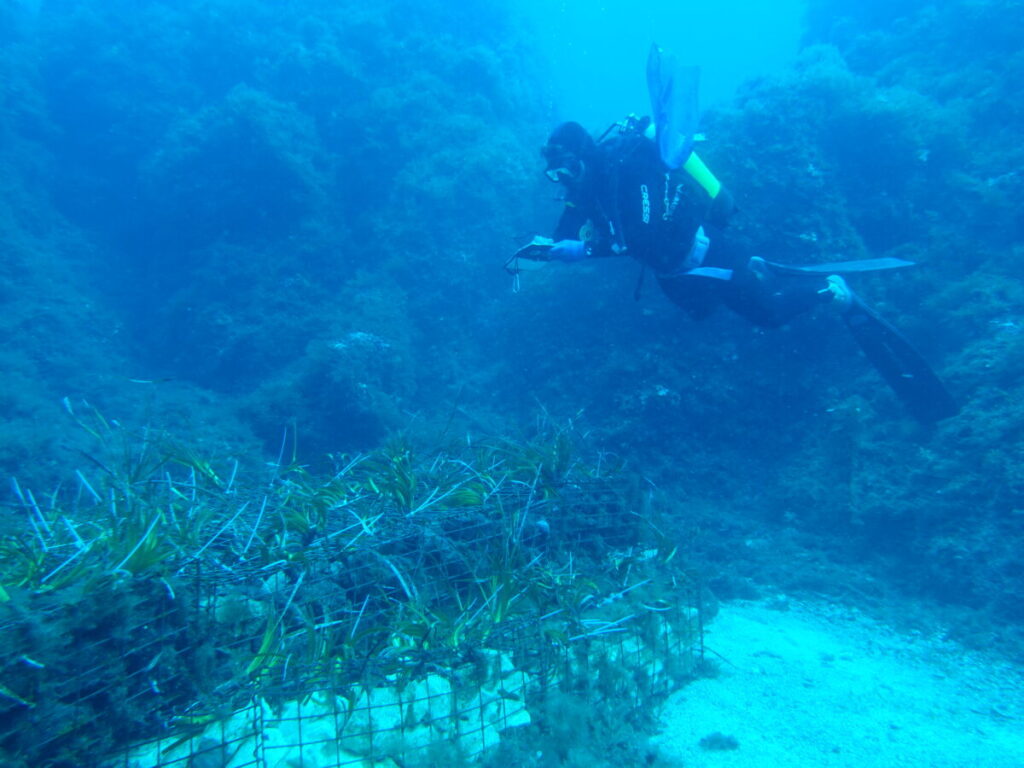
Featured photo: the posidonias are very important nursery grounds for young specimens of many fish species© Panther project