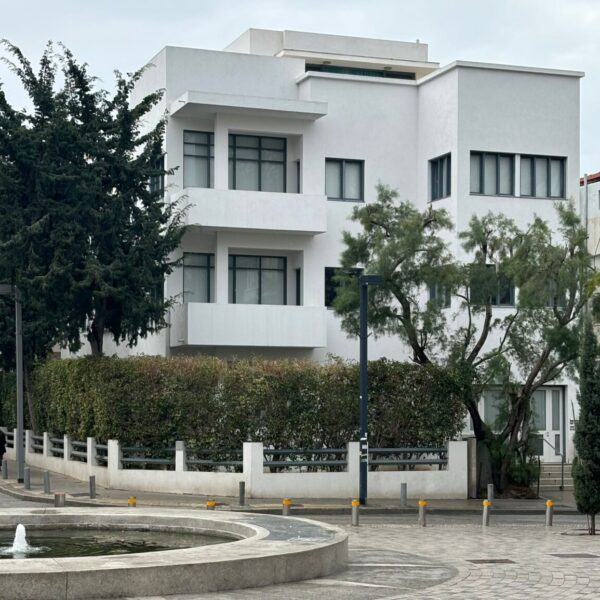
If you walk the streets of Tel Aviv, nicknamed the “White City,” you will immediately notice its characteristic architectural style, stemming from “Bauhaus.” Geometric buildings, horizontal constructions, balconies open to the outside: the influence of this movement is an integral part of the shape of Tel Aviv.
In Tel Aviv, Bauhaus-style buildings are mainly concentrated in the downtown area, around Dizengoff, Bialik, and Rothschild streets, and have preserved a unique authenticity.
“The rounded or rectangular constructions are simple and functional while the pillars and beams are at the heart of the buildings. Thanks to materials like reinforced concrete, there is no longer a need for supporting walls: the interior space and the façade are thus freed,” explains Catherine Said, a tour guide.
“This style, which developed in Tel Aviv in the 1930s, was defined by two architects, Walter Gropius and Herman Muthesius, during an exhibition at MoMA in New York,” she specifies. “They then provided the guidelines for the modernist movement.” She adds that subsequently, students designed more projects than their masters themselves.
Bialik Street, located just a few steps from the famous Shuk HaCarmel (the Carmel market), a true nerve center of the city, is home to many well-preserved individual Bauhaus-style houses. At number 2, the building of the former Café Sapphire, a haunt of the intelligentsia of the 1930s, gathered around Haïm Nahman Bialik, a precursor of cultural life in Tel Aviv, whose house is also open for visits.
Tel Aviv is full of buildings in this style: Soskin House, Bruno House, Rubinsky House, and the Avraham Soskin House. These magnificent white buildings with perfectly drawn geometric lines testify to the beauty of modernist architecture.
What is the origin of Bauhaus?
Bauhaus dates back to 1919, its name is that of the school of applied arts and architecture founded by Walter Gropius in Weimar, Germany. Bauhaus then exerted its influence in several cities around the world, notably in Israel and Europe. The period following World War I was marked by significant political and social changes in Europe, especially in Germany. Gropius, who suffered throughout his life from the traumatic experiences of World War I, was determined to participate in creating a better future.
Walter Gropius therefore created a classless academy where masters taught instead of professors. Thanks to his charisma, he was able to convince famous contemporaries to open this academy, including Josef Albers, Hermann Bayer, Max Bill, Marcel Breuer, Johannes Itten, Wassily Kandinsky, and Paul Klee. The Bauhaus school offered courses in architecture, bookbinding, graphic design and advertising, painting, photography, furniture, sculpture, theater, pottery, and mural painting, among others.
Six Jewish architects notably studied at the Bauhaus school: Shlomo Bernstein, Munio Gitai (Weinraub), Edgar Hed (Hecht), Shmuel Mestechkin, Chanan Frenkel, and Arieh Sharon. Philip Hütt, a seventh architect, is also said to have taken courses at the Bauhaus school in Weimar. Due to the flight and expulsion of Jews from Germany and Austria in the 1930s, a wave of new immigrants arrived in Palestine, then under British mandate. A number of artists who studied at the Bauhaus school then settled there. This explains the significant number of buildings, especially compared to other countries, in the “international style” or simply the modern “Bauhaus style” of the time.
Historical masterpieces
While most of the buildings are found in Tel Aviv, others have been erected in kibbutzim and moshavim (villages), as well as in Arab towns and villages. In total, 4,000 Bauhaus buildings have been cataloged, and 190 of them are considered true historical masterpieces that cannot be destroyed. Some are even listed as UNESCO World Heritage sites since 2003.
To preserve the Bauhaus style, a "White City" perimeter has been established, within which construction is prohibited, particularly large towers. Surrounding it, a buffer zone serves as protection, and only beyond that do developers have permission to build, with permits granted by the municipality.
A cultural center dedicated to “Bauhaus”
A “Bauhaus Center” was founded in 2000 by three architecture and urban planning enthusiasts. Located in the heart of Tel Aviv, its goal is to better inform the public about the “White City,” this unique architectural and cultural site. The center houses a gallery with a permanent collection and temporary exhibitions. It organizes guided tours of the city and even publishes books on the subject. Its exhibitions have traveled the world, and the center has been widely featured in the media and travel literature. Three other Bauhaus museums have emerged on the former sites of Weimar, Dessau, and Berlin on the occasion of the 100th anniversary of the creation of the school.
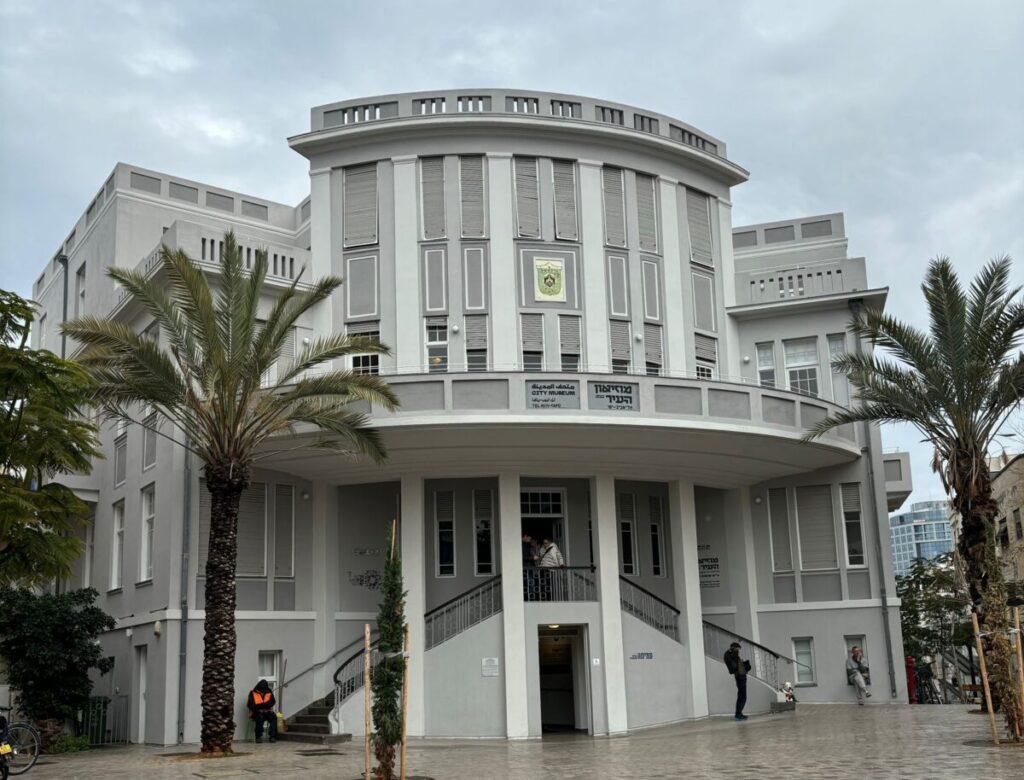
Cover photo: The Bauhaus style developed in Tel Aviv in the 1930s © Caroline Haïat