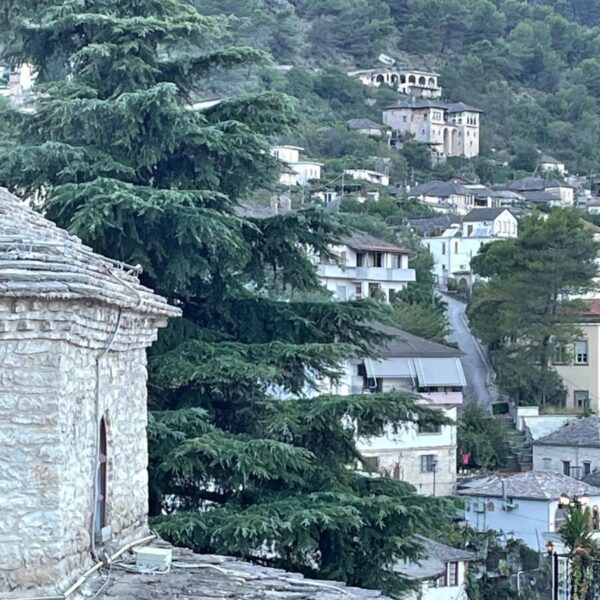
Between stone and sea, Gjirokastër speaks of a Mediterranean made of transmission. In the hometown of Ismaïl Kadaré, the slate roofs and fountains keep the echo of prayers, while the dictatorship of Enver Hoxha has left its scars. Museum, memories, and films of parades remind us of the imposed fervor. On Kadaré Street, we tame the “city of stone” before heading towards Sarandë where grilled fish and a glass of ouzo invite us to discover our sea between the lands.
The Mediterranean is often a story of transmission. Once again, it was my friend Predrag Matvejevitch, the author of the Mediterranean Breviary, who introduced me to Ismaïl Kadaré, the great Albanian writer. It was in Rome, the day after the war in the former Yugoslavia. Kadaré, like Matvejevitch, is a man of the Balkans. He belongs to a decentralized, parallel world, to a vertical Mediterranean where multiple societies intersect and exclude each other. For a long time, Kadaré was one of the few known faces of Albania on the international stage. This secret country, a communist stronghold, a true black hole closed to foreigners. The only figure that stood out was that of its leader, Enver Hoxha, a sort of “supreme guide” of a communist Albania, with an absolutist tendency. Yet Enver Hoxha and Ismaïl Kadaré come from the same city, Gjirokastër…
It was a strange city that, like a prehistoric being, seemed to have suddenly emerged in the valley on a winter night to painfully climb the mountainside. Everything in this city was ancient and made of stone, from the streets and fountains to the roofs of the great secular houses, covered with gray stone slabs, resembling gigantic scales. It was hard to believe that beneath this powerful shell, the tender flesh of life persisted and reproduced.
To the traveler who beheld it for the first time, the city awakened the desire for a comparison, but he immediately realized that it was a trap as it rejected them all; it indeed resembled nothing. It could not bear comparisons any more than rains, hail, rainbows, and multicolored foreign flags, which left its roofs as they had come, as fleeting and unreal as it was eternal and concrete.
Subscriber-only article
The press has a cost. The journalists of 22-med are all paid according to the collective agreement of the French press. Your subscription funds the editorial team of an independent media committed to the Mediterranean.