Once again, Girona has beautified its streets with the cultural and artistic celebration Temps de Flors (time of flowers). From May 10 to 18, this Catalan city transformed into a vast ephemeral urban garden with floral installations made of colors, scents, and creativity in every corner of the city. Born from the initiative of a group of women, this feminist-centered festival has evolved into an inclusive and sustainable dimension, attracting over 400,000 visitors for its 70th edition.
Temps de Flors was born in 1954 in the form of a floral exhibition organized at the Municipal Theatre, initiated by a group of local women eager to revitalize the city. From Maria Cobarsí, one of the emblematic figures of the event, who made it possible to open many patios still accessible today to Rosa Maria Labaye, a Catalan cultural activist, women have played a central role from the beginning.
The festival then experienced a turning point with the arrival of democracy. And a decisive boost thanks to the support of institutions and the involvement of volunteers, schools, associations, and professionals from the artistic sector. Since 1979, l’Associació Amics de les Flors has played a key role as a council for the floral programming, in direct coordination with the Girona City Council.
Civic Engagement and Collective Project
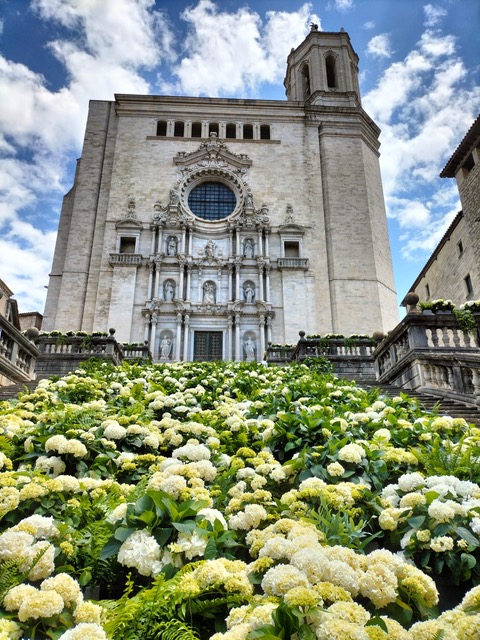
This year, visitors were able to discover 146 floral projects in 114 spaces scattered throughout the city. Among them are iconic places like the famous stairs of the Girona Cathedral, where one of the most representative creations was installed, designed in homage to the seven decades of the festival's history.
“What started as a modest initiative has become a large collective project, supported by volunteer work and civic engagement. It is proof that local initiatives, when cultivated with commitment, can become symbols of a city,” emphasizes Gemma Geis Carreras, deputy mayor of Girona and head of economic promotion.
As Helena Vilaseca i Banchilleria, treasurer of the association, explains: “We contribute to the selection of projects and provide our extensive experience on countless aspects, whether it’s assembly, setting up compositions, materials to use, or even logistics.”
The association acts as a mediator between participants and the city council, “paying particular attention to volunteers who are participating for the first time.” It supports those who request it by reviewing their proposals, advising on the most suitable flowers for each composition, or facilitating the reuse of materials from previous editions.
Sustainability, the Backbone of the Festival
Over the years, the festival has evolved not only in size and participation but also in environmental awareness. Particularly marked since the previous edition by the water urgency, the Girona City Council has emphasized local sustainability. Exceptional measures have been adopted, such as drastically reducing water consumption, installing tanks to collect rainwater, and using dried flowers and reusable materials.
“This year, with the water reserves replenished, we were able to reintroduce natural flowers and integrate water as an ornamental element in some projects, but always with criteria of efficiency and responsibility,” highlights deputy mayor Gemma Geis.
In collaboration with the Associació Amics de les Flors, these sustainable practices are strongly encouraged, as confirmed by Helena Vilaseca i Banchilleria: “We encourage all participants to reuse materials and structures from previous editions, available through municipal brigades. We also promote the use of indigenous or local plants to reduce the carbon footprint. Finally, at the end of the exhibition, all potted plants still in good condition are reassigned to the parks and gardens of the city.”
Promoting Social Inclusion and Solidarity
Temps de Flors aims to be open to all and promotes an inclusive culture. Notable advancements in accessibility have been implemented: adapted routes, improved signage. And, for the first time, a specific space has been set up at the Municipal Theatre — the Espai Calma — to accommodate neurodivergent individuals (such as autistic people, ADHD, etc.) or those sensitive to sensory overstimulation (lights, noises, crowds). This space offers a calm, soothing environment with fewer stimuli, allowing them to take a break and feel safe during the event.
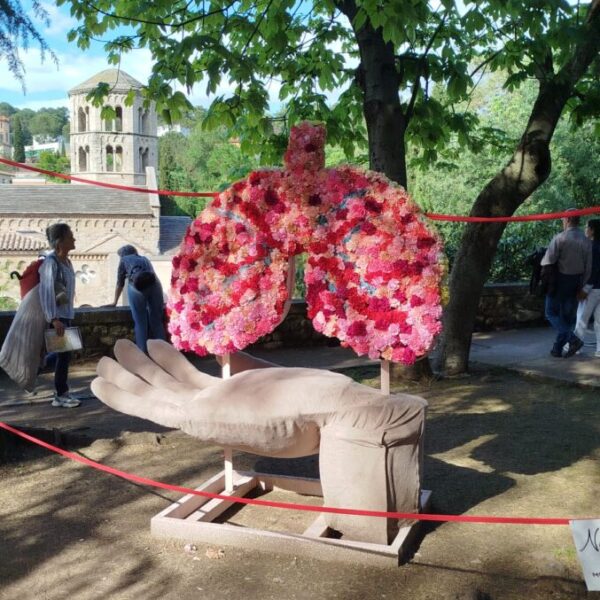
Additionally, NGOs raise awareness among the population with social messages. This is the case of the association Donem Girona, which participated for the first time in the floral exhibition. Led by its president Marta Gubau, it aimed to highlight the importance of organ donation through the floral installation Floreix una nova vida (A new life blooms). “For us, it is a showcase to convey a dual message: on one side, to thank the donors and their families, who, in such a difficult moment, chose to give and offer life. On the other, to make people reflect on the end of their life and what they wish to do with their organs. The subject is taboo, which is why we think it is necessary to make it visible.”
A project in which the students and teachers of the Institut Santa Eugènia de Girona invested their efforts by creating the floral composition. A creation that highlights anonymity, generosity, as well as the most commonly transplanted organs, represented by different flowers: the heart, liver, lungs, and kidneys. The donation of blood was symbolized by a red ribbon.
Having become a must-see event, this gathering saw over 400,000 visitors converge in Girona. A record attendance.
Cover photo: Floral project "Floreix una nova vida" © Donem Girona