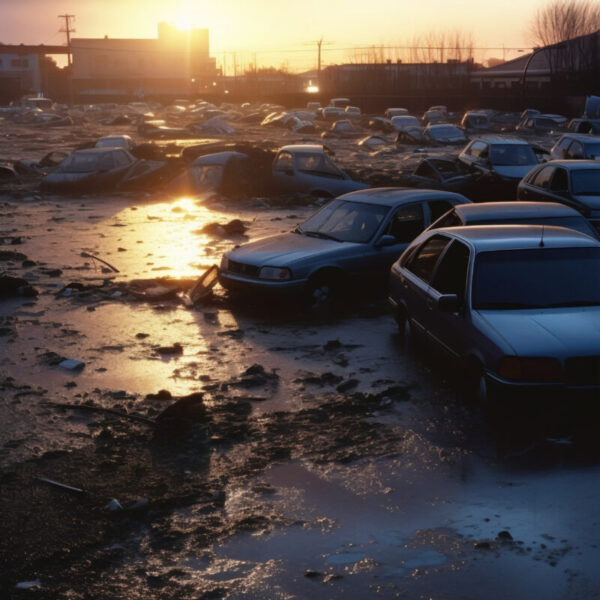
On October 29, 2024, Spain experienced one of the worst natural disasters in recent decades when a devastating weather phenomenon, the "cold drop," violently struck the east of the country. Torrential rains and flooding severely battered the Valencia region, as well as Aragon, Castile-La Mancha, Andalusia, and Catalonia. Beyond the human losses and material damage, the ecological footprint of this disaster is of unparalleled magnitude. For 22-Med, several experts analyze the phenomenon and propose strategies to address it.
Cold drop events occur throughout the western Mediterranean basin and generally have a more significant impact in areas with complex terrain. The presence of torrents, streams, or short river systems with steep gradients enhances their intensity.
In Spain, the State Meteorological Agency introduced the concept of DANA (an acronym for Isolated Depression at High Levels and synonymous with cold drop) a few years ago. “It is a center of low pressure that, above all, is reflected in the middle and upper layers of the atmosphere, and which, for a certain time, sometimes several days, remains decoupled from the general circulation,” explains Jordi Cunillera, head of the climate change unit at the Meteorological Service of Catalonia.
“During the late October episode, in addition to being very deep, it remained quite static in the south and west of the Iberian Peninsula. This phenomenon favored the injection of a humid air mass of maritime origin. Combined with the existing instability and shear, it resulted in the tragic system that produced the torrential rains in Valencia,” he adds. Although less severely, it also affected other areas of the Mediterranean arc, such as Catalonia.
Cunillera recalls that in the past, cold drops have already caused intense precipitation and significant problems in areas close to the Mediterranean coast, both in Spain and France. He attributes their impact to various factors, including warming. “In the current climate change scenario, sea surface temperatures have significantly increased. This warming provides additional energy that can lead to an increase in the amount of precipitation from a given episode and its intensity.”
Land Use Planning and Ecosystem Resilience
It is essential to consider land use over the past decades. Because, in many cases, as seen in the affected villages around Valencia, flood-prone areas have not been respected.
As Javier Martín-Vide, emeritus professor of physical geography at the University of Barcelona, explains: “The rapid and disorderly growth of these population centers a few decades ago, largely due to processes of population transfer from rural areas to these cities, occurred without adequate land and urban planning. It was, under these conditions, a disaster waiting to happen, although the population was not aware of this major danger, given that these watercourses are often dry or of low flow.”
Javier Martín-Vide believes that land and urban planning is the most effective and economical measure to organize the territory and reduce the impact of natural phenomena. He also emphasizes the importance of better understanding the territory.
For her part, Annelies Broekman, an agronomist and researcher at CREAF, adds: “The negative impact is due to the absence of resilient construction. Therefore, we should not build in flood-prone areas.”
This expert explains that the resilience of ecosystems to extreme phenomena is generally directly proportional to their initial state of health. And she specifies: “The only time we could talk about ecological impact induced by torrential rain like the cold drop would concern degraded areas, particularly desertified ones. Because when torrential rains fall on bare soils, they cause enormous erosion, and this erosion can lead to significant ecological impact.”
Annelies Broekman also argues that ecosystems in flood-prone areas can be devastated by rising waters, but that native plants generally benefit from floods as a means of renewal, while exotic species are less prepared. “The most important preventive measure is to prevent further degradation of fully functional natural spaces.”
Another measure to be taken quickly would be to restore degraded areas. And an even more decisive measure would aim to eliminate vulnerable constructions to climate change in natural areas, such as flood-prone areas or high fire risk zones. In the case of the cold drop, restoring wetlands like the Albufera in Valencia and maintaining a healthy watershed are essential to strengthen the resilience of ecosystems.
Adaptation and Ecological Reconstruction
Reconstruction will take time. Ecological planning and ecosystem restoration are essential for sustainably rebuilding the localities affected by flooding. “These strategies not only restore the natural balance, but they also reduce the vulnerability of urban areas to climate disasters to which we will be increasingly exposed,” explains Mariona Ferrandiz.
In planning, it is crucial to prioritize permeable surfaces to facilitate water infiltration and reduce surface accumulation. “It is also necessary to identify the most vulnerable areas using ecological and climatic modeling tools to prioritize the implementation of natural strategies in these areas.”
During the works, efforts should focus on restoring riparian forests and wetlands. It is particularly important to return riverbeds to their natural state to mitigate the impact of flooding by absorbing water and reducing flow speed during heavy rains.
Simulation and Modeling of Extreme Phenomena
Nowadays, advanced climate models are being developed to predict extreme phenomena. They simulate the development of such events under different climatic conditions. For example, in a warmer climate, where the atmosphere retains more moisture, leading to more intense precipitation. This is the case at the Barcelona Supercomputing Center (BSC-CNS), which has advanced supercomputing capabilities.
“Both theory and modeling indicate that a warmer climate is associated with more frequent and intense extreme precipitation. An intense storm like the cold drop is a specific weather phenomenon that is rare in itself, but not exceptional in a historical context,” explains Markus Donat, research professor and co-head of the Variability and Climate Change group at the Barcelona Supercomputing Center (BSC-CNS).
These scientists are working to understand the risks associated with these extreme phenomena to enable the development of more targeted adaptation and anticipation strategies. This will help protect populations from these increasingly frequent and violent climatic episodes.